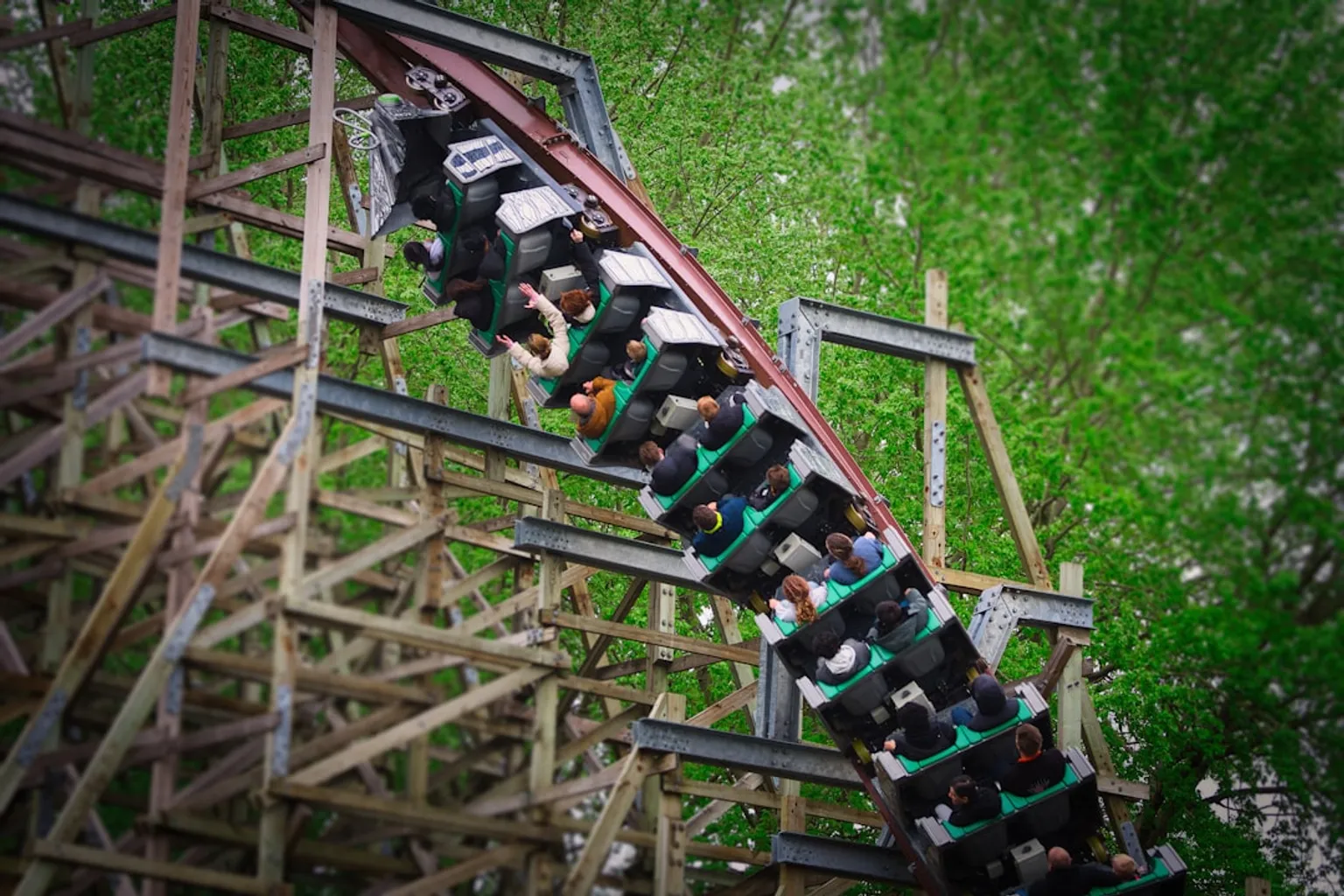
They determine how visitors move through one of Pigeon Forge’s most heavily developed tourism corridors—and how much value they extract from a facility built across more than 20 acres of Smoky Mountain terrain.
Tickets and prices
Rocky Top Mountain Coaster
I
Save
Box office and online booking
- Adult USD9.99
USD9.99
Official websiteII
Our pick · other
Coaster ride · 30 minutes
Take a 30-minute mountain coaster ride featuring four uplifts with carts traveling up to 30 mph.
USD17.33
Check availabilityThe attraction is designed to keep riders moving for more than nine minutes, climbing four lift hills before descending through four drops at speeds of up to 30 mph. That duration matters. Compared with a short amusement-park ride, Rocky Top offers a longer experience for each admission, but its setting raises a harder question: what does a mountain coaster add to a landscape already under pressure from roads, lodging, parking, stormwater runoff, and seasonal visitor surges?
The practical answer begins with the ticket structure. The ecological answer begins with the land beneath the track.
Rocky Top Mountain Coaster pricing options: what you are actually comparing
The attraction offers several ways to ride: a single admission, a discounted second ride on the same day, and combination packages. Tickets may be available online or at the venue, while third-party booking platforms can offer their own availability and package formats. The exact price shown to a visitor can change, so the most useful comparison is not a frozen dollar figure but the relationship between flexibility, repetition, and time.
A single ride is the cleanest option for visitors fitting the coaster into a wider Pigeon Forge itinerary. It limits commitment if the weather is unstable, if the queue is longer than expected, or if the rest of the day includes Dollywood, the Great Smoky Mountains National Park, dinner shows, or other attractions along Veterans Boulevard.
The same-day second-ride option changes the calculation. It makes more sense for visitors who have already built time around the coaster and want to experience the track at a different pace. Because riders control the cart with hand brakes, the second run is not necessarily a duplicate. A cautious first descent and a more confident second ride can feel materially different, even though the route is the same.
Combination passes are more difficult to judge in isolation. Their value depends on whether the other included attractions match your plans. A bundle can reduce the friction of buying several admissions, but it can also encourage an overpacked day in which visitors move between commercial sites without leaving much time for the mountain landscapes that give the region its identity.
| Ticket approach | Best suited to | Main advantage | Main limitation |
|---|---|---|---|
| Single ride | First-time visitors or tightly scheduled itineraries | Lowest commitment and easiest to fit around other plans | Less room to adapt to weather or riding preferences |
| Same-day second ride | Visitors staying in the area for several hours | Lets riders compare different braking styles and conditions | Requires enough time for a repeat visit |
| Combination package | Travelers planning multiple paid attractions | Can simplify booking and coordinate several activities | Value depends on using every included component |
| Online booking | Visitors planning around a fixed schedule | Helps secure a place before reaching the attraction | Less flexible if weather or traffic changes the day |
| On-site purchase | Visitors keeping plans open | Allows a decision after seeing local conditions | Availability and waiting time may be less predictable |
For anyone comparing Rocky Top Mountain Coaster tickets through different channels, the central issue is flexibility. Online purchase can be useful during busy travel periods, particularly when a family has a narrow window between check-in and dinner. On-site purchase can be preferable when the day’s weather is unsettled or when the group is unsure whether every rider meets the requirements.
A booking platform may show tickets available for the current or following day, but availability should not be treated as a guarantee that the attraction will be the best use of a particular hour. Pigeon Forge traffic can compress a schedule quickly, and a mountain coaster is more enjoyable when visitors are not arriving already late for the next reservation.
The cheapest ride is not always the best value; the useful ticket is the one that fits the actual shape of the day.
A Pigeon Forge mountain coaster built around control
Rocky Top is different from a conventional roller coaster in one important respect: the rider controls speed with a manual brake. The cart can reach approximately 30 mph, but maximum speed is not the point of every section. The experience depends on reading the slope, the curve, the spacing between carts, and the comfort level of the person riding with you.
That control makes the attraction accessible to a wider range of visitors than a fixed-speed thrill ride, but it also creates a responsibility. Braking too aggressively can reduce the rhythm of the descent; failing to control speed can create unsafe spacing. The operating instructions and staff guidance are part of the ride, not administrative noise before it.
The track’s four lift hills and four drops spread the experience across a large footprint. The ride lasts more than nine minutes, long enough for the landscape to register in fragments: cut slopes, tree lines, drainage channels, exposed rock, and the changing geometry of the track as it crosses the terrain. At this scale, the ride is not merely placed beside the forest. It is an engineered route through a managed patchwork of vegetation, soil, access surfaces, and infrastructure.
That distinction is important for eco-conscious travel. A commercial attraction does not become environmentally neutral because it retains trees between sections of track. Nor does development automatically erase every ecological function of the site. The real question is how much habitat remains connected, how runoff is managed, how vegetation is maintained, and whether construction and operations avoid pushing additional stress into neighboring streams and slopes.
Public information confirms the attraction’s size and ride characteristics, but it does not provide formal measurements of carbon emissions, energy consumption, habitat restoration, or stormwater performance. Those unknowns should remain unknown. They cannot be filled with green assumptions.
Height, weight, and riding arrangements
The height rules are straightforward but easy to overlook when a group is buying several admissions at once.
A rider must be at least 56 inches tall to operate a cart alone. A passenger can ride with someone at least 16 years old if the passenger is at least 38 inches tall and at least 3 years old. This creates two distinctly different experiences: the solo rider manages the brake independently, while the tandem arrangement requires adults and children to share the pace of the descent.
The weight limit also changes with conditions. Each sled supports up to 375 pounds in dry weather and up to 330 pounds in wet weather. That reduction is not a minor technical footnote. Rain affects braking, track conditions, clothing, and the handling of the cart, so visitors should expect operating decisions to become more conservative when the surface is wet.
A practical way to plan is to separate eligibility from comfort:
1. Measure children before booking. Height requirements are more decisive than age alone. A child who is old enough to travel independently may still need to ride as a passenger.
2. Decide who will ride together. Tandem riders need compatible expectations. One person may want a fast descent while the other prefers sustained braking.
3. Account for wet-weather limits. Groups near the dry-weather weight maximum should not assume the same arrangement will be permitted after rain.
4. Leave room for operational changes. Weather, maintenance, and crowd levels can alter the timing even when a ticket is valid.
5. Treat a second ride as a separate physical demand. More than nine minutes on the track is substantial, especially for younger passengers or anyone sensitive to repeated acceleration and braking.
The coaster’s manual speed control is also relevant to the landscape. A ride that allows riders to modulate speed does not eliminate mechanical energy use: the carts still need to be lifted four times, and the track, braking systems, lighting, buildings, and maintenance equipment all form part of the attraction’s operational footprint. But the longer ride duration means the visitor experience is not built around a few seconds of descent followed by immediate exit. The infrastructure is used over a more extended route.
That is an observation about design, not a sustainability certification. No formal environmental performance data is available in the supplied public information.
From Veterans Boulevard to the mountain edge
Rocky Top Mountain Coaster sits at 2940 Veterans Boulevard in Pigeon Forge, within a corridor shaped by intense visitor traffic and dense commercial development. The address places the attraction in a very different ecological context from a backcountry trail or a remote forest facility. Visitors arrive through an urbanized tourism landscape, where roads, parking areas, restaurants, hotels, signage, and entertainment venues already concentrate pressure on land and water.
This does not make the site ecologically irrelevant. It changes the appropriate standard of scrutiny.
A developed tourism corridor can sometimes absorb visitor demand more efficiently than dispersing new attractions into less disturbed areas. Existing roads and utilities may reduce the need for entirely new access infrastructure. Concentrating recreation in an already modified zone can be preferable to opening additional roads or facilities in more intact habitat.
But concentration also produces cumulative effects. Impervious surfaces accelerate runoff. Vehicle traffic increases noise and emissions. Artificial lighting can alter insect activity and nocturnal movement. Construction and repeated maintenance can fragment understory vegetation even when the dominant tree canopy remains. Small impacts become meaningful when repeated across a corridor serving millions of visitors over time.
The ecological vocabulary here is specific. A forest edge is not just a view. It is a zone where humidity, wind exposure, temperature, invasive-plant pressure, and predator-prey interactions can differ from the interior habitat. A drainage ditch is not automatically a stream, but poorly controlled runoff can carry sediment into downstream channels. A patch of vegetation may not qualify as high-quality habitat, yet its roots still stabilize soil and its mycelial networks still participate in decomposition and nutrient cycling.
For visitors, these processes are mostly invisible. That is one reason a ride through a wooded landscape can create a misleading impression of low impact. The track may appear to thread lightly through trees while the heavier ecological costs sit below eye level—in compacted soil, culverts, maintenance routes, and altered water flow.
The sustainability question is bigger than the ride
Mountain coasters occupy an awkward position in sustainable tourism. They rely on a landscape’s topography and vegetation to create their appeal, but they are also engineered attractions with a substantial physical presence. The business model depends on visitors wanting a controlled encounter with mountain terrain without committing to a long hike, technical trail, or unpredictable backcountry conditions.
That model can have a mixed relationship with conservation.
On one side, a compact attraction within an established tourist district may give families an outdoor experience without sending every visitor deeper into sensitive habitats. It can also create local employment and keep spending within the Pigeon Forge economy. Visitors who encounter the region through a commercial attraction may later choose to explore the national park, support local conservation groups, or develop a more concrete understanding of the area’s terrain.
On the other side, the attraction’s environmental benefit cannot be assumed from its outdoor setting. The coaster still requires construction materials, electricity, vehicle access, waste management, lighting, and ongoing vegetation control. The rides themselves are only one part of the footprint. Travel to Pigeon Forge—especially by private vehicle—may represent a larger share of an individual visitor’s emissions than the admission or the operation of the cart.
This is where sustainable tourism becomes a systems question rather than a label. A visitor can make a lower-impact trip decision without pretending the attraction is carbon neutral. The operator can manage land responsibly without claiming that the facility has no ecological cost. Both statements can be true at once.
The most useful questions for the attraction and the wider corridor would concern measurable performance:
- How is stormwater managed on slopes and beneath the track?
- Are native species used in revegetation, and how is invasive vegetation controlled?
- What proportion of electricity supports lift systems, lighting, buildings, and maintenance?
- How much land remains functionally connected for small mammals, reptiles, pollinators, and understory plants?
- What happens to soil and drainage during major rainfall events?
- Are environmental indicators monitored over time, rather than addressed only during construction?
The available facts do not answer these questions. A responsible visitor guide should say so plainly.
A wooded setting is not proof of a small footprint. The evidence is in drainage, habitat continuity, energy use, and maintenance—not in the number of trees visible from the track.
Choosing a lower-impact visit to Rocky Top
Visitors cannot redesign the coaster, but they can make choices that reduce pressure on the surrounding corridor and make the trip more coherent.
The first is timing. Rocky Top operates from 10:00 a.m. to 10:00 p.m. Sunday through Thursday and from 10:00 a.m. to 11:00 p.m. Friday and Saturday. Those extended hours spread demand beyond the middle of the day, although evening operation introduces its own considerations around lighting, traffic, and energy use. A visit outside the busiest period may reduce waiting and idling, but the exact crowd pattern varies by season, weather, holidays, and local events.
The second is transport. Pigeon Forge is a car-oriented destination, and many visitors will arrive by private vehicle. Combining the coaster with other stops in the same corridor can avoid unnecessary back-and-forth driving. Visitors staying nearby may be able to walk part of the route, use local transportation where available, or arrange their day around fewer vehicle movements. These are modest choices, but the cumulative effect of many small trips is not modest.
The third is ticket discipline. Buying a package only makes sense if the group intends to use it. An unused bundled admission represents wasted money and potentially a reason to rush between attractions. A single ride can be the more sustainable choice when it prevents an overextended itinerary built around collecting experiences rather than engaging with a place.
The fourth is behavior on site. Stay on designated paths, keep food and waste contained, and do not enter vegetated areas for photographs. This is not about preserving an imaginary untouched wilderness. The land around Pigeon Forge has a long history of human use and transformation. It is about preventing additional trampling, litter, and disturbance in a place already carrying heavy visitor pressure.
A practical visit might look like this:
1. Check the operating window and weather before leaving. Wet conditions can affect weight limits and ride operations.
2. Select the ticket type around the rest of the day, not in isolation. A repeat ride is useful only if the schedule can absorb it.
3. Group nearby activities geographically. Fewer vehicle movements mean less congestion and less idling along Veterans Boulevard.
4. Carry reusable water containers where permitted. High-volume tourism produces a steady stream of disposable packaging.
5. Keep the attraction separate from the national park in your expectations. A mountain coaster is an engineered commercial ride; the park is a protected landscape with different rules and ecological priorities.
6. Look for evidence rather than branding. If sustainability claims are made, ask whether they refer to actual monitoring, restoration, energy use, or only the presence of trees.
The comparison between online and on-site purchase also belongs here. Online booking is efficient when it prevents a wasted drive or secures a planned window. On-site purchase is efficient when it keeps the itinerary flexible and avoids committing to a ride that weather may compromise. Neither channel is inherently greener. The lower-impact option is the one that reduces unnecessary travel, duplicate bookings, and abandoned plans.
Rocky Top versus the wider Smoky Mountain experience
Rocky Top Mountain Coaster is not a substitute for hiking, wildlife observation, or quiet time in the Great Smoky Mountains. It is a constructed attraction that uses elevation, speed, and forest context to create a controlled experience. Its appeal is precisely that it compresses a mountain descent into a managed ride lasting more than nine minutes.
That distinction should not be treated as a moral judgment. Commercial recreation has a place in a regional economy, and not every visitor has the time, mobility, or interest required for a long trail. A well-run attraction can provide access to mountain scenery for families and travelers who would not otherwise seek it out.
The problem begins when commercial access is confused with ecological immersion. The coaster delivers contact with terrain, but not necessarily understanding of habitat. It passes through a living system while controlling what visitors can see, where they can stop, and how they move. That is part of the design.
For an eco-conscious traveler, the better approach is to combine rather than substitute. A ticketed ride can sit alongside a visit to a public trail, a local watershed, a conservation center, or a quieter community business. The value of the coaster then comes from its specific experience—not from claiming that speed through trees is equivalent to time spent observing the forest’s slower processes.
The broader climate implication
Climate change is already altering the conditions under which mountain tourism operates. Heavier rainfall can intensify erosion and drainage failures. Hotter, drier periods can increase vegetation stress and wildfire risk. Warmer winters can change seasonal visitation and maintenance schedules. Extreme weather can disrupt roads, utilities, and outdoor attractions across the region.
For a mountain coaster, climate resilience is therefore practical infrastructure, not abstract policy. Slope stability, culvert capacity, surface drainage, vegetation health, and power reliability determine whether the attraction can continue operating safely. The same systems also determine whether the facility passes avoidable damage downstream.
Rocky Top Mountain Coaster’s public information establishes its scale, operating hours, ride mechanics, location, and rider requirements. It does not establish a complete sustainability profile. That gap is not a reason to dismiss the attraction, but it is a reason to keep the language precise.
Buy the ticket because you want the ride: four lift hills, four drops, manual speed control, and a long descent through a managed mountain setting. Choose the ticket format that matches your actual schedule. Reduce unnecessary driving and avoid treating the surrounding forest as a backdrop made for unrestricted access.
The larger lesson extends beyond Pigeon Forge. As warming conditions reshape mountain destinations, the future of tourism will depend less on whether an attraction looks green from the track and more on whether its operators can demonstrate careful water management, habitat continuity, durable infrastructure, and transparent resource use. The landscape will carry the evidence—in roots, runoff, desiccation, and regrowth—long after the ride cycle ends.