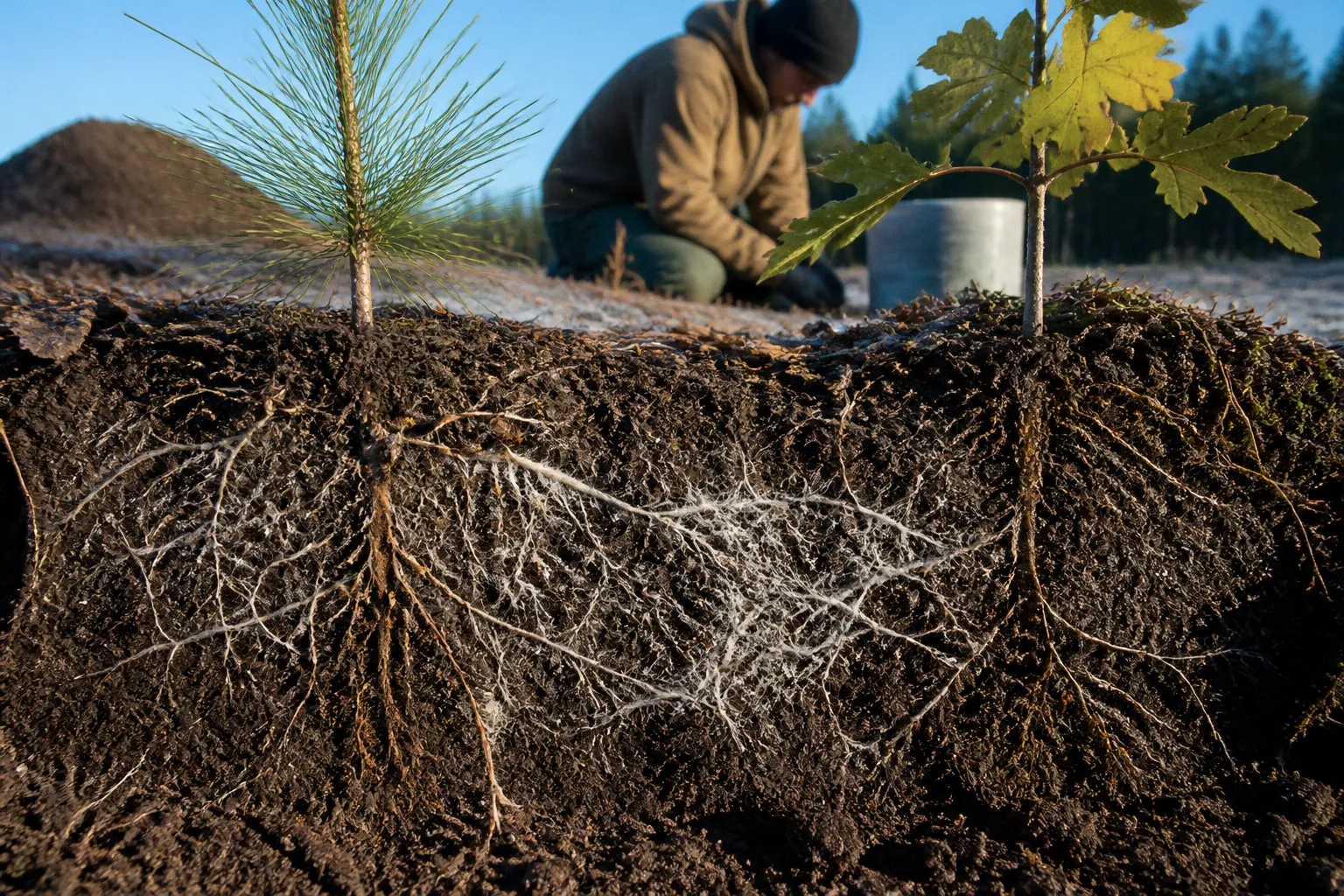
On a degraded site, roots may sit in compacted, nutrient-poor soil with little of the living fungal network that once helped woodland plants find water, unlock minerals, and hold the ground together. The seedling is not simply waiting to grow; it is trying to rebuild an entire support system while exposed to drought, erosion and competition.
This is where mycorrhizal fungi in forest restoration become more than a specialist term. They are living partners attached to, and extending from, tree roots, turning the soil around a young plant into a wider and more responsive supply network. In the right conditions, that partnership can make the difference between a plantation that merely survives its first season and a recovering forest with a realistic chance of taking hold.
The idea is ancient. Plants and mycorrhizal fungi have been exchanging resources for roughly 460 million years, since the early evolution of land plants. The arrangement is straightforward, though its consequences reach deep into the ecosystem: fungi help plants access water and nutrients, while plants provide the fungi with carbon and carbohydrates made through photosynthesis.
The 460-million-year partnership beneath the trees
When we picture a tree, we tend to picture the trunk, crown and leaves. The root system is harder to see, and the fungal partners attached to it are invisible altogether. Yet the visible tree is only one part of the working organism.
Mycorrhizal fungi grow as fine threads through the soil. These threads, known as hyphae, can reach into spaces that thicker roots cannot easily explore. They may connect with a root surface or enter root tissues, depending on the type of mycorrhizal relationship involved. In practical terms, the fungus helps the tree search a larger volume of soil without requiring the tree to build every centimetre of that search system itself.
The exchange is not charity. The fungus receives carbon compounds from the tree, and the tree gains access to resources that may otherwise be difficult to obtain. These can include water and mineral nutrients, particularly in soils where nutrients are present but locked into forms that roots cannot readily use.
That exchange matters most when the soil has lost its natural structure. Forest restoration sites are often former mines, heavily farmed land, cleared woodland or ground disturbed by construction and extraction. The soil may have been compacted by machinery, stripped of organic matter, contaminated, eroded or repeatedly turned over. A native fungal network that developed over many years can be damaged in a single season of intensive disturbance.
A tree planted into damaged ground is not starting with an empty landscape; it is starting with a missing support network.
The phrase underground fungal networks in reforestation can sound grander than the process itself, but the physical work is humble. Fine fungal threads occupy pores in the soil, meet root surfaces and move through small gaps between particles. They help transform a loose collection of mineral grains into a living environment where water can infiltrate, nutrients can circulate and roots can keep extending.
There is more than one kind of mycorrhizal association. Arbuscular mycorrhizal fungi form partnerships with many plants, while ectomycorrhizal fungi associate with a smaller group of tree and plant species. Ectomycorrhizal relationships are linked to approximately 10% of plant and tree species, but that group includes many important climax trees used in forestry and natural woodland restoration.
That distinction is not a footnote. A fungal product suited to one tree community cannot automatically be treated as a universal forest-restoration solution. The tree species, soil conditions and local ecology all shape which fungal partnership can function.
What the survival figures tell us — and what they do not
The clearest evidence for mycorrhizal inoculation comes from restoration work where the ground is already struggling to support vegetation. One large USDA Forest Service trial covered 3,000 acres of reclaimed mine land and involved five million seedlings inoculated with ectomycorrhizal fungi. The inoculated trees recorded an average survival rate of 85%, compared with 50% for uninoculated control trees.
That is a substantial difference, especially on land where every surviving seedling represents another root system stabilising the ground and another future source of shade, leaf litter and habitat. It also gives restoration teams a useful sense of scale: fungal inoculation is not only a greenhouse experiment or a garden curiosity. It has been applied across a landscape-sized project.
Research in managed forest plots has likewise found that tree species associated with mycorrhizal fungi can show survival rates up to 35% higher than trees lacking those associations. The figures do not mean that fungi remove every threat from a restoration site. They show that the relationship can strengthen the plant’s starting position, particularly where the soil has been damaged.
Several pressures still remain:
- Severe drought can overwhelm a young tree even when its roots have fungal partners.
- Chemical contamination may limit both root growth and fungal activity.
- Compacted ground can restrict the movement of air and water through the soil.
- Poorly matched tree and fungal species may produce a weak or ineffective association.
- Browsing, fire, invasive plants and extreme weather can continue to damage seedlings above ground.
This is why the best way to understand the 85% versus 50% result is not as a guarantee, but as evidence that the biological condition of soil can alter the trajectory of a restoration project. A fungal partner may improve access to resources, yet it cannot compensate for every failed part of site preparation.
The numbers also raise a practical question: where did the fungi come from, and how were they introduced? Inoculation can mean coating seeds or roots, adding fungal material to planting holes, or incorporating an inoculant into the growing medium before seedlings reach the field. The method varies with the species, nursery system and restoration design. There is no single universal application rate for every soil type and microclimate, and the available evidence does not support pretending otherwise.
Rebuilding soil health one pore at a time
The phrase soil health can become vague when it is used as a general promise. In restoration work, it becomes more tangible when we look at the physical architecture of soil.
Healthy soil contains a mixture of mineral particles, organic matter, water-filled spaces and air-filled pores. Roots need enough resistance to remain anchored, but not so much compaction that they cannot extend. Rain needs to enter the ground instead of running across the surface. Moisture needs to remain available between storms. Fungal threads contribute to this structure by binding soil particles into stable aggregates.
Mycorrhizal fungi produce organic compounds such as glomalin, which help bind particles together. The resulting aggregates create pore spaces that support water infiltration and moisture retention. The effect is not dramatic in the way a new drainage channel is dramatic; it is a gradual improvement in the way the ground holds together and handles rainfall.
This is one reason mycorrhizal fungi and soil restoration should be considered together. If we focus only on the seedling, we miss the larger work. A tree needs access to water, but the site also needs soil that can receive and retain that water. A tree needs nutrients, but those nutrients need to move through a functioning soil system. A forest needs roots, but roots need a ground layer that does not collapse into compaction or wash away after heavy rain.
The relationship can be pictured as a series of connected exchanges:
| Part of the system | What it contributes | What restoration gains |
|---|---|---|
| Tree roots | Carbon compounds produced by photosynthesis | A living partner that can support root development |
| Mycorrhizal fungi | Fine threads that explore soil beyond the immediate root surface | Wider access to water and mineral nutrients |
| Soil aggregates | Bound particles and connected pore spaces | Better infiltration, structure and moisture retention |
| Leaf litter and organic matter | Carbon and nutrients returned to the ground | Food and habitat for a broader soil community |
| Established vegetation | Shade, roots and protection from erosion | More stable conditions for future regeneration |
This is also where forest soil microbiome recovery becomes a useful way of thinking. The goal is not to add one product and declare the underground community repaired. It is to create conditions in which fungi, roots, bacteria, decomposing organisms and organic matter can gradually support one another.
In a healthy woodland, this process is continuous. Leaves fall, roots die back, fungi redistribute nutrients, and new plants enter the space left by older ones. On a reclaimed mine or intensively managed field, that loop may have been interrupted. Reintroducing mycorrhizal fungi can help restart one part of it, but the wider cycle still depends on vegetation cover, reduced disturbance and time.
Why inoculation is a tool, not a shortcut
Artificial inoculation is attractive because it offers something restoration projects often lack: a deliberate way to replace a biological function that has been lost. But the underground world is not a blank canvas waiting for the correct ingredient.
Soil already contains microorganisms, including native fungal strains. Their abundance and condition vary from one site to another. Disturbance, contamination, compaction and intensive agricultural management can reduce or fragment naturally occurring mycorrhizal networks. At the same time, introducing fungi into a site does not guarantee that they will persist, spread or form a useful association with every planted tree.
The practical sequence therefore begins before the inoculant reaches the root.
1. Match the tree to the restoration setting.
The species selected for a wetland edge, a dry upland slope and a reclaimed mine will face different pressures. Their fungal associations will differ as well.
2. Understand the soil disturbance.
A site with compacted ground requires a different response from one with contamination, severe erosion or a depleted organic layer. Fungi cannot work effectively if the physical conditions prevent roots from entering the soil.
3. Use a compatible fungal association.
Ectomycorrhizal fungi are valuable for the tree species that form ectomycorrhizal relationships, but they are not a universal partner for all plants. Other trees and plants depend on different mycorrhizal types.
4. Protect the root-fungus relationship during planting.
Rough handling, drying or poor storage can undermine a nursery-grown association before the seedling reaches the field. The biology is delicate even when the restoration objective is ambitious.
5. Follow the partnership beyond the first planting season.
Survival is an early measure, not the final definition of success. A recovering forest also needs growth, reproduction, natural regeneration, soil development and a mix of habitats.
This approach keeps mycorrhizal inoculation for soil health in its proper place. It is a means of rebuilding capacity, not a substitute for sound restoration design.
The most useful fungal inoculant is not the one with the boldest promise; it is the one that fits the tree, the soil and the recovery plan.
There is still uncertainty around how introduced fungal strains persist over multiple decades across different restoration biomes. A strain that establishes well in one soil and climate may behave differently elsewhere. That does not cancel the value of inoculation. It simply means restoration teams need to measure more than planting numbers and first-year survival.
The 10% that can shape an entire woodland
Ectomycorrhizal fungi associate with roughly 10% of plant and tree species, a relatively small share when counted across all plants. Yet many key climax tree species used in forestry and natural woodland restoration belong to this group. Their importance is therefore larger than the percentage first suggests.
A mature woodland is not just a collection of individual trees. It is a layered habitat: trunks and branches above, leaf litter at the surface, roots below, and a network of organisms moving nutrients and carbon through the ground. When ectomycorrhizal trees establish, their fungal partners can help create the soil conditions that later support a wider community.
This is especially relevant in reforestation projects designed to move beyond rows of fast-growing trees. A plantation can provide cover quickly, but a resilient woodland depends on structure and succession: different heights, ages, root patterns and relationships with soil organisms. Fungal partnerships are part of that longer transition.
The same principle applies to conservation planting around fragmented habitats. A strip of restored woodland may provide shade, nesting sites and movement corridors for wildlife, but its future depends on whether the vegetation can remain rooted through dry periods and heavy rain. Mycorrhizal fungi may support that stability by improving resource access and soil aggregation, while the growing vegetation returns organic material to the ground.
We should also be careful with the word network. A fungal network is not automatically a benevolent communications system connecting every tree in a forest. It is a biological relationship shaped by species, soil, climate and competition. Its value is clearest when described in practical terms: fungal threads extend the reach of roots, assist with nutrient and water acquisition, and help bind soil particles into a more stable structure.
That grounded view is useful because it keeps attention on what restoration workers can actually change. They can reduce soil disturbance, protect existing vegetation, choose compatible tree species, restore organic matter and, where the site calls for it, introduce suitable mycorrhizal fungi. They can also monitor whether the intervention is improving survival and soil condition rather than assuming that an application alone has completed the work.
From nursery roots to a living forest loop
The journey of a restored tree begins in a nursery or planting bed, but it does not end when the seedling is placed in the ground. If the fungal relationship is working, the young tree gains a larger below-ground reach. As it grows, it contributes carbon to its fungal partners. Its roots help hold soil, and its leaves eventually return organic matter. Other plants and organisms then enter the developing system.
This is the loop that matters: carbon moves from tree to fungus, water and nutrients move back toward the root, soil particles become more stable, and the expanding vegetation feeds the next stage of recovery. The loop is slow, uneven and vulnerable to disturbance, but it is more durable than a one-time intervention.
For us, that changes the way a restoration project should be judged. Counting seedlings is useful, but it tells only the first part of the story. We also need to ask whether the soil is becoming less compacted, whether moisture remains available, whether native vegetation is returning and whether the planted trees are growing into a functioning habitat rather than surviving as isolated stems.
Mycorrhizal fungi in forest restoration are therefore best understood as infrastructure made of living threads. They do not make damaged land instantly healthy, and they cannot protect every tree from drought, contamination or poor planning. What they can do is reconnect a biological process that forests have used for hundreds of millions of years.
That is a modest-sounding intervention with far-reaching consequences. When we reclaim disturbed ground, we are not simply putting trees back where trees used to stand. We are rebuilding the relationships that allow a forest to hold water, protect soil, store carbon and make room for other life. The work begins underground, where the smallest threads often carry the largest share of the future.