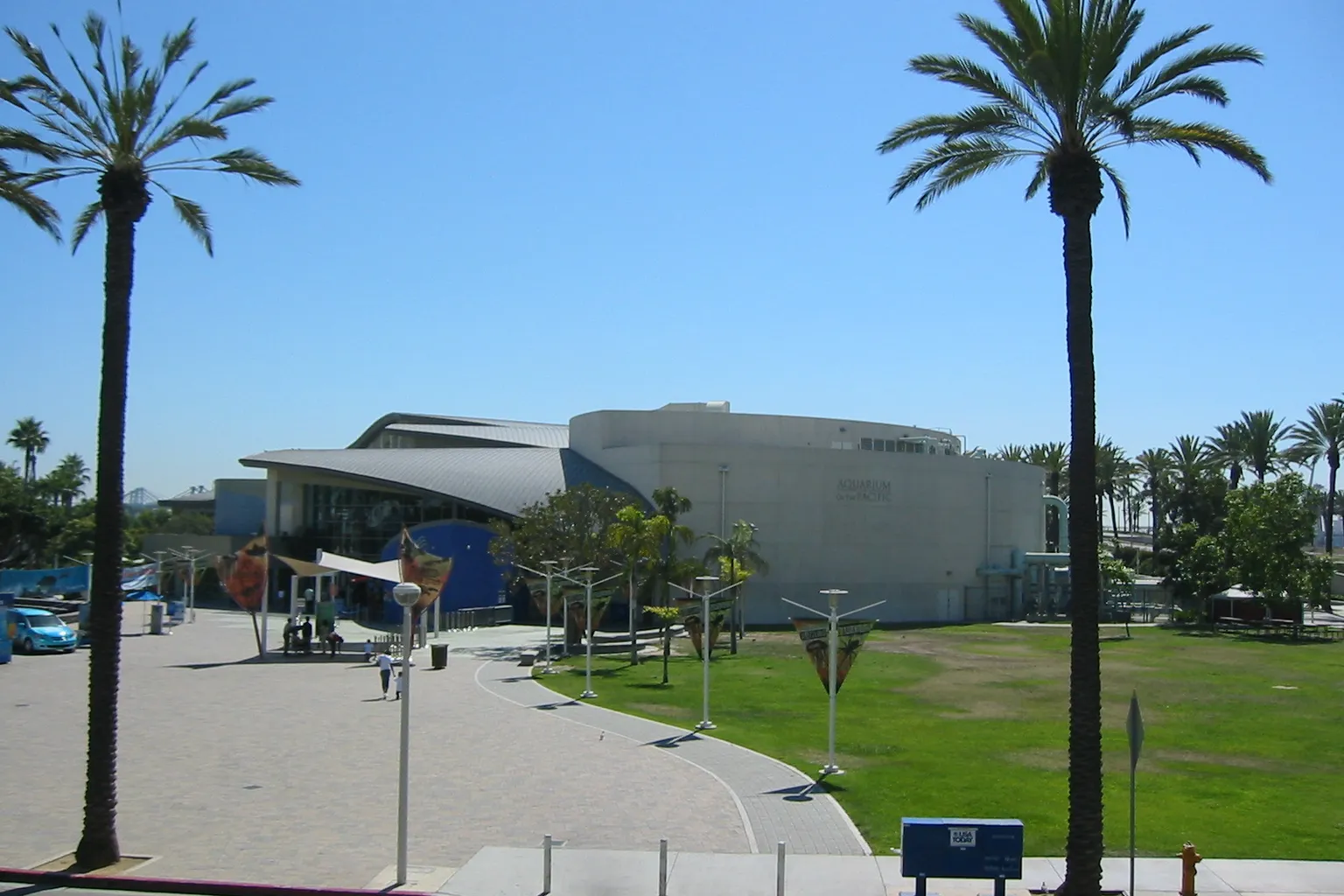
The Pacific, Bottled: What a Visitor Is Actually Paying to See
That meeting of currents helps create one of the most productive marine environments on the continent: a coast shaped by upwelling, kelp forests, migratory whales, seabird colonies, and nursery habitat for young fish and sharks.
Tickets and prices
Aquarium of the Pacific
I
Save
Box office and online booking
- Adult USD15
- Child USD6
- Reduced USD10
USD15
Official websiteII
Our pick · skip-the-line
Skip-the-line ticket — Priority access
Skip the line to explore over 100 exhibits, see more than 12,000 animals, and access the Jelly Dreamscapes gallery.
USD49.98
Check availabilityThe Aquarium of the Pacific, at 100 Aquarium Way on the downtown waterfront, is a public interpretation of that offshore world. It is not a theme park with marine imagery attached to it. The better comparison is a working educational institution that has built a visitor experience around living habitats, field research, conservation projects, and the changing conditions of the Pacific Ocean.
The galleries move from the cold-temperate Pacific to tropical environments, and the shift is perceptible before a visitor reads the interpretive panels. Lighting, sound, water temperature, and the species on display change from one zone to the next. The June Keyes Penguin Habitat houses Magellanic penguins, small, vocal birds that nest along the Patagonian coast. The sea otter exhibit has a different rhythm: southern sea otters raft, groom themselves, and use stones to open shellfish. Their recovery along the California coast has been uneven, which makes the animals more than a crowd-pleasing exhibit. They are also part of a longer conservation story.
Shark Lagoon adds touch pools and close views of species that are easy to misunderstand when seen only in photographs. Visitors may encounter bamboo sharks, rays, and young sevengill sharks, depending on the current exhibit setup and animal-care schedule. Lorikeet Forest is an open-air aviary where visitors enter a mixed flock of rainbow lorikeets. The birds are Australian rather than native to the North Pacific, but the exhibit still demonstrates how a small tropical environment has to be managed inside a very different climate.
That context matters when deciding whether to buy tickets Aquarium of the Pacific. The admission price is not simply payment for a set of tanks. It provides access to carefully managed habitats, public programming, animal presentations, and explanations of ecological processes that are difficult to observe from shore. The value is strongest for visitors who want more than a quick walk through an attraction and are willing to spend time with the interpretive material.
How the Timed Reservation System Works
The reservation system is the first practical issue to settle. For standard general admission, a visitor selects a date and, where required, an entry window during the booking process. The timed-entry reservation and the admission ticket are connected: the slot determines when the visitor can enter, while the ticket determines access to the aquarium experience itself.
When buying directly through the aquarium’s official website, the date and entry window are normally selected during checkout. The confirmation should be checked before leaving for Long Beach, particularly if the booking includes more than general admission. A receipt, a confirmation email, or a mobile ticket is not a substitute for reading the actual entry details. Package products can have separate schedules, and boat departures cannot be treated as flexible extensions of the aquarium’s opening hours.
Timed entry matters most during weekends, federal holidays, school breaks, and other high-demand periods. A weekday visit may offer more flexibility, including the possibility of buying at the on-site box office, but walk-up availability should not be assumed when the aquarium is busy. Visitors who already know their date are usually better off arranging admission in advance rather than relying on a spare slot at the gate.
The distinction is simple but useful:
- The admission ticket gives access to the aquarium’s galleries and included presentations.
- The timed-entry reservation determines when standard visitors may enter.
- A package ticket may combine admission with a harbor tour, whale-watching trip, or another scheduled experience.
- A confirmation should be checked for the correct date, entry time, product type, and any separate meeting instructions.
The aquarium’s timed-entry model is primarily a crowd-management tool. It helps distribute arrivals instead of allowing everyone to enter at once, which is particularly relevant in galleries with narrow viewing areas, touch pools, and popular animal habitats. It also gives visitors a more realistic sense of how much of the day is available for the aquarium rather than leaving the schedule entirely open.
For standard admission, think of the time slot as part of the ticket rather than as a separate afterthought. The booking is not complete until the date and entry window match the day you actually intend to visit.
Third-party booking platforms also sell aquarium admission and related packages. They can be convenient, especially for travelers comparing several attractions in the Los Angeles area, but the listing needs to be read as a separate product. A third-party voucher may include general admission, a timed entry, a package upgrade, or a different set of conditions. The title alone does not establish what is included.
Cancellation and rescheduling terms vary by seller. If the ticket was purchased through a third-party platform, that platform’s policy governs the booking. Standard official tickets are non-refundable and non-transferable, so a visitor should not assume that a change of plans will automatically lead to a refund, a name change, or a new date. Before paying, check the seller’s rules for cancellations, rescheduling, missed entry windows, and changes to bundled activities.
Ticket Packages at a Glance
General admission is the baseline option. It covers the indoor and outdoor aquarium areas included in the standard visit, along with the presentations and programming listed for that day. Pacific Visions is part of the broader aquarium experience and focuses on the future of the Pacific, including climate change, ocean acidification, and the pressures affecting marine ecosystems.
Some products add an experience outside the galleries. These packages can be attractive, but they also make the schedule less forgiving. A harbor cruise or whale-watching trip operates on its own departure time. Arriving late may affect not only the boat excursion but also the amount of time available inside the aquarium.
| Ticket type | What it generally includes | Reservation approach | Best suited for |
|---|---|---|---|
| General admission | Aquarium galleries, outdoor habitats, Pacific Visions, and scheduled presentations | Select a date and timed entry when required | First-time visitors, families, and local repeat visitors |
| VIP package | General admission with additional benefits and greater entry flexibility | Check the product’s specific entry conditions | Visitors who value flexibility or want a bundled upgrade |
| Harbor Tour package | Aquarium admission combined with a narrated cruise through the Port of Long Beach | Aquarium entry and boat departure must be coordinated | Visitors who want both the galleries and a harbor view |
| Whale Watch package | Aquarium admission combined with a seasonal whale-watching cruise | Availability and departure times depend on the cruise schedule | Visitors planning a longer marine-focused outing |
The Harbor Tour and Whale Watch products are not interchangeable with ordinary general admission. They may require the visitor to arrive earlier, allow time to find the boat departure point, and follow instructions that do not appear on a basic aquarium ticket. Read the full itinerary before booking rather than treating the package as a simple add-on at the entrance.
Age categories also affect the final price. Children under three generally enter free, while child, adult, and senior rates apply to different age groups. Because prices and eligibility can change, use the age categories displayed for the selected date and product rather than relying on an old screenshot or a price quoted by another traveler.
For anyone comparing aquarium of the pacific admission prices, the headline amount is only one part of the calculation. A lower base price may not include a boat trip, a premium presentation, or the flexibility that matters to a family traveling on a fixed schedule. Conversely, a more expensive package may be unnecessary for a visitor who wants to spend the entire day moving slowly through the galleries.
Discounts, Combos, and Who Actually Qualifies
Discounts are available through several channels, but they should be treated as separate offers rather than combined automatically. Eligibility, booking method, valid dates, and proof requirements can differ.
- AAA members may receive a discount on eligible general admission when using the designated booking path. The membership benefit applies to the qualifying ticket and is not necessarily available for every package.
- Active military personnel and veterans may have access to reduced admission through military ticket offices or an online verification process. Bring the documentation requested by the seller; having a military ID does not automatically mean that every online or gate transaction will be processed in the same way.
- Aquarium and Los Angeles Zoo combinations can work well for visitors who plan to see both institutions. The value depends on whether both visits fit comfortably into the pass’s validity period. A combination ticket is less useful if the second attraction is only a theoretical possibility.
- Grocery-store and promotional coupons may appear for limited periods. These offers typically have their own expiration dates and restrictions, and they may not be combined with other discounts.
The important distinction is between a discount and a more flexible booking. A reduced price does not usually change the admission rules, the entry window, or the cancellation conditions attached to the underlying product. A coupon can lower the cost without making the ticket refundable or transferable.
A discount changes the price; it does not automatically change the terms. Check the validity window, eligibility requirements, and cancellation rules before treating a promotional ticket as a flexible reservation.
Visitors searching for aquarium of the pacific discount tickets should start with the official site and the membership or eligibility program they actually qualify for. Search results often mix current offers with expired promotions, reseller listings, and package prices that are not directly comparable. A ticket that appears cheaper may exclude a timed entry, a presentation, or the date the visitor needs.
The same caution applies to combination products. The Aquarium and L.A. Zoo option can make sense for a traveler who wants two separate outings, while it adds little value to someone with only a few hours in Long Beach. The right comparison is not the discount percentage but the total cost of the visits the traveler genuinely plans to make.
Practical Logistics: Parking, Strollers, and Peak Times
Parking is available in the aquarium’s on-site structure on Shoreline Drive. Visitors should pay attention to the validation procedure used on the day of their visit. A validated ticket and an unvalidated ticket may be charged differently, and it is easy to overlook the process when leaving through a busy lobby. Keep the parking ticket with you and confirm where validation is handled before heading back to the car.
The structure can fill during weekend afternoons and major events in the Long Beach area. When that happens, nearby commercial lots may be available, but they may not offer the same validation arrangement. Arriving earlier is more than a way to secure a convenient parking space: it also leaves time to find the entrance, handle tickets, and reach the first presentation without rushing.
The aquarium does not function like a short stop that can always be completed in an hour. Visitors who want to see the galleries, attend a feeding or diver presentation, spend time at the touch pools, and watch Pacific Visions should plan for a substantial visit. Families may need additional time for breaks, while photographers and repeat visitors often move more slowly than first-time guests.
Strollers are not normally rented on site. The aquarium may provide a limited number of baby backpacks on a first-come basis, but visitors who need a conventional stroller should bring their own. The indoor areas are wheelchair-accessible, and elevators connect the relevant gallery levels. The outdoor route through areas such as Shark Lagoon and Lorikeet Forest is designed for visitor circulation, although crowds can make any route feel narrower during peak periods.
The busiest periods are predictable:
- weekends and federal holiday periods;
- school spring break;
- the summer travel season;
- event days in downtown Long Beach;
- popular seasonal programming and school-group visits.
Inside the galleries, crowd density is not always highest immediately after opening. Midday can be particularly busy as several arrival groups overlap and families reach the most popular habitats at roughly the same time. The first available entry window is usually the calmest choice for visitors who want more space, while the final part of the day can work for those who have already spent the morning elsewhere.
The daily program should be checked before arrival. Penguin and sea otter presentations can follow posted schedules that change with the season, animal-care needs, and special programming. The practical approach is to build the visit around one or two presentations and then explore the galleries between them. Trying to cross the entire aquarium repeatedly for every scheduled event can turn a relaxed outing into a series of unnecessary detours.
Pacific Visions also works best when treated as part of the route rather than as something to squeeze in at the end. Its immersive presentation follows a cycle, and entering near the beginning is generally more satisfying than arriving halfway through and trying to reconstruct the narrative from the middle.
Reading the Aquarium Through a Climate Lens
A visit to the Aquarium of the Pacific has an obvious entertainment component, but the institution’s environmental role is what gives the experience its longer relevance. The aquarium supports conservation and education projects connected to Southern California species and habitats, including work related to endangered steelhead, sea otter recovery, and the future of coastal ecosystems.
Southern California steelhead face a combination of pressures that are familiar across the Pacific coast: altered rivers, loss of estuary habitat, barriers to migration, water diversion, and competition within managed systems. A gallery display cannot solve those problems, but it can make them legible to visitors who may otherwise experience the ocean only as scenery.
The same is true of the kelp forests along the Southern California coast. Kelp habitat is influenced by water temperature, storms, grazing pressure from sea urchins, and the condition of the broader food web. When canopy declines, the effect is not limited to one species. Kelp provides structure for fish and invertebrates, changes the flow of energy through the ecosystem, and affects what coastal communities see from the surface.
Pacific Visions places these issues in a form that is easier to absorb than a technical report. The climate conversation is not separated from the animals in the rest of the building; it explains why the condition of ocean habitats matters to the species visitors have just seen. Ocean warming, acidification, shifting currents, and habitat loss are presented as connected pressures rather than isolated vocabulary.
That is also why the aquarium’s conservation material should not be treated as decorative text between exhibits. It changes how the visitor reads the animals. A penguin habitat becomes a discussion of range, breeding, and changing conditions. A sea otter exhibit becomes a reminder that population recovery is not the same as complete security. A touch pool becomes an opportunity to consider how coastal ecosystems are observed, managed, and protected.
What to Check Before You Buy
The most common ticket mistakes are practical rather than complicated. Before completing the purchase, confirm:
- the exact visit date and entry window;
- whether the ticket is general admission or a package;
- whether a boat departure is included and when it leaves;
- the age category used for each traveler;
- whether a discount requires membership or verification;
- the seller’s cancellation and rescheduling rules;
- whether the ticket is refundable or transferable;
- parking and arrival arrangements for the selected time.
These checks are especially important when using a reseller. The phrase aquarium of the pacific timed entry tickets may lead to several different products, including official admission, third-party vouchers, and packages with additional activities. The reservation system may look similar at checkout, but the conditions can be different once the booking is issued.
For a direct official purchase, standard tickets should be treated as fixed plans: non-refundable and non-transferable. If the date is uncertain, the safest response is not to assume that a later change will be accepted. Instead, compare the available products and their terms before payment. Some flexibility may be built into a premium package, but that flexibility must be stated in the product conditions rather than inferred from the price.
The same principle applies to rescheduling. A third-party seller may permit a date change, prohibit it, or process it only within a defined period. The aquarium may not be able to alter a booking made through another platform. The seller named on the confirmation is the first place to check.
The Practical Bottom Line
To buy tickets Aquarium of the Pacific without unnecessary friction, start with the official booking page, choose the date carefully, and treat the timed-entry window as part of the admission rather than as an optional extra. If the visit includes a harbor cruise or whale-watching trip, coordinate the aquarium entry with the fixed departure time. If the ticket comes from a reseller, read the seller’s conditions instead of assuming that the aquarium’s standard rules apply in exactly the same way.
General admission is the sensible choice for visitors who want to concentrate on the galleries, animal habitats, presentations, and Pacific Visions. A combination ticket is worthwhile only when the additional attraction fits the actual itinerary. A discount is useful when the visitor qualifies and can meet its conditions; it is not a substitute for flexibility.
The best visit is usually the one planned around the aquarium’s rhythm: arrive with enough time for parking and entry, attend a presentation, move through the habitats without trying to rush every gallery, and leave room for the climate and conservation material. The penguins, otters, kelp systems, touch pools, and Pacific Visions theater are not separate attractions competing for attention. Together, they explain how a changing ocean is experienced by animals, researchers, and coastal communities.
The reservation system, package structure, discount channels, and entry rules are simply the mechanics of getting inside. The more durable value of the visit is the chance to see the Pacific not as a distant blue background, but as a living system under pressure.
FAQ
How does timed entry work at the Aquarium of the Pacific?
What does general admission to the Aquarium of the Pacific include?
Are Aquarium of the Pacific tickets refundable or transferable?
Do Aquarium of the Pacific packages include boat tours?
Are there discounts for Aquarium of the Pacific tickets?
Photo: Eric Kilby / CC BY-SA 2.0 — Wikimedia Commons