In other places, the same hands-off approach leaves a site trapped in decline, cut off from seed sources, vulnerable to wildfire, or too altered to recover without help.
Compare car rental deals in United Kingdom
See available offersPartner link — DiscoverCars comparisonThat is the practical question behind rewilding vs active conservation management. Passive rewilding can be cheaper, quieter and surprisingly effective, but it is not a universal recipe. Active habitat management can look more interventionist—planting, fencing, controlled grazing, removing invasive species or reintroducing lost animals—yet those actions may be the only way to reopen a natural pathway that has been blocked for decades.
The choice is less about whether we should interfere with nature and more about understanding what the landscape can still do for itself.
Passive rewilding works best when nature still has a route back
Passive rewilding, sometimes described as spontaneous ecological succession, begins with restraint. We reduce the pressure that keeps an ecosystem in its damaged state and allow natural processes to resume. That may mean ending intensive grazing, stopping cultivation, removing drainage, reducing disturbance or protecting a site from further clearing. It does not mean abandoning the land without thought or observation.
Once the pressure is lifted, recovery may begin through a familiar sequence. Pioneer plants colonise exposed ground. Insects arrive with flowering vegetation. Birds carry seeds between patches of habitat. Fallen leaves build soil, shade develops beneath young trees, and the site becomes more structurally varied. Each layer creates conditions for the next.
A large European analysis by WILDCARD researchers, covering 156 studies, found that spontaneous ecological succession successfully restored vegetation in 67% of cases. That result was higher than an earlier global benchmark of 60%, drawn from 530 studies. The finding matters because it pushes back against the assumption that restoration always starts with machinery, planting teams and long lists of target species.
In suitable landscapes, nature may already possess much of the fabric it needs to mend itself.
Passive recovery is particularly promising where several conditions overlap:
- Nearby natural habitat can supply seeds, insects, fungi and animals.
- The soil has not been stripped, compacted or contaminated beyond recovery.
- The main pressures—such as intensive farming, grazing or repeated clearance—can be removed.
- The site is large and connected enough for wildlife to move through it.
- Invasive species, fire or hydrological disruption are not overwhelming the returning community.
This is where the benefits of passive rewilding become tangible. It can avoid unnecessary ground disturbance, preserve the seed bank, allow species to assemble in their own combinations and reduce the cost of repeated planting or maintenance. It can also produce habitats that are less uniform than a restoration scheme designed around a fixed planting plan.
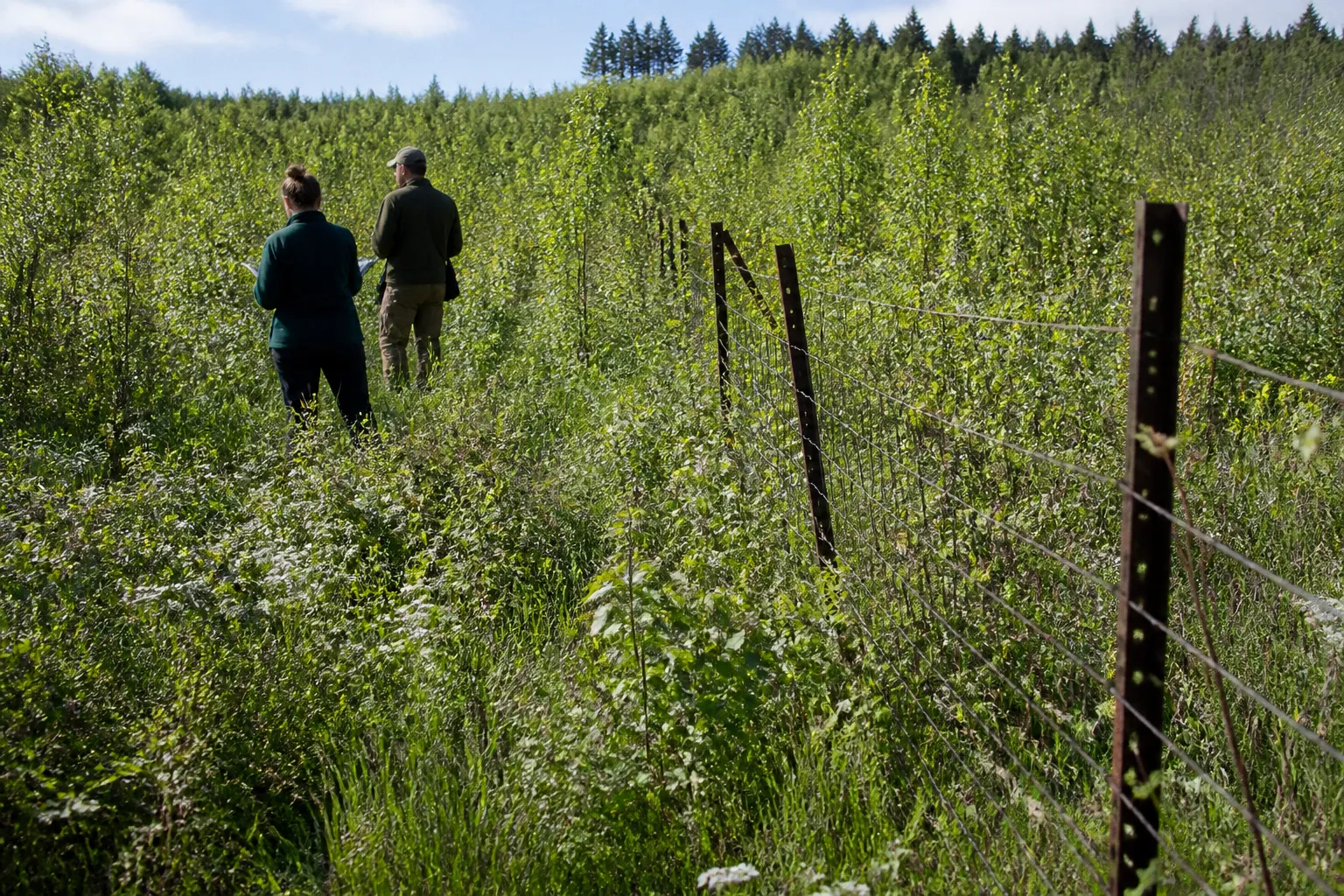
But “passive” is an easily misunderstood word. A recovering site still needs a baseline survey, protection from damaging land uses and enough monitoring to tell recovery from quiet decline. In some places, assisted natural regeneration—such as fencing livestock out or controlling an invasive plant at the outset—is what allows succession to begin. The intervention is light, but it is not necessarily absent.
Passive rewilding is not leaving land behind. It is removing the obstruction and watching closely enough to know whether nature can use the opening.
The first trade-off: speed, cost and ecological fit
Active habitat management conservation projects start from a different premise. Rather than waiting for succession to supply missing pieces, practitioners add or remove what the landscape needs. They may plant locally appropriate trees, restore a wetland’s water levels, clear invasive scrub, reintroduce a missing grazer, create nesting structures or manage vegetation through mowing and controlled burning.
This approach is often more expensive and labour-intensive, but the comparison is not simply between a cheap option and a costly one. The real question is whether the investment solves a bottleneck that passive recovery cannot overcome.
A degraded mine site with compacted soil and no nearby woodland may not receive the same biological arrivals as a lightly used field beside an ancient forest. A drained wetland may remain dry even after agricultural production stops. A grassland shaped for centuries by grazing may close over with scrub if all management ends. In each case, non-intervention can preserve the problem rather than remove it.
The two approaches are not opposites in every landscape. A project may fence a site for the first few years, remove an invasive shrub, rewet a peatland and then step back. Another may plant a narrow corridor to reconnect two woodland blocks, while allowing the wider area to regenerate without further planting. Restoration is often a sequence of decisions rather than a permanent identity.
| Restoration condition | Passive rewilding | Active habitat management |
|---|---|---|
| Nearby seed and wildlife sources | Often well suited, as natural arrivals can drive recovery | May still be used to speed up or steer colonisation |
| Severely degraded soil | Recovery may be slow or stall without preparation | Soil repair, planting or hydrological work can reopen the pathway |
| Invasive species pressure | Can allow invasive plants to dominate | Targeted removal may be essential at the beginning |
| Need for rapid habitat creation | Usually slower and less predictable | More capable of delivering a defined structure quickly |
| Long-established cultural landscape | May remove the management that supports its biodiversity | Grazing, mowing or controlled burning may maintain habitat |
| Large connected wilderness | Can support natural ecological processes at scale | Useful for targeted gaps, species recovery and conflict reduction |
| Cost and ongoing labour | Generally lower, though monitoring and protection remain necessary | Higher, with recurring work often built into the project |
A meta-analysis of terrestrial ecosystem restoration in China found that ecological restoration increased biodiversity by 43% compared with degraded conditions. Yet restored sites still remained, on average, 13% below pristine natural ecosystems. That gap is not a failure so much as a reminder that recovering a functioning ecosystem is not the same as recreating every feature of an undisturbed one.
Active management can narrow some gaps quickly, particularly where a missing species or physical condition is obvious. Passive recovery can sometimes produce richer, less predetermined outcomes. The decision depends on what has been lost, what remains nearby and how much time the landscape has.
The quiet problem of dispersal: forests cannot colonise what they cannot reach
Natural regeneration is often discussed as though seeds simply arrive when a field is no longer cultivated. In reality, dispersal is one of the most stubborn limits on passive rewilding.
Research in England found that natural woodland species colonised former agricultural sites from existing seed sources over distances of only 135 metres. That is not a universal boundary for every plant or landscape, but it shows how narrow the natural bridge can be. A field may sit within a region that looks broadly green on a satellite image while remaining biologically isolated from the woodland species it needs.
Trees may arrive before the plants associated with mature woodland soils. Wind-dispersed species can cross open ground, while heavier seeds depend on birds, mammals or gravity. Some woodland-floor plants spread slowly because their seeds are moved by ants or because they rely on fungi already present in the soil. A young stand can therefore look like a forest long before it functions as one.
Specialised woodland-floor plants may take more than a century to establish naturally in passively regenerated forests. That timescale changes the meaning of success. If the objective is simply to increase tree cover, passive succession may appear to work within a few decades. If the objective is to recover the full woodland community—understorey plants, fungi, deadwood organisms, breeding birds and soil relationships—the wait is considerably longer.
This is where active restoration can act as a bridge rather than a replacement for natural processes. Practitioners might plant a corridor between isolated woods, move locally sourced seed, protect naturally emerging seedlings or restore the soil conditions that allow woodland plants to establish. The goal is not to manufacture a finished forest, but to reconnect the loops that make forest recovery possible.
A useful assessment begins with the landscape around the site:
1. Map the nearest functioning habitat. A patch of mature woodland, wetland or species-rich grassland is not just scenery; it is a source of seeds, spores, insects and animals.
2. Identify the missing dispersers. If a plant depends on a bird, mammal or insect that no longer visits, natural recovery may stop at the boundary of possibility.
3. Look beneath the surface. Soil compaction, drainage and the loss of fungi can matter as much as what grows above ground.
4. Separate visible cover from ecological maturity. A stand of young trees is valuable, but it does not yet provide every function of an old forest.
5. Set a timescale that matches the outcome. A five-year planting target and a century-long woodland recovery are different projects, even when they occupy the same field.
The danger is not that passive rewilding is too slow in every case. It is that we mistake a first green flush for the completion of restoration and stop asking which species and processes are still missing.
When non-intervention increases fire risk
The case for active management becomes especially strong in landscapes shaped by long human use. Mediterranean cultural landscapes are a clear example. Their biodiversity is not always held in a pristine wilderness state; it can depend on traditional grazing, rotational cutting, small fields, open woodland and other forms of careful disturbance.
If those practices disappear and all management stops, dense vegetation may accumulate. Open habitats can close over, species adapted to grazing can decline, and wildfire risk can rise. In such places, strict non-intervention may reduce biodiversity rather than protect it.
This does not make traditional land use automatically sustainable, nor does it justify intensive production under a conservation label. It means that the ecological baseline is historical and human-shaped. The habitat that conservationists are trying to retain may be a mosaic created through generations of low-intensity management.
Active management can maintain that mosaic through selective grazing, seasonal mowing, removal of encroaching scrub or carefully planned fire. The details matter. Timing a cut during the breeding season, grazing too heavily or burning without regard to soil and weather can damage the very community the project is intended to support.
The same principle applies beyond the Mediterranean. Heathlands, floodplain meadows and some coastal habitats require periodic disturbance to prevent a small number of vigorous species from taking over. Wetlands may need their water levels restored and then managed to prevent reed beds or woody vegetation from closing the system. A decision to do nothing is still a decision about which plants will gain ground.
A landscape can be wild in appearance and still depend on deliberate care; the absence of people is not the same as the presence of ecological freedom.
The strongest active programmes therefore imitate natural processes where possible. Grazing animals may replace the browsing patterns of lost herbivores. Controlled burns may replicate a historical fire regime at a safer scale. Selective tree thinning may recreate the gaps once made by storms, large animals or river movement. The aim is not to keep nature in a fixed picture, but to preserve the disturbances that allow many species to share the same space.
Large animals change the scale of the decision
Rewilding is sometimes presented as a matter of releasing a few animals into a recovering landscape. For large herbivores and predators, that framing is too small.
Projects intended to restore self-sustaining trophic dynamics—where predators, herbivores, vegetation and scavengers regulate one another—need extensive, connected territory. A commonly cited minimum scale for supporting large herbivores and predators without unacceptable levels of human-wildlife conflict is at least 10,000 hectares.
That figure is not a universal threshold for every species or project, but it makes one point clearly: rewilding animals is a land-use decision, not an isolated conservation gesture. The animals need food across seasons, room to move, safe breeding areas and routes that do not force them through roads, villages or intensively farmed land. People living around the project need credible arrangements for livestock, crops, access and compensation where damage occurs.
In a small or fragmented landscape, active management may be more realistic. Conservationists can protect nesting areas, create wildlife corridors, manage prey populations or support a threatened species directly. A predator reintroduction may be inappropriate, while restoring a wetland, removing a barrier in a river or reconnecting hedgerows could deliver substantial ecological benefits.
Scale also affects monitoring. A large rewilding landscape may be able to absorb local changes and allow animals to move naturally. A small reserve has less room for error. A single invasive plant, disease outbreak or browsing pressure can reshape the site quickly, making targeted intervention necessary.
The question is not whether a project carries the label “rewilding.” It is whether the ecological processes being restored can operate at the scale available.
The European policy test: ambition needs a route to delivery
The European Union’s Nature Restoration Law, adopted in 2024, sets a target to restore at least 20% of the EU’s land and sea areas by 2030. That ambition brings the passive-versus-active debate out of individual reserves and into national planning.
At that scale, neither approach can carry the full burden. Passive recovery may offer a way to restore extensive areas where pressures can be removed and natural connectivity remains. It can make limited conservation budgets travel further, particularly across marginal farmland, recovering forests and landscapes where ecological processes are still intact.
Active management will remain indispensable where habitats are heavily degraded, species are close to local extinction, or restoration must meet a defined ecological and social need within a short period. It will also be needed to repair the physical conditions that make passive succession possible: blocked rivers, drained wetlands, compacted soils, fragmented woodland and invasive species outbreaks.
Large targets make sequencing important. A government may need to protect the best remaining habitats first, restore corridors second and use intensive interventions only where they remove a genuine barrier. Without that ordering, projects can spend heavily on visible planting while leaving the surrounding landscape hostile to long-term recovery.
The most useful question for each site is therefore not “passive or active?” but:
- What is preventing recovery now?
- Can that pressure be removed without further intervention?
- Are the organisms needed for recovery close enough to arrive?
- Is the landscape large and connected enough to sustain the intended processes?
- Does the habitat depend on a historical pattern of grazing, cutting or fire?
- How quickly does the ecological and social situation need to improve?
- What can be measured after five years, and what may take a century?
These questions also protect restoration from a common failure: treating a method as a moral position. Passive rewilding is not inherently more natural because it uses fewer tools. Active management is not inherently less ecological because people are involved. Both approaches can either support or undermine biodiversity depending on how closely they fit the living system.
A blended path is often the most honest one
The strongest restoration projects tend to work in layers. They begin by removing the pressures that keep a landscape degraded, then intervene where a physical or biological barrier blocks recovery, and finally allow natural succession to carry the work forward.
That might mean fencing a regenerating woodland against browsing, planting a short corridor between seed sources, controlling invasive species during the first years, restoring a wetland’s water regime and then reducing the intensity of management. In a fire-prone cultural landscape, it might mean maintaining grazing and open habitat rather than attempting to return the area to unmanaged forest. In a fragmented river system, it could involve removing barriers while allowing native vegetation to recolonise the banks.
This blended approach also makes room for uncertainty. We do not know the exact point at which every ecosystem can shift from active intervention to self-sustaining recovery. There is no universal price per hectare or single monitoring metric that resolves the decision across forests, wetlands, grasslands and marine habitats.
What we can do is watch for function rather than appearance. Are native species arriving and reproducing? Is the soil holding water? Are pollinators and seed dispersers returning? Is the food web becoming more complex? Can the habitat withstand drought, fire or a bad season without collapsing? Are neighbouring communities able to live with the changes?
Those are slower questions, but they are more useful than counting planted trees alone.
The debate over rewilding vs traditional conservation becomes clearer when we stop treating restoration as a contest between human action and natural purity. Nature has already been rearranged by roads, farms, drainage, fire suppression, hunting and climate change. In many places, stepping back is powerful precisely because it allows damaged systems to recover their own relationships. In others, a carefully chosen intervention is what gives those relationships a chance to return.
Passive rewilding offers an essential lesson in restraint: do not replace a process that is still capable of doing the work. Active habitat management offers the complementary lesson in responsibility: when a process has been cut, isolated or pushed beyond its limits, help rebuild the conditions it needs.
The practical path is usually neither a blank cheque for intervention nor a blanket instruction to walk away. It is to reclaim the parts of the ecological loop that remain, repair the breaks that prevent recovery, and then give the landscape enough room—and enough time—to become more than the sum of our plans.