The pitch sounds almost too clean. No animals, no methane from cattle, no land-hungry pastures. Yet the ingredient list names beta-lactoglobulin and casein, which read less like a smoothie and more like a chemistry exam.
So the natural question lands: is this stuff actually safe to drink?
We are talking about precision fermentation dairy, and the honest answer is more layered than a simple yes or no. The proteins are real. The science behind producing them is not entirely new, even if the commercial wave is. But the safety assessment depends on more than the identity of the final protein. Regulators also examine the microorganism used, the genetic construct, the fermentation process, purification, possible residues, allergenicity, intended use and exposure.
The rules that govern how these products reach your fridge also differ significantly between countries. A product may pass through a US safety review while still waiting for an EU authorisation. And one of the most common assumptions — that synthetic milk automatically sidesteps dairy allergies — is simply wrong.
The useful question is therefore not whether precision fermentation sounds futuristic. It is what is actually inside the product, what remains from the production process, who is assessing it and how clearly the result is communicated to consumers.
The Science Behind Bioidentical Proteins
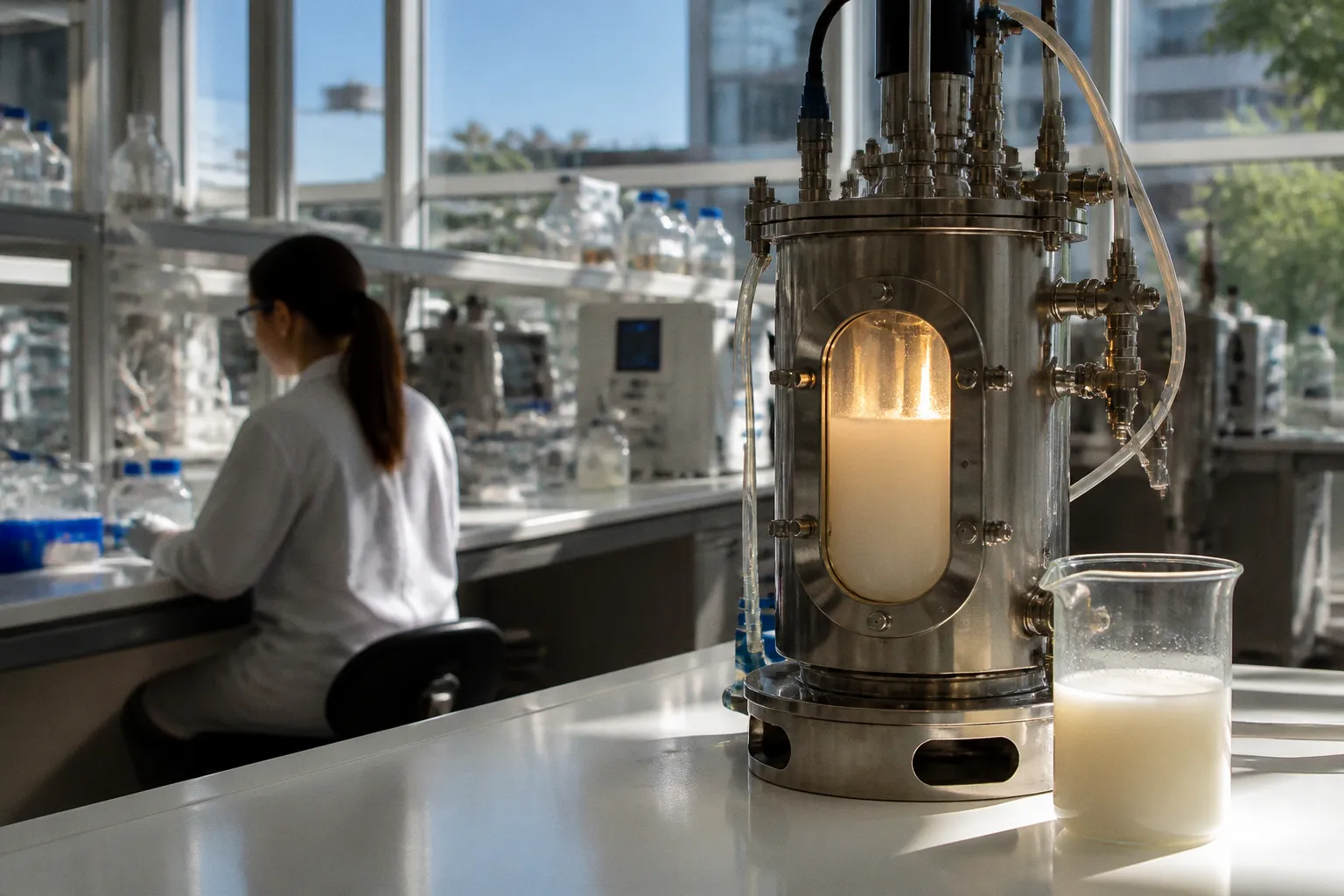
Precision fermentation takes a familiar industrial setup: a fermentation tank populated not by wild yeast but by microorganisms selected or engineered to produce a particular protein. Yeast, bacteria or fungi grow in stainless-steel vessels, fed with a controlled source of nutrients. During that process, they produce the target molecule. The molecule is then separated from the fermentation mixture, purified, dried or otherwise processed, and incorporated into a food.
The organism is not being used to make milk in the way a cow does. It is being used as a production platform for a specific ingredient.
When the target is a dairy protein, the result is more precise than the phrase “milk alternative” suggests. Beta-lactoglobulin, a major whey protein in cow’s milk, can be produced by microorganisms with the same amino-acid sequence as the bovine protein. Casein, the family of proteins responsible for curd formation and much of dairy’s structure, can also be produced through fermentation. Lactoferrin, an iron-binding protein found in milk and other biological fluids, has likewise become a target for microbial production.
This is the point that catches many people off guard. Precision fermentation is not the same as making oat milk or almond milk. Plant-based alternatives usually begin with a plant ingredient and aim to reproduce some of milk’s sensory or functional properties. Precision-fermented dairy starts with the protein function itself. A company may use the resulting protein to create a liquid beverage, ice cream, cheese or another product, but the central ingredient is not a plant protein pretending to be dairy. It is a dairy protein made through a different route.
That distinction also explains why the comparison between precision fermentation and whey protein is useful but incomplete. Conventional whey protein is recovered from cow’s milk, usually as part of cheese production. Precision-fermented whey protein is produced by a microorganism, then purified. Their production histories differ, but the intended protein can be molecularly equivalent. The safety assessment must therefore consider both the familiar nature of the molecule and the unfamiliarity of the manufacturing process.
Companies such as All G have reported lactoferrin purity above 99.5% for their precision-fermented bovine lactoferrin, marketed under the LFX designation. That is a company-reported specification for a particular ingredient, not a universal legal threshold for every food or infant-formula application. Purity figures are meaningful only when paired with information about the testing method, the identity of the remaining material and the intended use.
“Bioidentical” does not mean plant-derived. It means the protein is intended to match the corresponding animal protein, even though it was made without the animal.
The word “bioidentical” can still conceal important differences. A protein’s amino-acid sequence may match the bovine version, while the final food differs in formulation, concentration, minerals, sugars, fats and processing. Milk is not just a collection of proteins. It is a complex system, and a precision-fermented ingredient normally supplies only selected components of that system.
That matters for safety and for nutrition. A beverage containing fermented beta-lactoglobulin is not automatically nutritionally identical to cow’s milk. It may contain no lactose, or it may be combined with other ingredients that determine its carbohydrate and fat content. It may also need stabilisers, vitamins or minerals to achieve the properties expected from a conventional dairy product. Consumers should judge the finished product, not just the origin story of its headline protein.
What the production organism contributes
The microorganism is generally a tool rather than the intended food ingredient. It is selected for its ability to grow predictably and produce the desired protein. The production strain, the inserted genetic material and the conditions used in the tank all become part of the safety case.
Regulators and independent assessors may look at questions such as:
- whether the production organism is well characterised;
- whether it can produce toxins or other harmful metabolites;
- whether the introduced genetic sequence is stable;
- whether the organism itself remains in the final ingredient;
- whether the purification process removes unwanted cells, DNA, proteins and process chemicals;
- whether the final ingredient contains substances that could cause allergic or other adverse reactions.
This is why “made by microbes” is not, by itself, either a safety guarantee or a warning sign. Microorganisms are already used to produce many food ingredients, enzymes, vitamins and pharmaceutical substances. The relevant issue is the specific strain, the specific protein and the specific controls around them.
Navigating the Regulatory Divide
If a product launches in one market long before it appears in another, the explanation often lies in the regulatory framework rather than in a sudden change in the underlying protein.
In the United States, companies commonly use the GRAS framework for food ingredients produced through precision fermentation. GRAS means Generally Recognized as Safe. It is part of the US food-safety system and can be supported by scientific procedures, published research, expert review or a combination of evidence. A company may make a GRAS determination and use FDA’s voluntary notification procedure, asking the agency whether it has questions about the company’s conclusion. A “no questions” response is not the same as a product-by-product approval in the European sense, but it is an important part of the US regulatory record.
All G received a “no questions” response from the FDA for its lactoferrin notification. Other companies have pursued similar routes for different precision-fermented proteins. The details still matter: the conclusion may apply to a defined ingredient, a specified production process and stated conditions of use. It does not automatically clear every product made with that protein, every concentration or every future manufacturing change.
In the European Union, the main route for a novel precision-fermented food ingredient is generally the Novel Food framework. Applications are assessed by the European Food Safety Authority, while authorisation is ultimately handled through the EU regulatory process. The evidence can cover the production organism, genetic modification, composition, toxicology, allergenicity, dietary exposure and the proposed uses.
This process is deliberately more formal and can take years. The precise timing for the first EU Novel Food authorisation of a particular precision-fermented milk protein remains uncertain. It depends on the completeness of an application, questions raised during assessment, requests for additional information, risk-management decisions and the product’s intended use. There is no sound basis for turning that uncertainty into a firm shelf-date forecast.
The practical contrast is clearer than any prediction. US and EU authorities are asking overlapping safety questions, but they organise the answers differently. The United States has a pathway that can allow a defined ingredient onto the market after a GRAS determination and FDA notification process. The EU requires a Novel Food authorisation for products that fall within that framework, with a more centralised assessment and formal decision.
| Aspect | US FDA and GRAS | EU Novel Food framework |
|---|---|---|
| Regulatory logic | Establish that a defined use of an ingredient is generally recognised as safe | Assess and authorise a food or ingredient considered novel under EU law |
| Typical evidence | Safety data, technical information, intended conditions of use and expert assessment | Identity, production process, composition, exposure, toxicology, allergenicity and other data required for the application |
| Agency role | FDA may review a voluntary GRAS notice and issue a “no questions” response | EFSA evaluates the scientific safety of an application; authorisation follows the EU decision process |
| Public visibility | GRAS notices and FDA responses may be available through FDA records | EFSA opinions and non-confidential application materials may be published; confidential commercial information is protected |
| Timing | Can be comparatively quick for a well-supported, defined use, but varies by case | Timing varies and may extend over several years, depending on the application and assessment |
The public-record difference is worth stating carefully. EFSA opinions are public, and non-confidential parts of applications can be made available. That does not mean that every page of every application dossier is open for inspection. Applicants can identify information they regard as confidential, subject to the applicable transparency and confidentiality rules. The public may therefore see the scientific conclusion and substantial supporting material without seeing a complete, unredacted commercial dossier.
That distinction matters because regulatory transparency is often discussed as if it were binary. It is not. A published opinion can provide a detailed account of the authority’s reasoning while still excluding manufacturing know-how, commercially sensitive information or other protected material.
Nor is the regulatory asymmetry a verdict on the intrinsic safety of one continent’s food and the irresponsibility of another’s. It reflects different legal traditions, evidence requirements and institutional choices. Safety is being evaluated through different administrative lenses.
The Allergen Reality You Should Not Skip
This is where the most important consumer myth needs correcting.
Precision-fermented dairy proteins may be bioidentical to proteins in cow’s milk. That sameness is central to their usefulness in cheese-making, foaming, texture and nutrition. It is also why people with cow’s-milk allergy cannot assume that “animal-free dairy” is allergy-free.
A milk allergy is an immune reaction to specific milk proteins. Removing the cow from the production chain does not necessarily remove the protein structures recognised by the immune system. If the final ingredient contains a protein sufficiently similar to a known milk allergen, it may still trigger a reaction. The risk must be evaluated for the actual product and communicated through appropriate allergen labelling.
| Common assumption | More accurate interpretation |
|---|---|
| Animal-free dairy is automatically allergy-free | Not necessarily. A product containing bioidentical milk proteins may still present a milk-allergen risk. |
| Lab-made means hypoallergenic | The production method does not determine allergenicity on its own. The protein and its immune reactivity matter. |
| Lactose-free means suitable for everyone with dairy problems | Lactose intolerance and milk-protein allergy are different conditions. Removing lactose does not remove milk proteins. |
| Plant-based milk and precision-fermented dairy are interchangeable | They have different ingredients, nutritional profiles and allergen considerations. A person’s risk depends on the exact product and their medical condition. |
Lactose intolerance is a separate issue. Lactose is the sugar naturally present in milk, while beta-lactoglobulin and casein are proteins. A precision-fermented product may be formulated without lactose, which could make it relevant to some lactose-intolerant consumers. That does not make it suitable for someone with a milk-protein allergy.
The wording on the carton therefore matters more than the marketing shorthand. “Animal-free” describes the production route. It does not necessarily describe the absence of dairy proteins, the absence of allergens or the nutritional equivalence of the finished product.
For anyone with a diagnosed allergy, especially a child’s caregiver, a new category deserves the same caution as any other unfamiliar packaged food. Read the allergen declaration, check the manufacturer’s product information and follow medical advice. A reassuring sustainability claim cannot override the biology of an allergic reaction.
Cross-contact is another practical concern. A facility may produce several ingredients or use shared equipment. The risk is managed through cleaning, segregation, validated procedures and lab testing, but the controls need to be appropriate to the facility and the product. This is one reason a safety assessment cannot stop at the phrase “the protein is identical to milk protein”. The question is also how the ingredient is made, handled and formulated.
The absence of a cow from the tank does not make a milk protein disappear. For allergy purposes, the molecule matters more than the animal’s presence.
Global Safety Standards and the FAO’s Harmonisation Push
Precision fermentation is developing across borders, while food law remains largely national or regional. That creates a familiar problem: a company may have one production platform, but it must explain that platform to multiple authorities using different categories and procedures.
The Food and Agriculture Organization of the United Nations has been helping map that landscape. In 2025, the FAO released a global report reviewing food-safety considerations, potential hazards and regulatory practices across 35 jurisdictions. The work drew on the views of more than 100 regulatory experts and included roundtable discussions held jointly with Agriculture and Agri-Food Canada in October 2024.
The report does not create a single worldwide approval standard. It cannot, because countries still differ in their legislation, institutional responsibilities and definitions of novel or genetically modified food. Its value is more practical: it shows where the systems overlap and where they diverge.
Some jurisdictions may assess a precision-fermented ingredient under novel-food rules. Others may use an existing food-ingredient pathway, a GRAS-style approach or a framework for products made with genetically modified microorganisms. In some cases, the final ingredient may not contain viable production organisms or detectable genetic material, while the production process still has to be examined closely. The legal treatment can depend on both the organism and the final product.
International mapping is useful for another reason. It separates technical safety questions from market-access questions. A product can be scientifically well characterised and still face a long authorisation route because the relevant category is new, the authority needs more information or the country has not yet settled which rules apply.
The FAO’s work also highlights a challenge that will become more important as the sector grows: regulators need comparable terminology. “Precision fermentation” can describe different organisms, products and levels of processing. A purified protein, a complex fermentation-derived ingredient and a finished beverage should not be treated as if they present exactly the same assessment task.
A more harmonised vocabulary would help authorities compare evidence without pretending that every product is identical. It would also make it easier for consumers, investors and food manufacturers to understand what a regulatory decision actually covers.
For the moment, the international picture remains a patchwork. That does not mean that the science is lawless. It means that the same scientific questions are being fitted into different legal systems.
Purity and Production: What the Microbes Leave Behind
Walk back through the production line and the questions change. The proteins may be familiar, but the route to the glass is not.
Fermentation produces more than the target molecule. Depending on the organism and the process, the vessel may contain microbial cells, residual nutrients, host-cell proteins, nucleic acids, metabolic by-products and other components of the culture medium. The target protein then has to be separated and purified to a specification suitable for its intended use.
This is not a cosmetic stage. It is where much of the safety case becomes tangible.
A manufacturer needs to show that the final ingredient has a consistent identity and composition. It also needs to control contamination, monitor the production strain, validate the purification process and demonstrate that unwanted materials are removed or kept below appropriate limits. The required evidence depends on the ingredient and its use. A highly purified protein used at a modest concentration in a food is not the same regulatory question as a concentrated ingredient intended for a nutritionally sensitive population.
All G has reported lactoferrin purity above 99.5% for its LFX ingredient. That figure is relevant to the company’s product specification, but it should not be presented as a universal requirement for food-grade ingredients or infant formula. There is no single purity percentage that, by itself, determines whether every precision-fermented ingredient is safe or suitable for every application. Regulators assess the whole product and its use, including the identity of impurities and the evidence supporting the proposed exposure.
A purity number also does not tell us everything about manufacturing quality. Two ingredients can have similar headline purity while differing in residual host-cell proteins, process-related substances, microbiological controls or analytical methods. The meaningful questions include how purity was measured, what the remaining fraction contains and whether the process performs consistently from batch to batch.
The production risks that deserve attention
The main concerns are familiar to specialists in biotechnology and food manufacturing, even if they sound new in a dairy aisle:
- Microbial contamination: Fermentation systems need controls against unwanted bacteria, fungi and viruses, with monitoring and procedures for handling deviations.
- Production-strain identity: The microorganism used in the tank must remain the intended strain and behave consistently under production conditions.
- Genetic stability: If the organism has been engineered, the inserted genetic material and its expression need to be monitored over time.
- Residual host-cell material: Purification should control remaining cells, DNA, proteins and metabolites from the production organism.
- Process chemicals and nutrients: Materials used in growth and downstream processing must be controlled, removed where necessary and covered by the safety assessment.
- Allergen carry-over: Shared equipment or facilities can create cross-contact risks if allergenic proteins are handled alongside other ingredients.
- Batch consistency: The finished ingredient should meet its identity, purity and microbiological specifications repeatedly, not only in a pilot batch.
- Changes in scale: A process that works in a laboratory vessel may require additional validation when moved to industrial production.
None of these risks is unique to precision fermentation. Conventional dairy, brewing, enzyme production and pharmaceutical biotechnology all rely on contamination control, process validation and analytical testing. The difference is that a newer food category has to build confidence while consumers are still learning what the process means.
The engineered microorganism is also not necessarily present in the final food. In many systems, it is removed during downstream processing. But that fact must be demonstrated for the specific product rather than assumed from the marketing language. “The microbe does not remain in the ingredient” is a testable manufacturing claim, not a general property of fermentation.
The proteins may be old, but the production line is new — and unfamiliar production lines earn the most careful scrutiny.
That scrutiny should include the final formulation, not only the fermentation tank. A product can contain a precision-fermented dairy protein alongside oils, sugars, stabilisers, vitamins or other allergens. The consumer’s exposure is to the finished recipe, and that is what labelling and risk communication must describe.
What “Safe” Means at the Shelf
So, is precision fermentation dairy safe?
The evidence and regulatory work so far support a cautious answer: a precision-fermented dairy ingredient can be made safe for a defined food use when the production organism is characterised, the manufacturing process is controlled, the ingredient is purified to an appropriate specification and the safety evidence supports the proposed exposure.
That answer is deliberately less dramatic than either side of the debate. The proteins themselves may be familiar and well understood. The production route is based on established fermentation technology. But familiarity with a protein does not eliminate the need to assess the microorganism, impurities, manufacturing controls and intended use.
The important footnotes are these.
If you have a cow’s-milk allergy, precision-fermented dairy is not automatically a workaround. If you are lactose-intolerant, a product made without lactose may be relevant, but lactose intolerance is not the same as milk-protein allergy and individual tolerance still matters. If you are considering a product for an infant, a medically restricted diet or another sensitive use, the finished product’s authorisation and formulation matter more than a general claim about precision fermentation.
Regulatory status also needs to be read precisely. A US GRAS conclusion or FDA “no questions” response concerns a defined ingredient and its conditions of use. It does not mean that every product using a similar protein has been cleared. In the EU, the first authorisation timeline for a specific precision-fermented milk protein remains uncertain, and the absence of an authorisation is not the same thing as a finding that the technology is unsafe.
The same precision is needed when reading public documents. EFSA opinions and non-confidential application materials can provide substantial information, but they are not identical to complete, unredacted dossiers. Confidential commercial information may be withheld under the applicable rules.
The FAO’s 35-jurisdiction report is useful because it shows how regulators are approaching the category internationally. It does not remove the need to examine the decision for a specific ingredient, product and market.
Safety here is not a binary label. It is a layered conclusion built from the protein, the production organism, the purification process, the proposed use and the regulator’s evidence.
Precision fermentation will not make every dairy question disappear. It may reduce dependence on animals for selected proteins, offer new tools for food manufacturing and create products that would be difficult to produce through conventional agriculture. It may also introduce new supply chains, new labelling debates and new expectations around transparency.
The sensible position is neither automatic distrust nor automatic celebration. Read what the product actually contains. Distinguish lactose from milk protein. Look for the relevant allergen information. Pay attention to the regulatory route and the conditions of use. And remember that “animal-free” describes how an ingredient was made, not whether it is free from every biological risk associated with dairy.
The cow may be absent from the fermentation tank. The responsibility for proving safety is not.