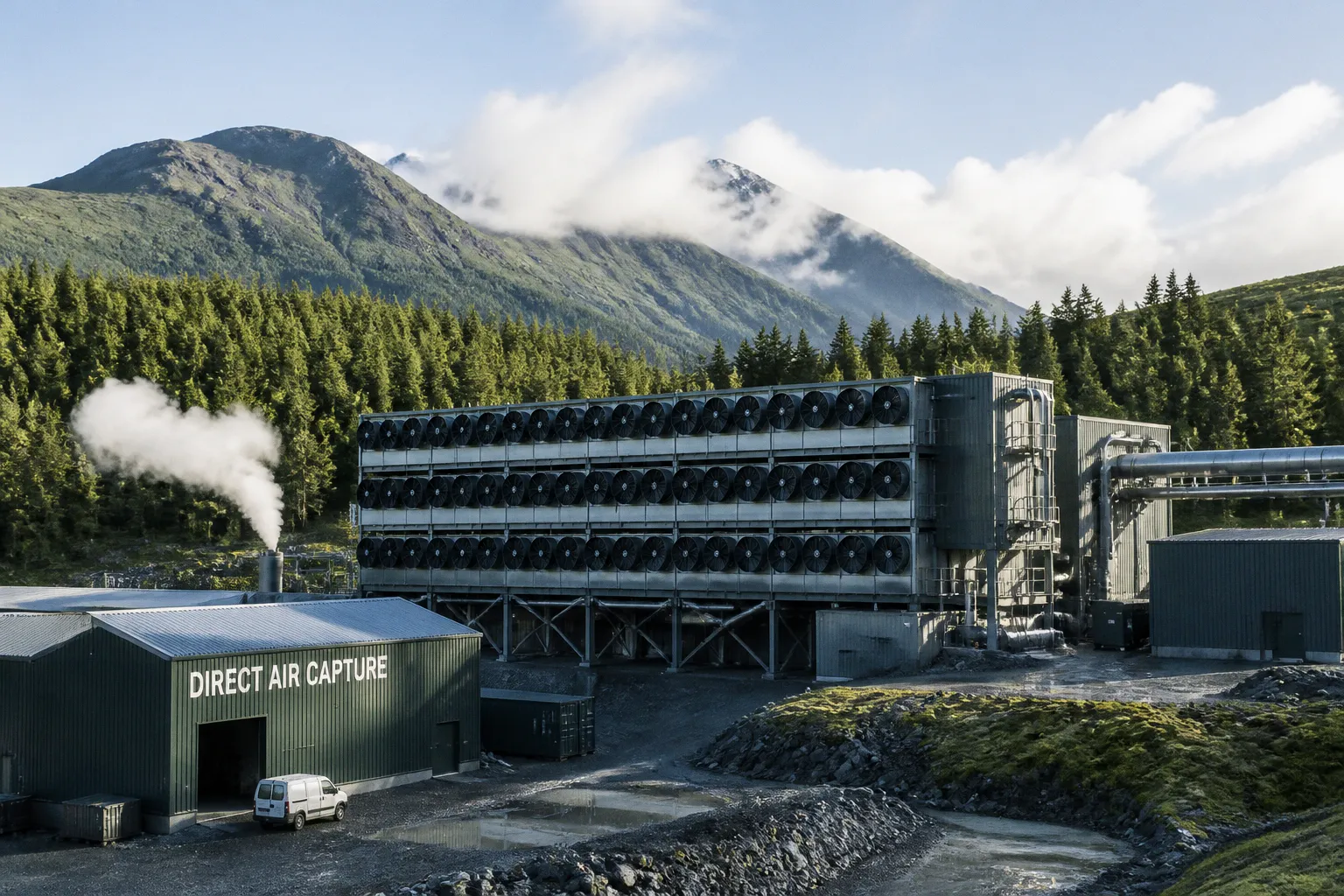
One intercepts a relatively concentrated stream before it reaches the atmosphere. The other searches open air for a gas present at roughly 0.04% concentration.
Compare car rental deals in United Kingdom
See available offersPartner link — DiscoverCars comparisonThat difference governs almost everything that follows: energy demand, cost, siting, infrastructure, and the climate value of each tonne captured. The question is not simply whether direct air capture or point-source carbon capture is the better technology. The more consequential question is which carbon problem each technology is actually equipped to address.
The thermodynamic divide: flue gas versus ambient air
Point-source carbon capture and storage, or CCS, is positioned at the mouth of an industrial process. The exhaust from a cement plant, steelworks, chemical facility, refinery, or fossil-fuel power station carries carbon dioxide in a concentrated stream compared with ordinary air. Capture equipment separates that CO2 from the rest of the exhaust, compresses it, and sends it toward permanent geological storage or another controlled destination.
The technology does not erase the industrial process. It intervenes before part of its carbon reaches the atmosphere.
Direct air capture, by contrast, operates after emissions have dispersed. Fans move ambient air through chemical contactors or filters, where a sorbent binds to the CO2. The sorbent is then regenerated using heat, electricity, or both. The concentrated gas is compressed and prepared for storage or use.
The distinction looks simple on paper. In the field, it is a difference in scale and dilution. Point-source CCS works with a stream in which the target molecule is comparatively abundant. DAC must process enormous quantities of air to collect the same mass of CO2. The surrounding atmosphere is not an industrial chimney: it is a moving, variable medium shaped by wind, humidity, temperature, vegetation, topography, and urban infrastructure.
Point-source CCS stops a concentrated emission from entering the atmosphere. Direct air capture tries to retrieve carbon after the atmosphere has already received it.
This is why the phrase “direct air capture vs point source carbon capture” can mislead when it implies a straightforward contest. The two systems are not interchangeable versions of the same machine. Their roles overlap only at the end of the chain, where captured CO2 may be transported and stored underground.
What each technology can claim
Point-source CCS is primarily an emissions-prevention technology. When installed on an industrial source and paired with permanent storage, it can prevent new emissions from that source from entering the atmosphere. It does not, by itself, remove historical CO2 that is already dispersed through the air.
DAC is a carbon dioxide removal technology when the captured gas is permanently stored and the facility’s energy supply and operations do not generate emissions that substantially undermine the removal. It can address residual or historic emissions, including emissions that are difficult to trace back to one chimney.
That distinction matters for climate accounting. Capturing CO2 at a cement plant can reduce the plant’s future contribution to atmospheric carbon. Capturing CO2 from ambient air can produce a net removal, but only after the full energy and storage system is considered.
Neither label is automatically a climate guarantee. A captured tonne is not the same as a permanently removed tonne. The outcome depends on energy sources, capture performance, transport, storage integrity, and the emissions associated with construction and operation.
Why DAC consumes so much energy
The basic challenge of DAC is not merely that air contains less CO2 than flue gas. It is that the capture medium must repeatedly separate a dilute molecule from a large, chemically active background.
Air contains nitrogen, oxygen, water vapour, particulate matter, and other trace gases. A DAC plant draws that mixture across a material designed to bind selectively with carbon dioxide. Once the sorbent is loaded, the system must release a concentrated CO2 stream without destroying the sorbent or consuming disproportionate amounts of energy.
Two broad approaches illustrate the difference in operating conditions.
| Parameter | Solid DAC | Liquid DAC |
|---|---|---|
| Capture medium | Solid sorbents attached to filters or structured contactors | Alkaline liquid solutions that react with CO2 |
| Regeneration temperature | Approximately 80–120°C | Approximately 300–800°C |
| Main energy challenge | Repeated low-temperature heating, airflow, and sorbent cycling | High-temperature heat and chemical regeneration |
| Siting implication | Can pair with low-temperature waste heat or renewable heat sources | Requires a more substantial high-temperature energy system |
| Climate sensitivity | Performance depends on sorbent durability, energy source, and moisture management | Performance depends on heat intensity, chemical handling, and system efficiency |
Solid DAC systems operate at lower regeneration temperatures, generally around 80°C to 120°C. That does not make them energy-light. Fans still have to move air through the contactors, and the sorbent must be cycled through capture and release many times. Liquid DAC systems require far more intense heat, with regeneration temperatures in the range of approximately 300°C to 800°C.
Existing DAC systems designed to capture one million tonnes of CO2 annually require roughly 180 to 500 megawatts of power, according to available estimates. The approximate energy split is 80% thermal energy and 20% electricity. Those figures are not a universal specification for every future plant, but they establish the scale of the problem: removing carbon from air is also an exercise in building and supplying a large energy system.
For an ecologist, the siting consequence is difficult to ignore. A DAC plant may occupy less land than the renewable generation required to supply it. Its visible machinery—fans, contactors, heat exchangers, compressors—can be concentrated in one industrial zone, while the associated solar, wind, geothermal, or transmission infrastructure extends through a wider landscape. The carbon accounting must include that larger footprint.
A facility powered by abundant, genuinely low-carbon energy is a different climate instrument from one drawing electricity from a grid still dominated by fossil generation. The same capture unit can have very different net removal performance depending on where it operates and when it draws power.
The efficiency question is really a boundary question
Comparisons of DAC efficiency versus point-source capture often focus on the capture unit alone. That is understandable: engineers need to know how much energy enters the equipment and how much CO2 leaves it. But climate policy must look beyond the absorber or filter.
For point-source CCS, the key questions include:
- How concentrated is the CO2 stream?
- How much energy does the capture process draw from the industrial facility?
- Does that energy reduce the plant’s useful output or increase fuel consumption?
- How far must the compressed CO2 travel to reach storage?
- Is the storage site characterized and monitored for permanence?
- What emissions remain from the industrial process after capture?
For DAC, the questions widen:
- How much air must pass through the system for each tonne captured?
- What is the sorbent’s working capacity under local humidity and temperature?
- How frequently must the material be regenerated or replaced?
- Is the required heat low-temperature or high-temperature?
- What electricity is used by fans, pumps, compressors, and controls?
- What additional renewable generation or grid capacity must be built?
- Is captured CO2 permanently stored, or does a utilization pathway return it to the atmosphere?
The last question is particularly important. Using captured CO2 in fuels, building materials, or industrial products may delay its return to the atmosphere, but utilization is not automatically equivalent to permanent removal. A carbonated material with long service life presents a different climate case from a synthetic fuel that is burned within months.
Point-source CCS also has a system boundary that can conceal substantial emissions. A capture rate at the chimney does not describe upstream methane leakage from fuel extraction, emissions from transporting feedstocks, or the energy penalty imposed on the facility. Nor does it make every industrial process compatible with net-zero objectives. Capturing emissions from a new fossil-fuel installation may prevent some atmospheric release while leaving the underlying extraction and combustion system in place.
This is why a carbon capture technology comparison should not rank technologies by capture percentage alone. A lower-cost tonne captured at a chimney may be more useful for preventing unavoidable process emissions. A more expensive tonne removed from air may be indispensable for balancing emissions that cannot otherwise be eliminated. The climate value lies in the function, not the novelty of the equipment.
Cost: concentration still sets the first price
The cost of DAC is high because the technology pays an energy and equipment penalty for working with dilute atmospheric CO2. Current estimates for early DAC operations range from about $500 to more than $1,000 per tonne of CO2 captured. The International Energy Agency has estimated a possible cost range of roughly $125 to $335 per tonne for large-scale facilities, depending on technology and operating conditions.
Those ranges should not be read as a settled market price. DAC remains an evolving industrial field, and the exact commercial cost achieved by individual plants is not uniformly transparent. But the direction is clear: current DAC is substantially more expensive than capturing CO2 from many concentrated industrial streams.
The long-term target often discussed for DAC is below $100 per tonne. Reaching that level would require more than incremental improvements to a single filter. It would likely depend on larger manufacturing volumes, longer-lived sorbents, better contactor design, lower-cost clean energy, improved heat integration, reliable transport networks, and storage projects operating at much larger scale.
The cost of point-source CCS varies widely by sector. A capture system fitted to a relatively concentrated process stream may be easier to operate than one attached to a dilute or chemically complex exhaust. Cement, steel, hydrogen, refining, and power generation do not present the same gas composition, temperature, pressure, or operating pattern.
Nor is the cheapest tonne necessarily the most valuable tonne. Some industrial emissions are process emissions rather than energy emissions. Cement manufacture, for example, releases CO2 through the chemical transformation of limestone, not only through fuel combustion. Electrification and efficiency can address parts of the industrial emissions problem, but they cannot remove every source of carbon from the process itself.
That is where point-source CCS has a distinct role. It can address emissions at facilities where the carbon is concentrated and where alternative production routes remain limited. Its economic case is strongest when capture is integrated into the process rather than added as an afterthought, and when storage infrastructure is available nearby.
DAC faces a different economic test. It must demonstrate not only that it can capture CO2 from air, but that it can deliver verified, durable removals at a cost society can support without displacing faster and cheaper emissions reductions.
The expensive part of DAC is not the final pipe carrying CO2 away. It is the continuous work of finding a dilute gas molecule in moving air and giving it a route into permanent storage.
Siting: freedom from the chimney, dependence on the landscape
One of DAC’s principal advantages is that it does not need to sit beside an emitting industrial source. A plant can be located near suitable geological storage, dedicated renewable power, low-carbon heat, or existing transport infrastructure. If the storage basin is far from major industrial clusters, DAC may reduce the need to move CO2 long distances from scattered emitters.
That flexibility changes the geography of carbon management.
Point-source CCS tends to cluster around industrial corridors, ports, pipelines, and known geological formations. The capture equipment is anchored to the emission source. A steelworks cannot simply move its chimney to a more favourable storage basin. Transport networks must connect the facility to injection sites, and multiple industrial sources may need to share that infrastructure to make it economical.
DAC can, in principle, be placed at the storage end of the system. A plant near a saline formation or other suitable geological reservoir could capture atmospheric CO2 and inject it without building a long pipeline from a distant factory. That does not eliminate infrastructure. It shifts where the energy, water, roads, workforce, and transmission capacity are required.
Local ecological conditions still matter. A DAC facility in an arid region may face competition for water, even if its process water demand is modest compared with other heavy industries. In humid environments, moisture can affect sorbent performance and regeneration requirements. In cold climates, seasonal changes can alter airflow, heat demand, and maintenance. Dust and biological material can foul air contactors. Every site has its own combination of constraints.
The surrounding landscape is not an empty platform for climate infrastructure. It contains estuaries, aquifers, agricultural soils, wetlands, migration corridors, and communities with existing claims on land and water. A facility advertised as a climate solution can still create local ecological pressure if its energy and resource requirements are treated as externalities.
For point-source CCS, the same principle applies to pipeline routes and storage zones. A carbon transport corridor can cross farmland, forest, wetlands, or densely settled areas. Geological storage is not simply a deep hole in the ground; it requires characterization, monitoring, pressure management, and long-term governance. The subsurface has structure, permeability, faults, and existing uses that determine whether injection is appropriate.
The hidden infrastructure of a captured tonne
A credible comparison between DAC and point-source CCS must follow CO2 beyond the capture unit. The complete chain can include:
1. Conditioning and compression: CO2 must be prepared for transport, often requiring substantial electricity and careful control of pressure and impurities.
2. Transport: Pipelines, ships, rail, or road systems connect capture facilities with storage sites, each with different energy and safety requirements.
3. Injection: Wells and surface facilities deliver CO2 into geological formations.
4. Monitoring: Operators track pressure, plume movement, and potential leakage pathways over time.
5. Accounting: A removal claim requires evidence that captured carbon is not simply being counted twice or released later through utilization.
The engineering is only one layer. Regulatory structures, liability rules, public consent, and monitoring standards determine whether a storage project is durable in practice. A carbon removal credit with weak verification can carry the appearance of permanence without its substance.
What each technology contributes to net zero
The strongest climate strategy does not ask DAC to replace point-source CCS, or point-source CCS to perform DAC’s job. It assigns each technology to the emissions profile it can address with the least ecological and energetic damage.
Point-source CCS is most relevant where emissions are concentrated and difficult to eliminate through electrification, efficiency, material substitution, or process redesign. It may be especially important for residual process emissions in heavy industry. But it should not become a reason to delay direct emissions cuts where cleaner alternatives already exist.
DAC is most relevant for residual emissions and atmospheric carbon removal. Aviation, agriculture, certain industrial processes, and other sectors may retain emissions that are difficult to eliminate completely. DAC could help balance those emissions if it reaches much lower costs, operates on genuinely low-carbon energy, and stores carbon permanently.
That role is narrower than the broadest claims made for the technology, but it is still significant. The atmosphere does not distinguish between CO2 from a refinery, a field, a flight, or a forest fire once the gas is dispersed. DAC is one of the few tools designed to work on that atmospheric pool rather than on a specific source.
The danger is substitution. If DAC is treated as permission to maintain high emissions, its removal capacity will be asked to chase a moving target. The scale required for global climate stabilization would be immense, and every additional tonne emitted increases the burden placed on future removal systems.
A second danger is accounting without ecology. A facility can capture CO2 and still depend on a carbon-intensive energy system, fragile water supply, or storage chain that has not been demonstrated at the necessary duration. Technology is not a synonym for permanence.
A practical comparison
| Question | Direct air capture | Point-source CCS |
|---|---|---|
| Where does it capture CO2? | From ambient air at approximately 0.04% concentration | From concentrated industrial or power-plant exhaust streams |
| Primary climate function | Carbon dioxide removal when paired with permanent storage | Prevention of new emissions from a point source |
| Can it address historic emissions? | Yes, in principle, because it draws from atmospheric CO2 | No, not by itself |
| Energy profile | High airflow demand plus thermal and electrical energy for regeneration and compression | Energy penalty depends on exhaust composition, capture process, and facility integration |
| Typical cost position | Currently expensive, with early estimates from about $500 to more than $1,000 per tonne; large-scale estimates can be lower | Generally less costly than DAC where CO2 is concentrated, though costs vary by sector |
| Siting | Can be located near storage, renewable energy, or low-carbon heat | Usually tied to the industrial source and then connected to storage |
| Negative emissions | Possible with permanent geological storage and low-carbon operations | Not negative unless combined with biomass-based capture, such as BECCS |
| Main risk | Large energy and infrastructure demand for dilute atmospheric capture | Lock-in of emitting infrastructure or overstatement of capture performance |
This table captures the central point: DAC and CCS should be judged against different counterfactuals. DAC is competing with other carbon removal approaches and with the consequences of leaving residual emissions in the atmosphere. Point-source CCS is competing with process redesign, electrification, fuel switching, efficiency, and—where those options are unavailable—continued unabated emissions.
The climate implication beyond the machinery
The debate over DAC versus point-source CCS often becomes a debate about equipment: fans against chimneys, solid sorbents against liquid solvents, low-temperature regeneration against high-temperature heat. Those details matter, but the larger issue is how quickly societies reduce the flow of carbon into the atmosphere.
A forest soil, a peatland, an estuary, and a geological storage formation all hold carbon in different ways and on different timescales. The durability of a solution cannot be inferred from the elegance of its machinery. A removal system must be connected to energy, land, water, transport, monitoring, and governance without quietly transferring harm into one of those surrounding systems.
By 2050, climate strategies are expected to require carbon dioxide removal at much larger scales than today, alongside deep emissions reductions. That future makes room for DAC, particularly for dispersed and residual emissions. It also makes point-source CCS relevant to industrial processes where carbon cannot yet be eliminated at the source.
But the order matters. Point-source capture should not be used to preserve avoidable emissions. DAC should not be used to make continued expansion appear climate-neutral. The first task remains reducing the amount of carbon entering the atmosphere. Capture and removal technologies then have to deal with the remainder: concentrated industrial emissions on one side, dispersed atmospheric carbon on the other.
The distinction is physical, not rhetorical. One system works at the chimney. The other works across the atmosphere. Climate policy becomes more credible when it respects that geography—and when every captured tonne is followed all the way from the air or exhaust stream to its final storage.