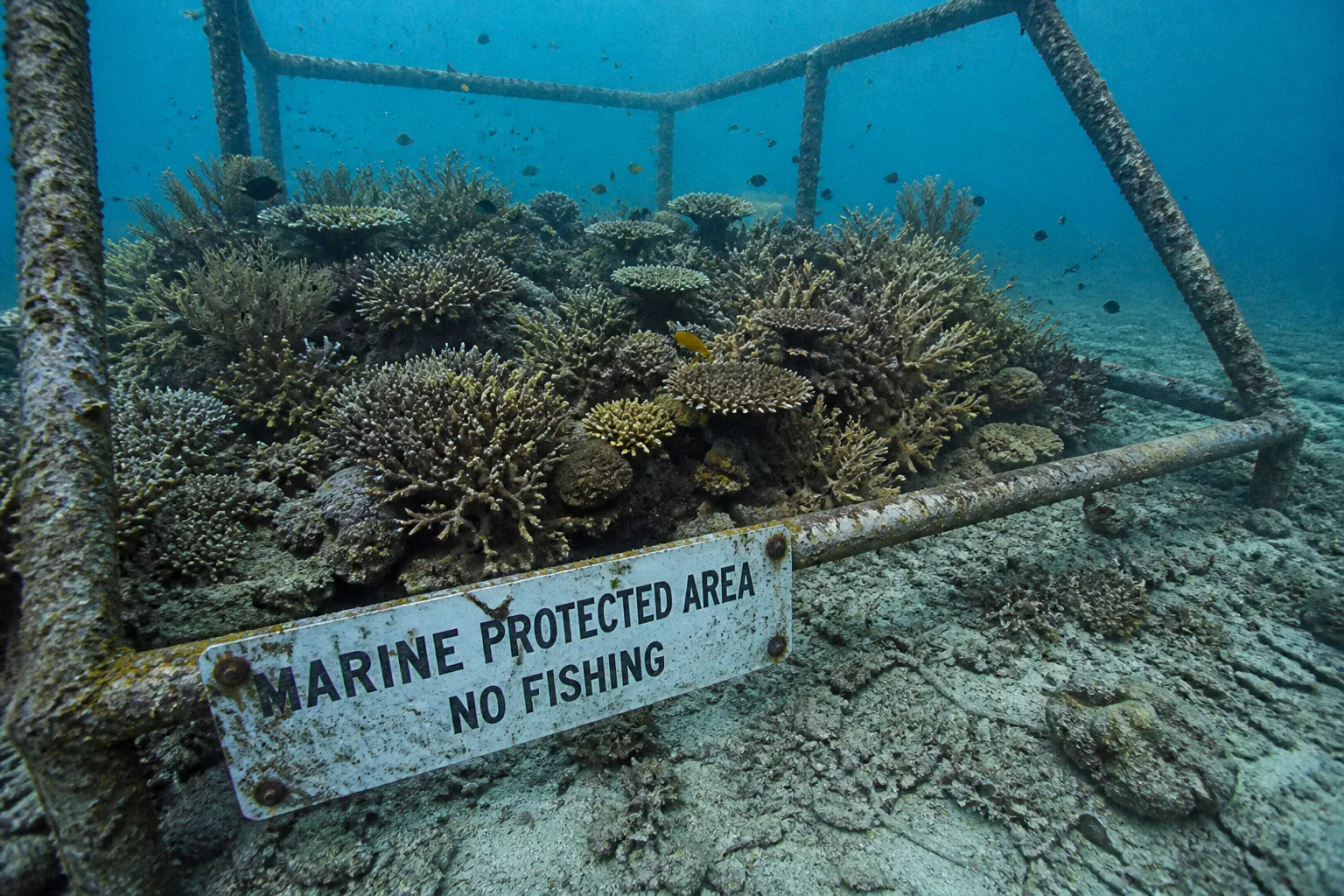
On the leeward side of the Mesoamerican Reef, where the seafloor shelves steeply from shallow spur-and-groove coral into channels of sand and seagrass, twelve years of underwater transects have produced a finding conservation biologists describe with uncomfortable precision. Out of 111 marine protected areas monitored along the Belizean, Honduran, Guatemalan, and Mexican coasts between 2006 and 2018, only five registered a meaningful increase in adult fish biomass. Twenty-eight sites went the other direction — fewer large fish, not more. The majority simply held steady. For a region holding some of the most ambitious marine conservation designations in the Caribbean, the numbers cut against the prevailing story that drawing a line on a nautical chart is enough.
The global push to protect 30% of the world's oceans by 2030 — a target embedded in the Kunming-Montreal Global Biodiversity Framework and echoed in regional commitments, including the European Union's effort to lift its marine protected area coverage from roughly 13.7% in 2023 toward 30% by the end of the decade — has built enormous momentum. Tens of thousands of square kilometers have been reclassified as protected in the past decade alone. And yet, as the Mesoamerican Reef data and a parallel systematic review of rigorously designed MPA studies both suggest, the central question is no longer how fast we are drawing boundaries. It is whether the boundaries we have already drawn are doing the work we claim they are doing.
The Paper Park Paradox: Why Designation Does Not Equal Protection
Walk the shorelines of any coastal state with a developed marine conservation agenda and you will find a recurring geography: a chain of protected zones, sometimes extending across hundreds of kilometers, occasionally stacked inside one another in overlapping layers of regional, national, and international designation. On paper, the coverage is impressive. Underneath the surface, the picture is far more uneven.
The term ecologists use for this gap is "paper park" — a marine protected area that exists in legal text and administrative maps but lacks the staff, surveillance equipment, community engagement, or political backing to enforce its own rules. The systematic review that examined 66 MPAs across 18 countries using rigorous before-after-control-impact (BACI) research designs found that just over half — 52.2% — produced positive or slightly positive ecological outcomes. Another 17.4% showed negative outcomes, often because poorly enforced reserves can concentrate displaced fishing effort onto neighboring habitats, a phenomenon researchers call regulatory spillover. The remaining 30.4% produced mixed or inconclusive results, often because the data could not isolate the reserve's effect from wider environmental noise.
The takeaway is not that marine protected areas do not work. It is that the binary of "protected or not protected" is misleading. Most existing MPAs fall somewhere along a gradient of extractive activity that ranges from strict no-take closure to lightly regulated multiple-use zone, and ecological outcomes scale with that gradient in measurable ways.
A marine protected area without enforcement is a line drawn on water, not a sanctuary.
Quantifying Success: The 52% Reality of Ecological Outcomes
The 52.2% figure deserves a closer look. It comes from studies that applied the most demanding experimental designs available to conservation science — comparisons of similar sites before and after protection, paired with control sites outside the protected boundary, across multiple time points. This is the gold standard, and the gold standard still returns a coin flip.
The pattern inside that coin flip is consistent. Fully and highly protected reserves — those that prohibit all extractive activities including commercial and recreational fishing, anchoring in sensitive habitat, and seabed disturbance — produce the largest and most reliable ecological gains: higher species abundance, larger fish, denser coral cover, more stable trophic structures. Partially protected reserves, which may restrict certain gear types, certain seasons, or certain species while permitting others, generate benefits on a smaller scale and erode quickly when management attention lapses. Minimally regulated zones, often designated for reasons of geopolitical convenience or pre-existing low-intensity use, generate little measurable conservation value at all.
This is not a marginal distinction. The Mesoamerican Reef data illustrates it sharply. The five reserves that did show significant biomass gains in the twelve-year window shared a set of characteristics: long establishment, dedicated enforcement staff, often community-based co-management arrangements, and physical isolation from heavy coastal fishing pressure. The twenty-eight reserves that lost biomass during the same period tended to be younger, smaller, closer to populated coastlines, and chronically underfunded. Geography mattered as much as policy.
The Five Pillars of High-Performance Marine Reserves
When researchers pool the characteristics of the world's best-performing marine protected areas, a consistent set of design features emerges. These are not aspirational goals; they are the recurring attributes of the small minority of reserves that have demonstrably rebuilt fish populations, restored habitat structure, and maintained those gains across multiple years.
| Design feature | Why it matters on the water |
|---|---|
| Fully protected status (no extractive use) | Allows predator-prey relationships and trophic structure to rebuild; partial protections leave key stressors in place |
| Established more than 10 years prior | Many ecological responses — including recovery of long-lived predatory fish — operate on decadal timescales |
| Area greater than 100 km² | Large reserves support self-sustaining populations of wide-ranging species and buffer against edge effects |
| Consistent, visible enforcement | Deterrence of illegal activity requires patrol capacity, not just legal text; community stewardship often supplements formal enforcement |
| Isolation by deep water or sand | Physical separation from external pressures limits spillover of fishing effort and larval dispersal into disturbed habitats |
The last criterion is one conservation planners increasingly recognize as decisive. A reserve that hugs a coastline and is bounded by shallow shelf is, by definition, accessible to the very fishing fleets it is supposed to exclude. A reserve bounded offshore by deep water has a natural moat — not perfect, but significant. The world's largest and most ecologically successful marine reserves, from the Papahānaumokuākea Marine National Monument in the Northwestern Hawaiian Islands to the Chagos Marine Reserve in the central Indian Ocean, share this profile: large, remote, isolated, and old enough to have accrued real recovery.
Migratory Megafauna and the Limits of Static Boundaries
Even the best-designed fixed-boundary reserve runs into a structural problem when the species it is meant to protect do not respect lines on charts. Tracking studies of more than 100 highly migratory marine megafauna species — sharks, tuna, whales, sea turtles, seals, billfish — have found that approximately 75% of the individuals tracked passed through active fishing zones during their migrations. For species such as the bluefin tuna, the leatherback turtle, or the shortfin mako shark, the critical habitat is not a fixed location but a corridor spanning thousands of kilometers of open ocean.
This is where static marine protected areas reach their operational limit. A no-take zone off the Galápagos cannot protect a scalloped hammerhead that migrates into the longline fleets of the southeastern Pacific. A well-managed reserve along the Mesoamerican Reef cannot prevent bycatch of a loggerhead turtle nesting on its beaches if the same animal is caught on a hook a thousand kilometers away two months later. The cumulative exposure, summed across a migration cycle, shapes population outcomes — and that exposure is determined less by the quality of any single reserve than by the patchwork of regulation, or absence of regulation, across the entire migratory range.
The emerging response is a shift from fixed polygons to dynamic, species-specific management: temporary spatial closures tied to migration timing, dynamic ocean management tools that close areas in near-real-time when tagged animals aggregate in known fishing hotspots, and multilateral agreements that coordinate protection across jurisdictional boundaries. The Eastern Tropical Pacific Marine Corridor (CMAR), a multinational initiative founded in 2004 by Costa Rica, Colombia, Ecuador, and Panama, is one attempt to knit together multiple national jurisdictions into a single migratory pathway. Whether such efforts can deliver the same ecological outcomes as a well-enforced static reserve remains an open question — and a pressing one, given that open-ocean species account for a disproportionate share of marine biodiversity.
Beyond the 30% Target: Shifting Focus from Coverage to Quality
The 30-by-30 target has done extraordinary work as a political catalyst. It has moved marine protection from a niche conservation concern into the mainstream of international climate and biodiversity negotiations, and it has given governments a measurable commitment with a clear deadline. As of 2023, the European Union had reached 13.7% marine protected area coverage — a tripling since 2012 — and most coastal states have published national roadmaps to close the remaining gap. The directional momentum is real.
But the Mesoamerican Reef evidence and the broader systematic review converge on a difficult conclusion: coverage without quality is a kind of accounting fiction. A marine protected area that allows industrial trawling, has no patrol vessels, sits on a coastline crowded with artisanal fishers, and was designated primarily to satisfy an international reporting requirement is, ecologically speaking, almost indistinguishable from the surrounding unprotected ocean. It is counted in the global percentage. It does not function as a refuge.
The next decade of marine conservation will be defined less by how many new square kilometers enter the global protected-area database and more by how the existing protected estate is actually managed. Reclassifying partially protected zones to fully protected status, investing in enforcement infrastructure, expanding the average size and age of reserves, and building the cross-border governance arrangements that mobile species require — these are the interventions that convert a paper park into a working ecosystem. The global targets are useful as a floor. They are dangerous as a ceiling.
The question is no longer whether we can draw enough lines on enough maps. The question is whether we are willing to do the slower, more expensive, less photogenic work that turns those lines into living systems — and whether the climate-strained oceans of the next century will let us catch up if we don't.