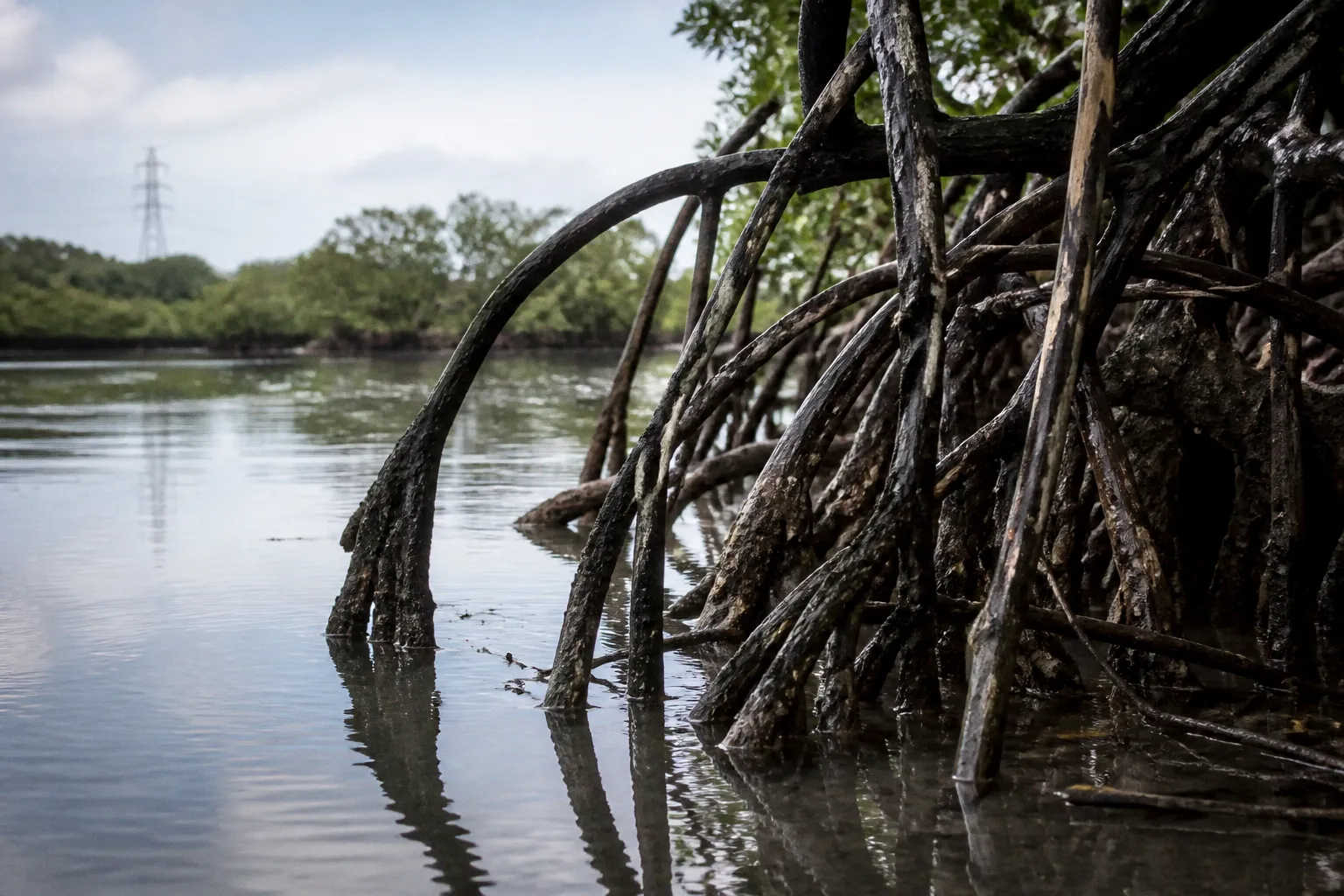
The project boundary may be mapped precisely, yet the forest around it remains vulnerable to aquaculture, oil-palm expansion, rice cultivation, sea-level rise and powerful cyclones. Research on investible mangroves in the region places up to 85% of that area under some form of permanence risk. It is a stark collision: the world’s most carbon-dense forests occupy a narrow, shifting margin between land and sea.
That makes mangrove carbon credits neither a straightforward climate solution nor a commodity that can be dismissed as greenwashing. They can direct substantial finance toward valuable coastal ecosystems, but only if their accounting reflects the forces capable of undoing them. A map can establish a project’s coordinates. It cannot guarantee that the roots will remain waterlogged, the soil will remain undisturbed or the local economy will stop pressing against the forest edge.
The Blue Carbon Premium: Why Mangroves Outperform Terrestrial Forests
The first evidence is physical. Mangroves stand in saturated, oxygen-poor soil where fallen leaves, branches and other organic material decompose slowly. Carbon entering this environment can remain stored in sediment and waterlogged soil for centuries. The result is an unusually concentrated carbon stock, accompanied by the tangled roots, estuarine sediment and repeated tidal flows that define the coastal forest.
Mangroves occupy only about 0.7% of the world’s land area, yet their carbon-storage capacity per hectare is estimated at four to five times that of terrestrial forests. That figure needs careful interpretation. It is not a promise that every mangrove hectare stores five times as much carbon as every terrestrial forest. Biomass, species composition, sediment, hydrology and disturbance all vary from one site to another. The comparison nevertheless captures the exceptional density of blue carbon: a relatively small global footprint can contain a disproportionately large climate store.
Much of that value lies below the surface. A visible stand of trunks and branches represents only part of the carbon account; organic matter also accumulates in the soil beneath the tidal forest. When hydrology changes or sediment is disturbed, that belowground stock can be exposed. Desiccation and oxidation may then accelerate the loss of carbon that a project once treated as protected.
This concentration is what gives blue carbon credits their appeal. Mangrove habitat also provides coastal protection and supports ecological functions that are difficult to reproduce once a forest is cleared. Estimates place the value of coastal property protected by mangroves at $36 billion. For climate-finance projects, several forms of value can therefore overlap: carbon storage, coastal protection, habitat conservation and the possibility of supporting long-term restoration.
A forest covering less than 1% of the world’s land can hold an outsized share of ecological value—and an equally outsized accounting risk.
That value is scarce. Blue carbon credits account for less than 1% of issuances in the voluntary carbon market. They commonly trade in the mid-$20s to low-$30s per tonne of carbon dioxide equivalent, a premium associated with limited supply and the additional coastal benefits associated with mangrove projects.
A premium price should not be confused with proof of quality. Scarcity can attract careful buyers, but it can also encourage exaggerated claims. If demand rises faster than credible monitoring, a high market price may reflect reputation and co-benefits rather than the reliability of every underlying tonne. The physical forest is dense in carbon; the market around it remains thin.
The Integrity Gap: MRV, Baselines and Additionality
A mangrove credit represents a claim about carbon that was protected, restored or avoided under a defined set of assumptions. The weakness of that claim often begins before a credit reaches a registry. The project must establish a credible baseline: what would have happened to the mangrove without intervention, and how much carbon would have been lost?
That question is unusually difficult along populated and economically active coasts. Oil-palm development, aquaculture and rice conversion can all create plausible alternative futures. If a project begins where conversion was already imminent, the carbon benefit may be substantial. If trees were unlikely to be cleared in the first place, the same claimed reduction may be largely additional on paper but uncertain in reality. This is the additionality problem: a credit should represent climate benefit that would not have occurred under a credible business-as-usual scenario.
Monitoring, reporting and verification, commonly shortened to MRV, must then establish whether the promised carbon remained stored. Remote sensing can show changes in canopy and land cover, but soil carbon is less visible. Field measurements are more direct, yet they are expensive and spatially limited. A project must connect those observations across an entire project area, account for disturbances and produce estimates that can survive independent scrutiny.
The main integrity problems are therefore connected rather than separate:
| Integrity issue | What the accounting must establish | Why the result can fail |
|---|---|---|
| Baseline | The likely loss of mangrove carbon without the project | Coastal development may be misjudged, slowing or accelerating future conversion |
| Additionality | Whether the credited reduction is genuinely caused by project finance or protection | The same outcome might have occurred without the credit purchase |
| MRV | Whether stored carbon can be measured, reported and independently checked | Canopy observations may miss soil-carbon loss or fail to cover the full site |
| Leakage | Whether clearing or degradation simply shifts elsewhere | Aquaculture, agriculture or development may move beyond the project boundary |
| Permanence | Whether the carbon remains stored for the stated period | Sea-level rise, cyclones and land conversion can reverse earlier gains |
No single measure solves this chain. A strong monitoring system cannot rescue a weak baseline. A conservative baseline cannot guarantee that carbon will remain in the soil. Additionality can be plausible while leakage is poorly understood, and leakage can be limited while a severe storm causes substantial loss.
The small size of the blue carbon market complicates general claims about its performance. Blue carbon makes up less than 1% of voluntary credit issuances, but there is no single precise annual volume of verified blue carbon credits across all registries that can be used to make sweeping judgments. The proportion of projects that consistently pass every relevant integrity test without overestimating baselines is also not established as a reliable global figure.
A high price can reward scarcity and coastal benefits, but scarcity is not evidence that every credit is sound.
This is not an argument that all mangrove credits are invalid. It is an argument against treating the category as self-validating. The ecological asset is real; each tonne associated with it still depends on project-specific evidence.
Permanence Under Pressure: When the Shoreline Moves
Permanence is the most difficult promise for any forest carbon credit, and mangroves are exposed to pressures that can be abrupt, cumulative and economically driven. An intact forest may endure gradual sea-level rise only if elevation, sediment accumulation and tidal flooding adjust quickly enough. Human infrastructure can also restrict the forest’s landward movement. In that situation, a fixed protected area can lose the space it needs to survive.
The soil makes this problem especially consequential. Mangrove carbon is not held only in the canopy. A project that focuses on tree cover may overlook carbon accumulated over longer periods beneath the forest. Disturbance, erosion or a sustained shift in tidal conditions can affect that store before the loss is obvious from above.
Extreme weather adds another layer. The same research identifying broad permanence risk in Southeast Asia includes Category 3 cyclones among the climate threats. A severe storm does not invalidate mangrove conservation, but it exposes the difference between an expected carbon benefit and a guaranteed one. Climate projects must account for the possibility that an entire credited stock could be damaged within a short period.
Socioeconomic pressures can be at least as important as physical exposure. Oil-palm plantations, aquaculture ponds and rice conversion reflect land-use decisions driven by economic value. Carbon finance is expected to alter those decisions, yet a project does not remove the competing demand for coastal space. If conservation revenue is temporary or enforcement is weak, the incentives that made conversion attractive can return.
The figure of up to 85% deserves particular restraint. It applies to investible mangroves in Southeast Asia, not to every mangrove ecosystem and not to 85% of all blue carbon projects. “Investible” is itself a selective category. Nevertheless, the estimate demonstrates why permanence cannot be treated as a background assumption. A large share of the region’s commercially relevant mangrove carbon is exposed simultaneously to climate and land-use threats.
A credible project therefore has to look beyond the next verification report. It must consider foreseeable sea-level conditions, severe storms, hydrological change and the economic forces that determine whether local actors will continue protecting the forest. A project boundary remains fixed in a registry while the shoreline does not.
Scaling Conservation: The Mangrove Breakthrough and Blended Finance
The Mangrove Breakthrough initiative has set a large ambition: mobilizing $4 billion by 2030 to protect and restore 15 million hectares of mangroves globally. Blended finance is central to that model, combining public, private and potentially carbon-market capital rather than relying on a single funding source.
The target reflects the scale of the conservation gap. Mangroves occupy a small part of the planet, but more than half of global mangrove ecosystems are assessed as facing collapse by 2050 under continued human and climate pressures. A global collapse could place 2.1 million coastal residents at risk and release as much as 1.8 billion tonnes of stored carbon. The costs of failure are therefore not limited to missing a climate target; they include the loss of a living coastal system and the exposure of communities situated behind it.
The financial ambition is substantial, but the headline area is not itself a carbon outcome. Fifteen million hectares protected or restored does not automatically mean 15 million hectares of additional, permanent carbon storage. Hectares vary in carbon density, condition and exposure. A restored tidal connection can produce a different result from planting seedlings without restoring sediment movement or water flow. Likewise, protecting a mature forest may preserve a large existing soil-carbon store, while restoration requires time for biomass, soil processes and ecosystem functions to develop.
The distinction matters in blue carbon because restoration is not simply tree planting. Mangroves depend on suitable elevation, salinity, tidal exchange and sediment supply. Where those conditions are present, protecting natural regeneration and hydrological function may be more important than the number of seedlings introduced. A narrow planting count cannot establish the future carbon balance of an estuary.
Blended finance can help address that ecological complexity if it keeps several objectives connected:
1. Carbon finance supports durable conservation rather than substituting for it. Credit revenue can complement public protection, enforcement and long-term habitat management.
2. Restoration budgets account for whole systems. Tidal hydrology, sediment and future coastal conditions must remain viable beyond the establishment phase.
3. Project scale matches the risks. A large mapped area cannot compensate for weak permanence provisions or baseline assumptions.
4. Financial targets are measured against ecological outcomes. Money mobilized and hectares targeted are leading indicators, not substitutes for carbon actually protected.
The market’s premium pricing may help attract the capital needed for this work. Mangrove credits selling in the mid-$20s to low-$30s per tonne of carbon dioxide equivalent could generate more revenue for a given volume of credited reductions than many lower-priced terrestrial credits. Yet the same scarcity that supports a premium can also encourage simplified marketing: “blue” becomes a label, and the label begins to substitute for evidence.
For large initiatives, credibility will depend on whether reporting can connect finance to survival, carbon and risk over time. A target of 15 million hectares establishes direction. It does not tell buyers how much additional carbon exists, where it sits or what happens when a cyclone crosses the project boundary.
Beyond the Offset: What Makes the Credits Worth Trusting
Mangrove carbon credits are most credible when they are treated as conditional instruments of conservation finance, not as permanent deposits of climate value. The credit is not the forest, and the tonne is not sealed inside the roots. Each represents a documented expectation about additional carbon benefit under assumptions that must remain plausible as the coast changes.
That places emphasis on the full accounting chain. The baseline must reflect credible development pressure. Additionality must be more than a plausible story. Monitoring must extend to soil carbon and project boundaries, not only visible trees. Leakage must be examined, and permanence arrangements must respond to sea-level rise, cyclones and local land-use incentives.
The broader climate implication is difficult to avoid. If global mangrove collapse released up to 1.8 billion tonnes of stored carbon, the result would weaken climate mitigation precisely while coastal conditions are becoming more difficult for people and habitats. Protecting these forests is therefore valuable even if the associated credit market remains small.
But conservation value does not make every credit automatically valid. Mangrove carbon is too dense, and the forest margin too exposed, for loose accounting to pass unnoticed. The strongest projects are those that recognize uncertainty without using it to inflate claims and that incorporate climate risk into the design from the beginning.
Mangrove credits deserve neither the language of a silver bullet nor the easy dismissal of a scam. They are real climate instruments only to the extent that their promises remain true as coasts move, storms intensify and land remains economically contested.
Their value lies in directing money toward ecosystems that store exceptional amounts of carbon and provide protection far beyond the project plot. Their weakness is that a fixed financial claim must survive in a landscape that is anything but fixed. The central test of blue carbon, therefore, is not whether mangroves are powerful carbon ecosystems. They are. It is whether the accounting can remain as resilient as the forest it claims to protect.