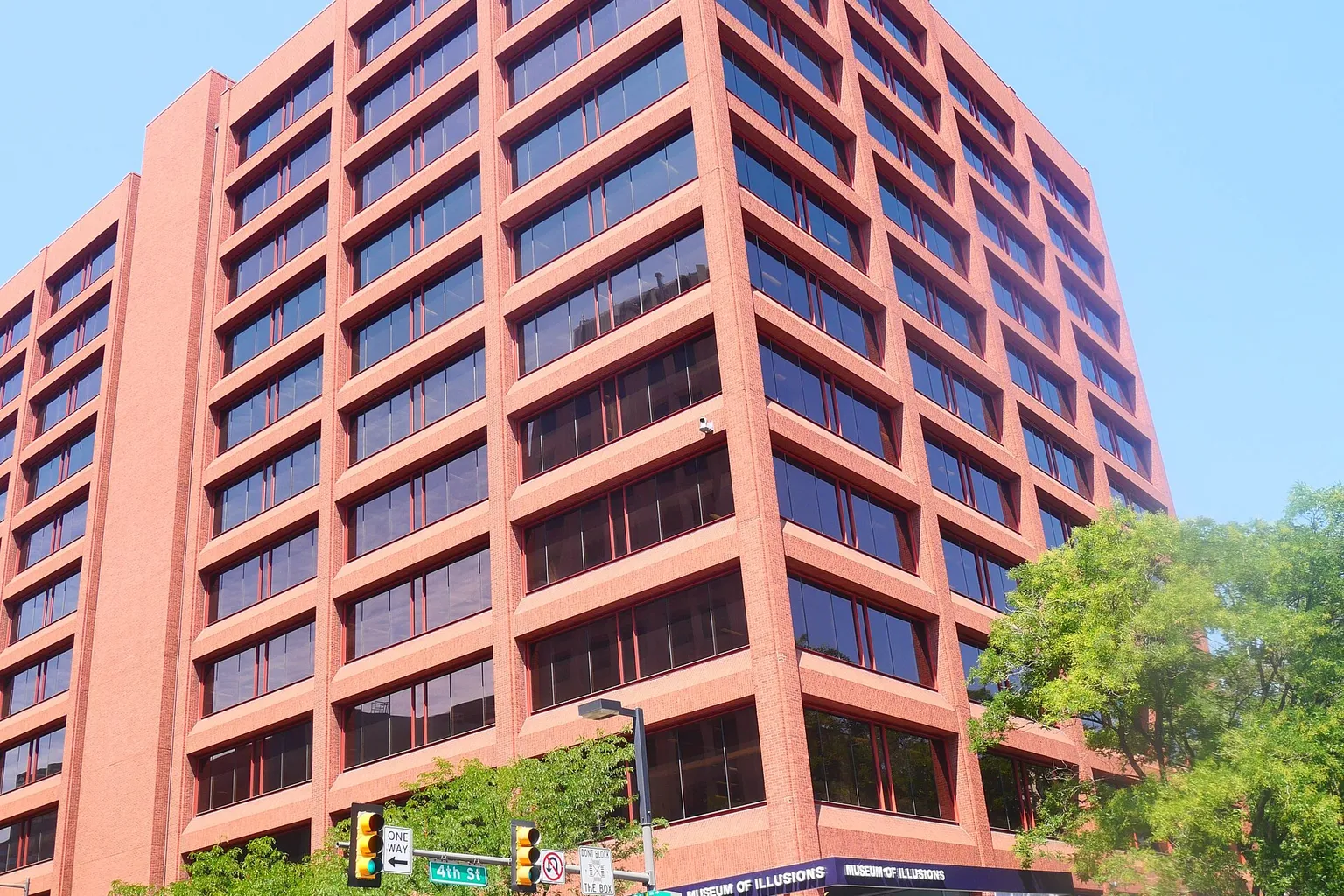
The environmental question is less theatrical but just as useful: how much infrastructure, energy, and transport does it take to create an hour of indoor visual confusion in the middle of Old City?
Tickets and prices
Museum of Illusions
I
Save
Box office and online booking
- Adult USD30.50
- Reduced USD28.50
USD30.50
Official websiteII
Our pick · entry ticket
Entry ticket · Timed entrance
This timed entrance ticket includes admission to optical illusions and rooms.
USD28.76
Check availabilityThe attraction at 401 Market Street occupies a compact urban site and can be reached without a car. That matters. For visitors deciding whether to buy tickets to the Museum of Illusions, the most consequential sustainability choice may happen before entering the building: how they reach Market Street, what else they combine with the visit, and whether they treat a short attraction as a standalone car journey.
The practical details are straightforward. The Museum of Illusions Philadelphia has more than 60 interactive, visual, and educational installations, including holograms, stereograms, a Vortex Tunnel, and a Reverse Room. Most visitors spend about an hour inside, moving through the exhibits at their own pace.
That hour is easy to fit into a wider Philadelphia itinerary. It is also easy to make environmentally inefficient if it produces an unnecessary round trip by private vehicle.
Navigating the Museum of Illusions: ticket options and policies
The Museum of Illusions uses a conventional visitor model: admission grants access to a sequence of interactive rooms and installations, with the experience designed for self-guided exploration. There is no long natural landscape to cross and no complicated trail system to navigate. The central logistical questions are timing, ticket type, and what happens if plans change.
The attraction operates:
- Sunday through Thursday: 10 a.m. to 8 p.m.
- Friday and Saturday: 10 a.m. to 9 p.m.
- Location: 401 Market Street, Philadelphia, Pennsylvania 19106
The later closing time on Friday and Saturday gives visitors more flexibility to place the museum after another Old City activity rather than creating a separate daytime journey. That is a small planning decision, but urban sustainability is usually built from such decisions: fewer duplicated trips, less idling, and more use of routes already being taken.
What to know before you buy tickets
Ticket availability and ticket options can vary, so visitors should check the current booking interface before committing. Timed-entry admission is available, and there may be several tour or entry formats depending on the date and provider.
The most important policy is less pleasant but clear: ticket sales are final and non-refundable. That makes timing more than a minor administrative detail. A ticket bought for a convenient hour is not automatically a flexible reservation if the rest of the day changes.
Before completing a purchase, check:
- The selected date and entry time, especially on Friday and Saturday evenings.
- Whether the ticket is for standard admission or a different timed-entry format.
- The age category attached to each visitor.
- The cancellation and refund conditions.
- Whether every member of the group has been included in the booking.
- The estimated arrival time in relation to public transport or other reservations.
The attraction’s relatively short average visit makes it possible to build a measured itinerary around the booking rather than rushing through the exhibits. It also means that a visitor travelling across the city solely for one hour indoors should think about the transport leg. The admission experience may be compact; the associated emissions are not determined by the length of the visit alone.
The greenest ticket is not a special admission tier. It is the ticket folded into a route you were already going to travel.
Inside the exhibits: what an hour at the museum actually offers
The Museum of Illusions Philadelphia is not a conventional collection of framed objects. Its exhibits depend on participation. Visitors walk, stand, look through, enter, photograph, and test their own visual assumptions. The attraction’s more than 60 installations draw on optical illusions, spatial distortion, reflected images, holographic effects, and educational demonstrations of perception.
The physical sequence matters. This is an indoor environment built around controlled confusion: floors that appear to tilt, rooms that alter apparent proportion, corridors that challenge balance, and visual fields that make a fixed object seem to move. The Vortex Tunnel is one of the clearest examples of that approach, using the relationship between a rotating visual environment and a stationary walkway to unsettle the visitor’s sense of stability.
Other installations work through scale and perspective. The Ames Room effect, for example, is commonly used to show how a distorted room can make people appear to change size when they move from one side to another. An Infinity Room relies on repeated reflections to extend a limited physical space into an apparently endless one. These experiences are not simply photo backdrops. Their value comes from revealing how quickly the brain accepts visual information as evidence.
That educational function is worth preserving in the description of the museum. Calling the site only an Instagram attraction misses the material point: visitors encounter demonstrations of perception through their own bodies. The lesson is immediate because the error is physical. A wall seems to shift, a person seems to grow, or a stable floor appears to move, and the visitor has to revise an assumption in real time.
The one-hour question
A typical visit lasts about one hour. That is enough time to explore the self-guided exhibits without turning the museum into an all-day commitment. It is also short enough that crowding and queue management can shape the experience more than stamina does.
A sensible rhythm is:
1. Begin with the orientation and simpler optical installations. These establish the basic relationship between viewpoint, light, and apparent form.
2. Move into the more spatially disorienting rooms. The Vortex Tunnel and perspective-based rooms are more engaging when visitors have not yet hurried through the introductory exhibits.
3. Allow time for photographs without making every installation a photo stop. The camera records the illusion, but it does not always explain it.
4. Pause after the most physically disorienting rooms. A short reset is useful before moving through additional visual effects.
5. Leave room in the schedule for walking or transit delays afterward. The attraction is compact, but Philadelphia travel time is not always predictable.
The museum is therefore best understood as a concentrated urban experience rather than a full-day destination. Visitors who are already in Old City can pair it with nearby cultural or historic stops. That reduces the environmental cost per activity because one arrival supports several purposes.
Sustainable urban access: reaching 401 Market Street responsibly
The Museum of Illusions Philadelphia is located in Old City, a dense central district where the choice between car, public transit, bicycle, and walking is unusually consequential. A private car can move a group directly to the address, but directness is not the same as efficiency. Parking, traffic circulation, and the return journey all form part of the attraction’s footprint.
For many visitors, SEPTA is the practical alternative. Philadelphia’s public transit network connects central neighborhoods and regional arrival points, and the Market-Frankford Line provides a useful route through the city’s east-west spine. The exact best connection depends on the starting point, but the principle is stable: entering the central city by rail or bus usually avoids the space and fuel demands of a single-occupancy vehicle.
Indego offers another option. Philadelphia has more than 250 Indego bike-share stations, giving visitors a flexible way to cover the last part of a journey or connect the museum with other destinations. A bike-share trip can work particularly well when the weather is suitable and the itinerary is not constrained by luggage or formal clothing.
| Travel choice | Practical strength | Environmental trade-off | Best fit |
|---|---|---|---|
| Walking | No transfer, no vehicle waiting, easy to combine with Old City stops | Depends on distance and weather; becomes less practical with luggage | Visitors already staying or exploring nearby |
| SEPTA | Connects central Philadelphia without requiring parking | Emissions depend on vehicle type, route, and passenger load | Visitors arriving from other city neighborhoods |
| Indego bike share | Flexible for short urban connections and last-mile travel | Weather, traffic, and cycling comfort can limit use | Visitors travelling light over manageable distances |
| Private car | Convenient for some groups and mobility needs | Fuel use, congestion, parking, and duplicated trips can raise the footprint | Visitors with accessibility, equipment, or regional constraints |
| Rideshare or taxi | Door-to-door access without parking a personal car | Vehicle still makes a road journey, sometimes without a full passenger load | Visitors needing direct access or travelling in a group |
No single transport option is environmentally correct for every visitor. A family carrying equipment, a visitor with limited mobility, and a solo traveller already near Market Street do not have the same practical choices. Sustainable tourism is not a demand that every person perform the same journey. It is a refusal to treat private-car travel as the automatic default when lower-impact alternatives are workable.
Build the museum into a route, not around it
The strongest planning move is spatial. Look at the entire day rather than only the attraction.
If the museum is the middle stop in an Old City itinerary, the visit can replace a separate cross-city excursion. If it is close to a rail arrival point, walking can complete the route. If a group is already using a vehicle for a longer regional journey, adding several Philadelphia stops may be more efficient than making multiple separate trips.
The distinction is between a destination and a detour. A destination is part of the route you need. A detour is a new transport demand created for a short activity.
For visitors comparing options, Philadelphia’s public transport and bike-share network provides the broader context needed to plan the approach to Market Street. The museum itself cannot determine the emissions of every journey to its doors. The city’s mobility network can make lower-impact choices easier.
The environmental footprint of immersive indoor attractions
The Museum of Illusions does not publish, in the available visitor information, specific figures for energy consumption, carbon emissions, or green-building certification. Those unknowns should remain unknown. It would be careless to label the attraction carbon-neutral or environmentally certified without primary documentation.
Still, the physical sources of impact are visible in the building type and visitor model.
An immersive indoor attraction generally depends on electricity for lighting, display systems, sensors, climate control, and the operation of interactive installations. It also has to maintain a stable interior environment for visitors and equipment. The energy demand is not limited to the moments when a guest triggers an exhibit; ventilation, lighting, and building systems may operate across opening hours and beyond them.
Materials also matter. Rooms built around mirrors, coatings, projection surfaces, plastics, electronics, and mechanical components have different maintenance cycles from a conventional gallery. A damaged interactive installation may require replacement parts rather than a simple cleaning. A display that looks weightless to the visitor still has a supply chain behind it: fabrication, transport, repair, disposal, and eventual refurbishment.
The visitor experience can conceal that infrastructure because the attraction is deliberately focused on perception. The less visible the machinery, the more convincing the illusion. Environmental accounting works in the opposite direction. It has to bring the hidden systems back into view.
What visitors can reasonably conclude
Visitors should not assume that an interactive museum has a lower footprint than an outdoor attraction simply because it occupies a small urban site. Nor should they assume the opposite. The answer depends on building efficiency, energy sources, visitor numbers, maintenance, waste practices, and transport patterns—data not established here.
What can be said with confidence is narrower:
- The venue concentrates many experiences in a central urban location.
- The visit is relatively short, at about one hour for a typical guest.
- The attraction can be reached through Philadelphia’s public transport and bike-share systems.
- A visit combined with nearby activities can avoid a second, separate journey.
- The venue’s ticket sales are final, so avoidable unused admissions are also a planning failure.
- There is no verified basis in the available information for claiming a specific sustainability certification or carbon-neutral status.
That last point is not a criticism disguised as restraint. Environmental reporting is weakened when every attraction is described as green because it is walkable or educational. Location helps. Education helps. Neither replaces emissions data.
A central address lowers the pressure on the city’s streets, but it does not erase the electricity, materials, and maintenance hidden inside an immersive room.
Museum of Illusions tickets versus the wider Philadelphia day
The most useful comparison is not between the museum and another attraction in the abstract. It is between different ways of structuring the same day.
A standalone trip for a one-hour visit creates one set of transport demands. A visit integrated with Old City walking, public transit, and other appointments creates another. The admission product is the same; the itinerary changes its relative impact.
A standalone museum visit
This approach makes sense for visitors with a specific interest in optical illusions or for those who have limited time between other commitments. The short duration is an advantage. It allows the museum to fit into a narrow window without consuming an entire day.
The environmental weakness is transport duplication. If the visitor drives across the city, parks, enters for an hour, and drives back without any other purpose, the journey can dominate the footprint of the visit.
A clustered Old City itinerary
This is the more efficient urban pattern for many travellers. The museum becomes one stop among several, with walking or public transit connecting the day’s activities. The attraction’s one-hour average duration works well here because it does not require the visitor to devote a large block of time to one building.
Clustering also reduces pressure to rush. A museum visit followed by a walk through the district creates a slower sequence than a drive-in, drive-out excursion. It gives the visitor time to recover from the disorienting exhibits and lets the city itself remain part of the experience.
A car-based regional visit
For visitors arriving from outside Philadelphia, the calculation is more complicated. A private vehicle may be necessary because of distance, mobility requirements, or the needs of a larger group. The responsible question is not whether the journey can be made perfectly low-carbon. It is whether the trip can carry several purposes and avoid unnecessary circulation once in the city.
A regional visitor can reduce avoidable mileage by selecting parking once, combining the museum with nearby destinations, and leaving the car stationary while moving through the district on foot. The ecological value is not symbolic. Fewer short vehicle movements mean less fuel use and less demand for urban road space.
How to plan a lower-impact visit
A sustainable visit does not require treating the museum as an ethical test. It requires attention to the ordinary decisions that are easy to overlook.
Check the booking before travelling
Because tickets are final and non-refundable, confirm the date, time, and party size before purchase. A missed slot can produce wasted admission and a replacement journey. The attraction may have availability on the day or the following day through booking platforms, but that does not remove the need to verify the specific time you intend to attend.
Choose the transport mode from your actual starting point
Do not select a transport option based on a generic idea of what a responsible visitor should do. Check the distance, weather, mobility requirements, luggage, and time available. Walking is an excellent option when the route is reasonable. SEPTA is often practical for longer city connections. Indego can solve a short gap when cycling is comfortable and safe.
Reduce idle time and repeated crossings
Central Philadelphia visits become less efficient when the itinerary sends travellers back and forth across the city. Put the museum near the beginning or middle of a route that already passes through Old City. A timed entry is easier to manage when the surrounding route is geographically coherent.
Treat the one-hour duration as a planning advantage
A short average visit does not mean the attraction is disposable. It means the experience can be integrated without requiring a separate full-day transport pattern. Leave enough time for the exhibits, then continue on foot or by public transport rather than returning immediately to a distant base.
Keep the environmental claims proportional
The museum offers interactive and educational exhibits, but available visitor information does not establish its full energy or carbon profile. Visitors can make lower-impact choices around the attraction without declaring the venue itself sustainable. That distinction is worth keeping. It separates practical action from marketing language.
The broader climate question behind a small urban attraction
The Museum of Illusions Philadelphia is not a climate research station, a protected habitat, or a conservation project. Its relevance to environmental responsibility lies elsewhere: in how cities concentrate leisure, how visitors move through dense districts, and how much infrastructure can be hidden behind a short, highly controlled experience.
The same city that supports a visual-effects attraction also contains transit systems, bike-share stations, paved surfaces, historic buildings, drainage networks, and a population negotiating heat, congestion, and limited urban space. Climate impact is rarely produced by one dramatic decision. It accumulates through ordinary patterns: a separate car journey for every short activity, buildings cooled without scrutiny, disposable materials replaced without accounting, and attractions promoted without any public information about their operating footprint.
A visitor cannot solve those structural questions at the ticket counter. But a visitor can avoid adding an unnecessary trip, use the city’s existing mobility network, and refuse to confuse an attractive experience with evidence of sustainability.
The practical answer for most travellers is therefore measured rather than absolute: check the current Museum of Illusions ticket options, respect the final-sale policy, plan around the roughly one-hour visit, and reach 401 Market Street by walking, SEPTA, or bike share when those choices fit the journey. If a car is necessary, make the trip carry more than one purpose and keep the vehicle parked once you arrive.
The museum creates illusions by manipulating the relationship between space and perception. The environmental lesson is the reverse. Look beyond the room. The true footprint of the visit begins on the street, continues through the building’s hidden systems, and ends with the route taken home.
FAQ
How long does it take to visit the Museum of Illusions Philadelphia?
Can I get a refund if my plans change?
What are the operating hours for the museum?
Is the museum accessible by public transport?
Does the museum have a sustainability certification?
Photo: Jim.henderson / CC BY 4.0 — Wikimedia Commons