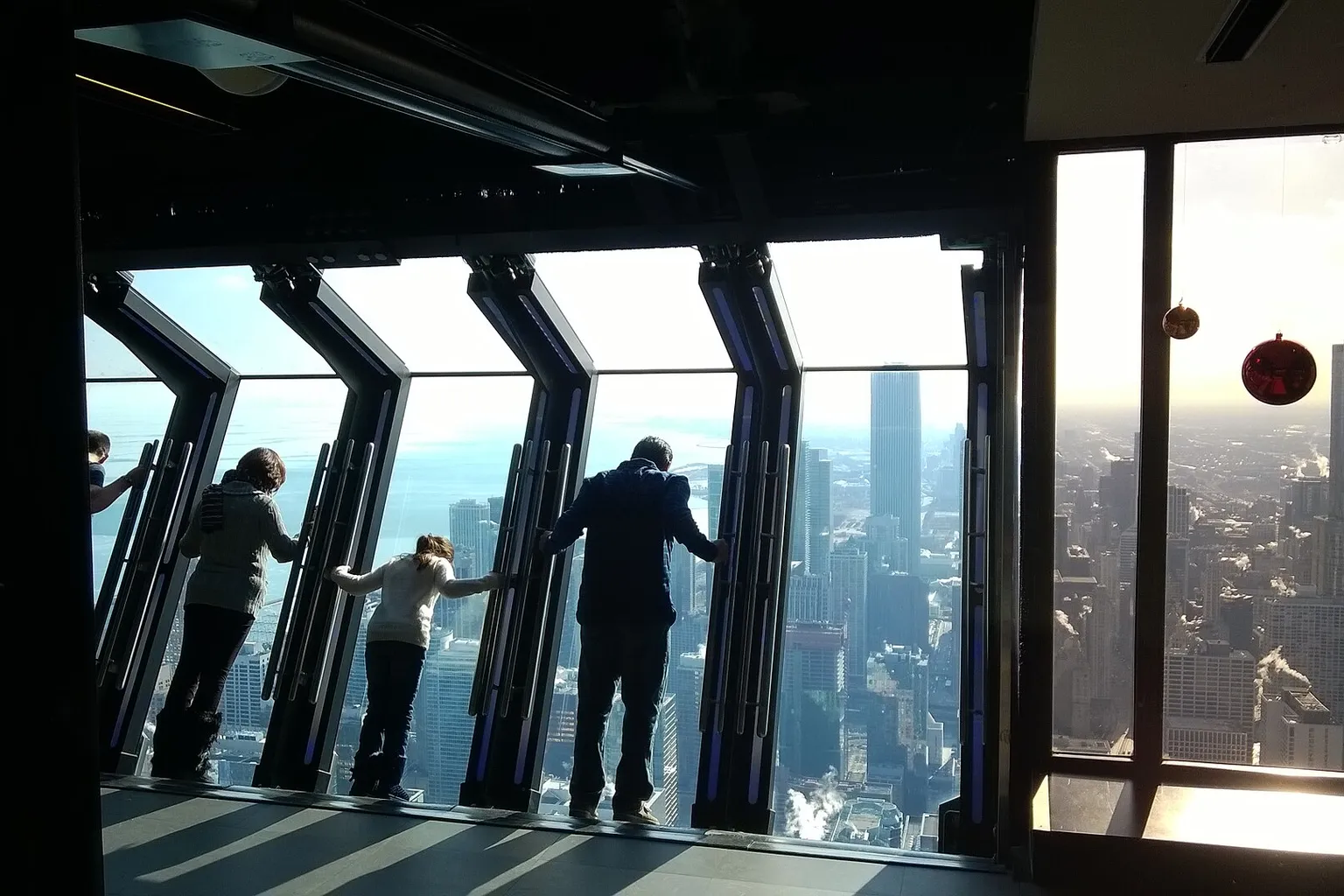
360 CHICAGO occupies part of a 1960s supertall whose structure, envelope, elevators, visitor circulation and mechanical systems were designed for a very different era of urban tourism. The observation deck is now being expanded onto the 95th and 96th floors as new high-performance window installation begins in 2026. For anyone deciding whether to buy tickets 360 CHICAGO, the relevant question is no longer limited to the view from the 94th floor. It is also how the attraction is being adapted inside an existing high-rise, and how much of the environmental case is demonstrated rather than simply promised.
Tickets and prices
360 CHICAGO
I
Save
Box office and online booking
- Adult USD104
USD104
Official websiteII
Our pick · entry ticket
Entry ticket · Skip the ticket purchase desk
Skip the ticket purchase desk to see panoramic lake and skyscraper views 94 stories up.
USD30
Check availabilityIII
entry ticket
Entry ticket · Cocktail hour · 1.5 hours
Enjoy a 1.5-hour cocktail hour experience 1,000 feet up with full 360-degree views.
USD43.84
Check availabilityThe distinction matters. The expansion has a confirmed physical scope, but its eventual energy performance has not been disclosed in a form that allows independent assessment. There are no public figures here for the project's annual energy savings, whole-building electricity use or per-visitor carbon footprint. What can be examined is the engineering logic: reuse of an existing tower, improvement of the glazed envelope, vertical transportation, visitor density and the travel choices made before and after the ticket is scanned.
A building that sways 5 to 8 inches in 60 mph winds is not a tourism amenity with engineering bolted on. It is engineered infrastructure that happens to host tourists.
Engineering the Skyline: The Structural Legacy of 875 N. Michigan
875 North Michigan Avenue was completed in 1969 to designs from Skidmore, Owings & Merrill, with Bruce Graham as lead architect and Fazlur Khan responsible for the structural engineering. Its exterior X-braced steel system is the feature most relevant to the visitor experience. By moving much of the structural expression to the façade, the design reduced the need for interior support columns across the office and residential floors.
That arrangement helps explain why a large observation experience can operate within the tower without turning the visitor level into a forest of columns. It also creates the architectural conditions for broad sightlines, flexible interior layouts and the dramatic relationship between the deck and the city outside. Those are visible benefits. The environmental conclusions are more conditional.
A structural system that uses material efficiently may have advantages over a less rational alternative, particularly when considered over the life of a building. But the existence of an exterior bracing system does not, by itself, provide a verified calculation of embodied carbon. That would require a defined comparison, a complete materials inventory, assumptions about construction and maintenance, and a life-cycle assessment. None of those performance figures are supplied here. The careful conclusion is therefore narrower: the tower's original structure is being reused rather than replaced, and that reuse avoids the need for a new standalone observation building.
That distinction is easy to lose in sustainability marketing. Reusing a high-rise frame can be an important environmental choice, but it is not the same as proving that every later intervention has a lower carbon impact than every possible alternative. A credible account should separate what is physically happening from what would need to be measured.
The tower is documented as reaching a pinnacle height of about 1,500 feet, including antennas, across 100 stories. It is also documented to move between 5 and 8 inches in 60 mph winds and to withstand wind speeds up to 132 mph. These figures describe the demanding conditions under which the building operates. They help explain why changes to the façade, visitor areas and mechanical systems cannot be treated like a routine interior refurbishment.
For 360 CHICAGO, the structural legacy is therefore both an asset and a constraint. The building provides height, views and a robust existing frame. At the same time, any new visitor experience has to work within the geometry, movement, loading, safety and servicing requirements of a mature supertall. The sustainability story begins with that reality, not with a claim that the tower is automatically efficient because it is tall.
Vertical Efficiency: How High-Speed Transit Impacts Carbon Footprints
The elevators serving the observation experience move visitors through a substantial vertical distance, reaching the upper floors in under a minute at speeds reported at around 22 miles per hour. That speed is part of the attraction's operating model: it allows the deck to handle visitors without turning the journey to the top into the main event.
It is also tempting to convert that fact directly into a carbon calculation. That would be premature. Elevator energy use depends on several variables, including the mass of the car and passengers, counterweight arrangements, acceleration and braking, control systems, regenerative equipment, standby demand and the number of trips made under different loading conditions. The building's published visitor information does not provide the data needed to isolate the elevator system's energy use or assign it accurately to each guest.
The basic engineering principle is still useful. Vertical transport requires energy, and the amount cannot be inferred from speed alone. A faster ride is not automatically a more energy-intensive ride per passenger, just as a full car is not automatically efficient in every operating condition. The result depends on the equipment and on how the system is scheduled and used.
Visitor behaviour affects that picture indirectly. Timed admissions, concentrated arrival windows and bundled experiences may help an operator coordinate capacity and reduce unnecessary movement through the attraction. They could also create different traffic patterns at busy and quiet times. But without operating data, it is not possible to say that one ticket format produces a particular electricity saving, or that a bundle has a lower measured carbon footprint than a separate purchase.
This is where the distinction between a plausible mechanism and a demonstrated result becomes important. The mechanism is straightforward: a visitor who completes several experiences during one visit may avoid having to return later, and a well-managed attraction may be able to use its vertical transport system more effectively when demand is organized. The measured effect, if any, would need to be established by the operator through elevator logs, occupancy data and energy monitoring.
The elevator is part of the environmental equation, but the public record does not yet provide the equation's answer.
For visitors, the practical implication is not to treat a ticket bundle as a certified climate product. It is to understand what the purchase includes and avoid unnecessary repeat visits when the same activities can reasonably be completed in one trip. That is a sensible travel decision, even when the resulting energy difference cannot be quantified.
The same caution applies to claims about the building's overall operating efficiency. A high-speed elevator, a compact urban site and a concentrated visitor flow may all support a comparatively efficient tourism model. None of them proves the attraction's actual per-visitor kWh figure. That number would require transparent boundaries: whether it includes only the observation deck or shared building services, whether it includes heating and cooling, and how visitor-related electricity is separated from the rest of the tower.
The 2026 Expansion: Integrating High-Performance Glass for Energy Savings
The most significant confirmed change in the deck's recent development is the 2026 expansion onto the 95th and 96th floors, alongside the installation of new high-performance windows. The project is therefore about more than adding another viewing area. It involves adapting upper levels and replacing part of the building envelope in a location exposed to wind, cold weather and strong solar conditions.
Glazing is a particularly sensitive part of an observation deck. Visitors expect uninterrupted views, so large areas of glass are not an optional decorative feature. At the same time, windows influence heat transfer, solar gain, glare, condensation risk and the amount of work required from heating and cooling systems. High-performance glazing can be designed to improve some or all of those conditions, depending on the glass composition, coatings, framing, installation quality and relationship with the existing façade.
That is the engineering rationale behind the 2026 work. It is not yet a public measurement of the result.
The available information does not disclose the complete glazing specification, a verified U-value, solar heat-gain coefficient, certification tier, annual energy model or post-installation monitoring. There is also no disclosed figure showing how much electricity or fuel the project is expected to save. Visitors researching 360 CHICAGO observation deck sustainability should therefore treat the replacement as a potentially meaningful envelope upgrade, not as proof of a quantified reduction in operational emissions.
The confirmed scope is still significant. The observation experience is being extended beyond the existing 94th-floor footprint, using additional levels within the same tower. That approach preserves the central advantage of adaptive reuse: the project works with an existing high-rise rather than requiring a new tower or a separate low-rise attraction to be built elsewhere. It also allows the operator to improve the visitor offer while addressing part of the envelope at the same time.
What should not be claimed is that the expansion automatically adds usable area without any structural consequences, or that it makes the tower more efficient by definition. Any upper-floor conversion involves design, construction, fire and life-safety requirements, vertical circulation, mechanical coordination and ongoing maintenance. The public scope confirms the floors involved and the glazing work; it does not provide a complete account of every technical intervention.
That gap is not a reason to dismiss the project. It is a reason to describe it accurately. The direction is credible because façade performance matters in a glazed observation space and because reuse is generally different from constructing a new attraction from scratch. The outcome remains unverified until energy and indoor-environment data are published.
Navigating Ticket Tiers: From General Admission to TILT Experiences
The ticket structure at 360 CHICAGO is layered rather than flat. General admission covers the core observation-deck visit, with views over Lake Michigan, the Chicago skyline and the surrounding city. Additional products can add experiences such as TILT or combine admission with food and drink options, including packages marketed around Sip, TILT & View.
That distinction matters because TILT is not simply an automatic feature of every admission ticket. Visitors who want to use it should check whether the selected product includes the ride or whether an upgrade is required. The same principle applies to bundled bar experiences: the wording of the package matters more than the general impression that everything at the top of the building is included.
CloudBar should also be understood on its own terms. It is primarily a bar with elevated snacks rather than a conventional full-service restaurant. That makes it a useful part of a visit for people who want a drink, a small bite and more time at the deck, but it may not replace a planned meal elsewhere in the Magnificent Mile area.
From a sustainability perspective, the ticket tier is best viewed as a visit-planning tool, not an energy label. A visitor who combines several activities into one scheduled visit may avoid making a second journey to the attraction. The operator may also be able to coordinate capacity more effectively when demand is organized through timed or bundled admission. Both are reasonable possibilities. Neither has been published as a measured reduction in elevator electricity or visitor carbon emissions.
The difference between a possible operational benefit and a verified one is especially important here. A bundled ticket does not physically change the elevator's motor, counterweight or control system. It may change how a visitor uses the attraction, but the effect depends on whether the guest would otherwise return, whether the extra experience changes time spent inside, how full the elevator is and how the attraction manages its flows. There is no disclosed per-visitor kWh comparison between general admission, TILT upgrades and combined packages.
| Product element | General admission | Bundle such as Sip, TILT & View |
|---|---|---|
| Observation-deck access | Included for the covered visit | Included for the covered visit |
| TILT | May require a separate upgrade or eligible ticket | Included when specified by the package |
| Bar or refreshment component | Depends on the selected product | Included when specified by the package |
| Planning advantage | Suits a visitor focused on the core deck | Suits a visitor combining several experiences |
| Sustainability interpretation | No published per-visitor energy figure | No published proof of lower energy use; may reduce the need for a separate visit |
The table is deliberately modest. It describes the purchasing distinction without turning it into a performance claim. Prices and availability can change by date, channel and package, so the live booking information remains the appropriate place to confirm what is included before purchase.
For someone deciding whether to buy tickets 360 CHICAGO, the most useful question is not which package sounds greenest. It is which package reflects the visit they actually intend to make. Buying an add-on that will not be used creates waste of a different kind, while choosing a suitable combination in advance can make the day simpler and reduce the chance of an unnecessary return trip.
Sustainable Tourism in the Magnificent Mile Corridor
The location gives 360 CHICAGO a sustainability argument that is broader than the building envelope. The attraction sits in a dense central district with hotels, restaurants, shops, offices and public transport within the same urban area. Visitors can combine the deck with other activities rather than travelling to a separate, purpose-built destination outside the city.
That does not make the attraction impact-free. A tall building still requires energy for lighting, climate control, elevators, water systems, cleaning, maintenance and the operation of visitor amenities. The observation deck also depends on a structure whose environmental performance is shared with other uses in the tower. Allocating those impacts to individual tourists is not straightforward.
The urban setting nevertheless changes the comparison. A visitor who reaches the Magnificent Mile by rail, bus, walking or a shared trip may avoid some of the additional vehicle emissions associated with driving alone to a dispersed attraction. The CTA Red Line station at Chicago/State is within walking distance, making public transport a practical option for many itineraries. The exact carbon saving depends on the visitor's origin, the mode displaced, occupancy and the rest of the journey, so it should not be presented as one universal number.
This is why the phrase 360 chicago visitor carbon footprint needs a defined boundary. Does it include the journey to the tower? The electricity used inside the deck? Food and drink? Retail purchases? The embodied impact of the 2026 construction work? Without those boundaries, a single footprint figure can create more confidence than clarity.
A more useful visitor-level framework has three parts:
1. Choose the arrival mode deliberately. Public transport, walking and shared travel can be more appropriate than a single-occupancy car for a central Chicago attraction, particularly when the rest of the day's itinerary is also downtown.
2. Match the ticket to the actual plan. If TILT, the observation deck and a bar stop are all part of the intended visit, a suitable bundle may reduce the likelihood of a second booking or a separate return journey. That is a planning benefit, not a verified electricity saving.
3. Treat sustainability claims according to their evidence. The 2026 glazing and floor expansion are concrete developments. Their eventual effect on energy use remains unknown until performance data, specifications and monitoring results are made public.
The building's age is not a disqualification. In fact, the continued use of a landmark tower can be more constructive than treating older structures as disposable whenever a newer attraction is imagined. But reuse should not be used as a substitute for measurement. A sustainable urban tourism claim is strongest when it identifies the existing asset being preserved, the intervention being made and the results that can actually be checked.
Direction is not the same as measured performance. The expansion is credible engineering; the audited metrics are not yet public.
The honest position is therefore balanced. 360 CHICAGO operates in a structurally distinctive building, benefits from a dense urban location and is undertaking a confirmed expansion that includes high-performance window installation. Those facts support a plausible sustainability case. They do not establish the attraction's total energy efficiency, elevator consumption or per-visitor carbon footprint.
For visitors, the practical choices remain clear even without a perfect dataset: arrive by a lower-impact mode where possible, avoid buying experiences that will not be used, and plan several activities into one visit when that genuinely fits the itinerary. The building is being adapted within the constraints of a 1969 supertall. The next step in the environmental story is not another broad claim about efficiency, but the publication of the measurements that would show what the adaptation achieved.
FAQ
What is the environmental impact of the 2026 expansion at 360 CHICAGO?
Does buying a bundled ticket reduce my carbon footprint?
Is the 360 CHICAGO tower energy-efficient because it is a tall building?
How can I reach 360 CHICAGO using public transport?
Does the ticket price include access to TILT and the bar?
Photo: GualdimG / CC BY-SA 4.0 — Wikimedia Commons