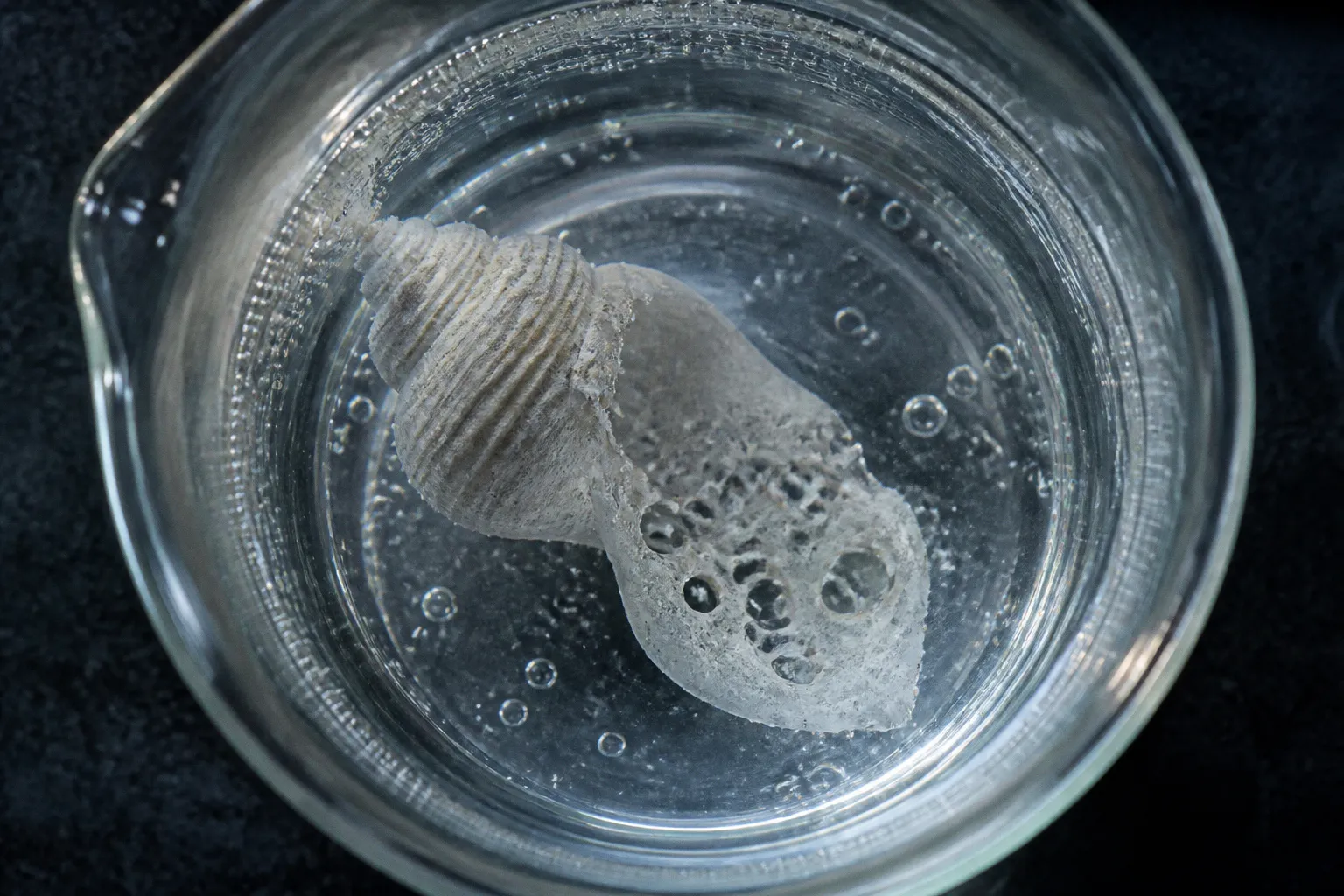
Since the Industrial Revolution, the average pH of the global surface ocean has fallen from about 8.2 to around 8.1.
A change of 0.1 may look modest on a page. It is not modest in the water. Because pH follows a logarithmic scale, this decline represents an increase of approximately 25% to 30% in hydrogen ion concentration, commonly described as a comparable rise in acidity. The ocean remains slightly alkaline; it has not become an acidic liquid. But it is becoming less alkaline, and that shift reaches into the chemistry of shells, skeletons, food webs and coastal livelihoods.
The ocean acidification chemical process begins with an ordinary atmospheric molecule meeting seawater. From there, a chain of reactions changes which building materials are available to marine life.
The molecular pathway: from atmospheric CO₂ to carbonic acid
Carbon dioxide is constantly exchanged between the atmosphere and the ocean. Gas moves into the surface water, particularly where winds and waves create contact between air and sea. Some of that CO₂ returns to the atmosphere, while some dissolves and joins the seawater chemistry.
Once dissolved, carbon dioxide reacts with water molecules to form carbonic acid:
CO₂ + H₂O ↔ H₂CO₃
Carbonic acid is a weak acid, and much of it quickly dissociates. It separates into bicarbonate ions and hydrogen ions:
H₂CO₃ ↔ H⁺ + HCO₃⁻
The free hydrogen ions are the part that lowers pH. The more hydrogen ions present, the more acidic—or, more precisely for seawater, the less basic—the solution becomes.
That first reaction is only one part of a larger chemical system. Seawater contains several forms of inorganic carbon, and they shift back and forth according to temperature, pressure, salinity and the amount of dissolved CO₂. The main forms are:
- dissolved carbon dioxide and carbonic acid;
- bicarbonate ions;
- carbonate ions.
Under normal ocean conditions, bicarbonate is the most abundant of these forms. Carbonate ions are less plentiful, but they are disproportionately important because many organisms use them to build calcium carbonate structures.
The key point is easy to miss: extra CO₂ does not simply add a little acid to the ocean as if someone had poured vinegar into a glass. It rearranges an existing chemical balance. The water takes up more carbon dioxide, more carbonic acid forms, and more hydrogen ions become available to react with other dissolved compounds.
The hydrogen ions then bind with carbonate ions:
H⁺ + CO₃²⁻ ↔ HCO₃⁻
This reaction leaves fewer free carbonate ions in the water. The carbon has not disappeared. It has moved into another form, and that change matters because organisms cannot use bicarbonate and carbonate interchangeably when they are trying to construct a shell or skeleton.
Ocean acidification is not the ocean turning acidic; it is the ocean losing some of the carbonate chemistry that marine life has built around.
The logarithmic reality of a 0.1 pH unit decline
The pH scale is logarithmic rather than linear. A one-unit movement represents a tenfold change in hydrogen ion concentration. That means a 0.1-unit shift is not one-tenth of a chemical event in the everyday sense.
Global surface ocean pH has declined from approximately 8.2 before the 1700s to about 8.1 today. The numerical difference is 0.1, but the associated rise in hydrogen ion concentration is roughly 30%. Depending on the way the comparison is calculated and the conditions being measured, the increase is often expressed as approximately 25% to 30%.
This is why the phrase a small pH change can be misleading. It makes the change sound like a minor adjustment on a ruler, when pH is more like a scale that compresses large chemical differences into compact numbers.
| Change in surface seawater | What it means |
|---|---|
| pH around 8.2 before large-scale industrial emissions | A representative pre-industrial baseline for global surface ocean conditions |
| pH around 8.1 today | Seawater remains alkaline but contains more hydrogen ions than before |
| A decline of 0.1 pH unit | Approximately 25% to 30% higher hydrogen ion concentration |
| Up to 0.3–0.4 additional pH units by 2100 under high-emission scenarios | A substantially larger change in carbonate chemistry, with consequences varying by region and species |
The scale also explains why scientists pay attention to the direction of change, not only to whether water has crossed the familiar pH 7 boundary. Ocean water at about pH 8.1 is still basic. Yet marine organisms evolved and adapted within particular ranges of temperature, carbonate availability and acidity. A shift in those conditions can make familiar biological tasks more energetically expensive long before seawater becomes chemically acidic in the everyday sense.
There is another practical complication: ocean pH is not identical everywhere. Surface waters change with photosynthesis, respiration, freshwater input, temperature and local circulation. Coastal waters can experience especially sharp fluctuations as algae grow, die and decompose. Upwelling can also bring deeper water, naturally richer in dissolved CO₂, toward the surface. The global average gives us the direction of travel, but it does not describe every shoreline or every season.
Carbonate ion depletion and the challenge for calcifying organisms
Many marine organisms build shells, plates or internal structures from calcium carbonate, often in the mineral forms aragonite or calcite. The construction process requires calcium ions and carbonate ions to combine:
Ca²⁺ + CO₃²⁻ ↔ CaCO₃
The calcium is generally abundant in seawater. The more immediate chemical difficulty is the declining supply of free carbonate ions. As additional hydrogen ions bind with carbonate, the water contains more bicarbonate and less carbonate available for calcification.
This affects organisms that rely on marine calcification, including many molluscs, corals, sea urchins and some planktonic species. A larval shell, a coral skeleton and a small protective plate on a drifting organism may look worlds apart, but each depends on the surrounding water providing the right ingredients at the right chemical balance.
When carbonate ions become less available, an organism may need to spend more energy maintaining or producing its calcium carbonate structure. The exact biological response differs by species, life stage and location. Some organisms show changes in shell formation or growth; others may be more resilient, especially where local conditions regularly expose them to variable chemistry. It would be a mistake to reduce the story to a single universal threshold.
What we can say with confidence is that the chemistry becomes less favourable for calcification as carbonate ions are drawn into bicarbonate. The challenge is not only whether a shell can form at all. It may also involve the energy required to form it, the rate at which it grows, and how easily it dissolves when the surrounding water becomes undersaturated with respect to the relevant calcium carbonate mineral.
Coral reefs illustrate the wider significance. Reef-building corals use calcium carbonate to create three-dimensional habitat. That structure shelters fish, invertebrates and algae, and it also shapes coastlines. If the chemistry makes skeletal construction more difficult, the consequences can extend beyond the individual coral to the habitat assembled over generations.
The same principle applies at smaller scales. Tiny marine organisms form part of the base of food webs, and their shells or plates can influence how carbon moves through the ocean. A change in the chemistry of one group does not automatically produce a single predictable outcome for the entire ecosystem, but it can alter the balance between growth, maintenance, predation and decomposition.
Why bicarbonate is not a simple substitute
It may seem intuitive that organisms could use bicarbonate instead, since it contains carbon and is abundant in seawater. Biology is not a matter of selecting whichever carbon-containing ion is closest at hand. The organism must control the chemistry inside and around its calcifying space, transport ions, regulate pH and supply energy for the process.
Some species can draw on bicarbonate through their own biochemical machinery. Others are less flexible. There is no universal marine response because calcification is tied to physiology, habitat and evolutionary history.
This is also why laboratory findings need careful interpretation. A species may respond differently to a gradual change than to a sudden exposure. A population living in a naturally variable estuary may have a different tolerance from one in a more chemically stable open-ocean environment. Temperature, oxygen, food supply and pollution can interact with acidification rather than acting as separate pressures in neat compartments.
The ocean as a global carbon sink: the trade-off inside the system
The ocean carbon sink mechanism is one of the planet’s great stabilising processes. By absorbing roughly 30% of human-released atmospheric CO₂, the ocean has taken in a large share of the emissions that would otherwise remain in the air and contribute to warming.
That service is real, and it is easy to describe it as if the ocean were simply storing carbon safely away. In practice, storage has a chemical cost. Carbon dioxide that enters seawater is not inert. It participates in the reactions that produce carbonic acid, release hydrogen ions and reduce carbonate ion availability.
The ocean therefore does two things at once:
1. It removes a portion of atmospheric CO₂, slowing the accumulation of greenhouse gas in the atmosphere.
2. It changes seawater chemistry as that carbon dissolves and moves through the carbonate system.
These are not competing interpretations. They are two sides of the same process.
The ocean’s uptake of carbon has helped moderate atmospheric warming, but it cannot be treated as an unlimited disposal route. The capacity of the surface ocean to absorb CO₂ depends on physical circulation, temperature and the chemistry of seawater. Carbon is also transported into deeper layers over time, where it can remain for long periods, but the full long-term behaviour of deep-ocean buffering systems over centuries remains difficult to predict, particularly under non-linear changes.
A warmer ocean generally holds less dissolved gas than a colder one, adding another layer of complexity. Circulation then redistributes heat, carbon and alkalinity, creating regional differences. Some areas may experience conditions that are more corrosive to calcium carbonate than the global surface average suggests, while others may be buffered by geology, freshwater chemistry or local mixing.
This is why a single global pH number is useful but incomplete. It tells us that the ocean carbonate system has shifted. It does not tell a shellfish farmer, coral reef manager or coastal community exactly what the water will do tomorrow morning. For that, measurements must be local and continuous enough to capture seasonal and daily movement.
How carbon dioxide changes ocean pH in the real world
The chemical pathway is global, but its effects are felt in very particular places. A bay can receive nutrient-rich runoff, support a burst of plant growth and then lose oxygen when that organic matter decomposes. Respiration adds CO₂ back to the water, lowering pH locally. Upwelling can bring deep water with naturally elevated CO₂ toward a productive coastal zone. River water can alter alkalinity and dilute seawater.
These local processes do not replace atmospheric CO₂ as the primary global driver of ocean acidification. They can, however, intensify or mask the long-term trend in a particular place.
For people working with marine systems, the most useful questions are often practical rather than dramatic:
- Is the measured change seasonal, daily or part of a longer trend?
- Is the water being influenced by upwelling, freshwater or biological activity?
- Which carbonate mineral does a local organism use?
- Are temperature and oxygen changing at the same time?
- Does the population include life stages that are more sensitive than adults?
- Is the local water already close to a threshold that makes shell or skeleton formation difficult?
The answers help separate the broad global signal from the local conditions that determine exposure. They also show why adaptation cannot be reduced to moving an organism into a different bucket labelled tolerant or vulnerable. The same species may cope well in one setting and struggle in another because the surrounding chemistry, food supply and temperature are different.
For consumers, this may sound distant from an ordinary meal or a shell on a beach. It is not. Marine food systems depend on organisms that grow within this chemistry, and coastal economies depend on habitats whose structure is partly made of calcium carbonate. The connection is not a straight line from a single molecule to a single price or product. It is a woven chain, and the first thread is the water itself.
What high-emission projections reveal about the direction of travel
Climate models and ocean chemistry projections commonly examine conditions through 2100 under different emissions pathways. Under high-emission scenarios, global surface ocean pH could decline by an additional 0.3 to 0.4 units compared with pre-industrial conditions.
That figure should not be read as a precise forecast for every part of the ocean. It is a projection of broad chemical change under a specified emissions future. Regional outcomes will depend on circulation, temperature, biological activity, alkalinity and the distribution of carbon between the surface and deep ocean.
Still, the direction is clear. More atmospheric CO₂ means more dissolved CO₂. More dissolved CO₂ means greater movement through the carbonic acid and bicarbonate reactions. More hydrogen ions mean fewer free carbonate ions. The chain is not mysterious, even though its biological consequences can be complex.
The chemistry also gives climate policy a useful point of connection. Cutting emissions does not instantly restore the ocean to its pre-industrial condition, because the ocean circulates slowly and the carbon already in the system does not vanish on demand. But reducing the amount of new CO₂ entering the atmosphere changes the trajectory. It limits how far the chemical shift proceeds and reduces the pressure added to marine systems already dealing with warming, deoxygenation, habitat loss and pollution.
That is the systemic takeaway: ocean acidification is not a separate marine problem waiting for a specialised marine solution. It is one of the places where the carbon cycle records our emissions. The remedy begins upstream, with the pace and scale of greenhouse gas release, while local monitoring, habitat protection and careful management can help communities respond to the chemistry already moving through their waters.
The ocean’s carbon sink is doing climate work for us, but the bill arrives in carbonate chemistry.
The chemistry we can still change
The ocean acidification chemical process is a sequence of ordinary reactions with planetary consequences. Atmospheric CO₂ dissolves into seawater, forms carbonic acid, releases hydrogen ions and shifts carbonate ions toward bicarbonate. The water remains alkaline, but its chemical balance moves away from the conditions that made calcification easier for many organisms.
A 0.1 pH-unit fall is therefore not a trivial decimal. It is a roughly 25% to 30% rise in hydrogen ion concentration across the global surface ocean, measured against the pre-industrial baseline. The figure gives us a way to understand scale, but the living consequences will be shaped by place, species and the other pressures arriving alongside acidification.
We do not need to pretend that every shell, reef or fishery will respond in the same way. Nor do we need to treat the ocean as a passive victim with no capacity to adapt. A clearer view is more useful: the ocean is absorbing carbon, buffering atmospheric change and, at the same time, carrying a chemical burden produced by that absorption.
If we want to keep more marine carbonate available for shells and skeletons, the most direct lever is the one that begins the chain. Reclaiming carbon from the atmosphere is not a household sorting exercise; it means reducing fossil carbon emissions at the systems level. The ocean will continue to move carbon through its chemistry, but the amount we add determines how hard that chemistry has to work—and how much of the marine fabric must adjust around it.