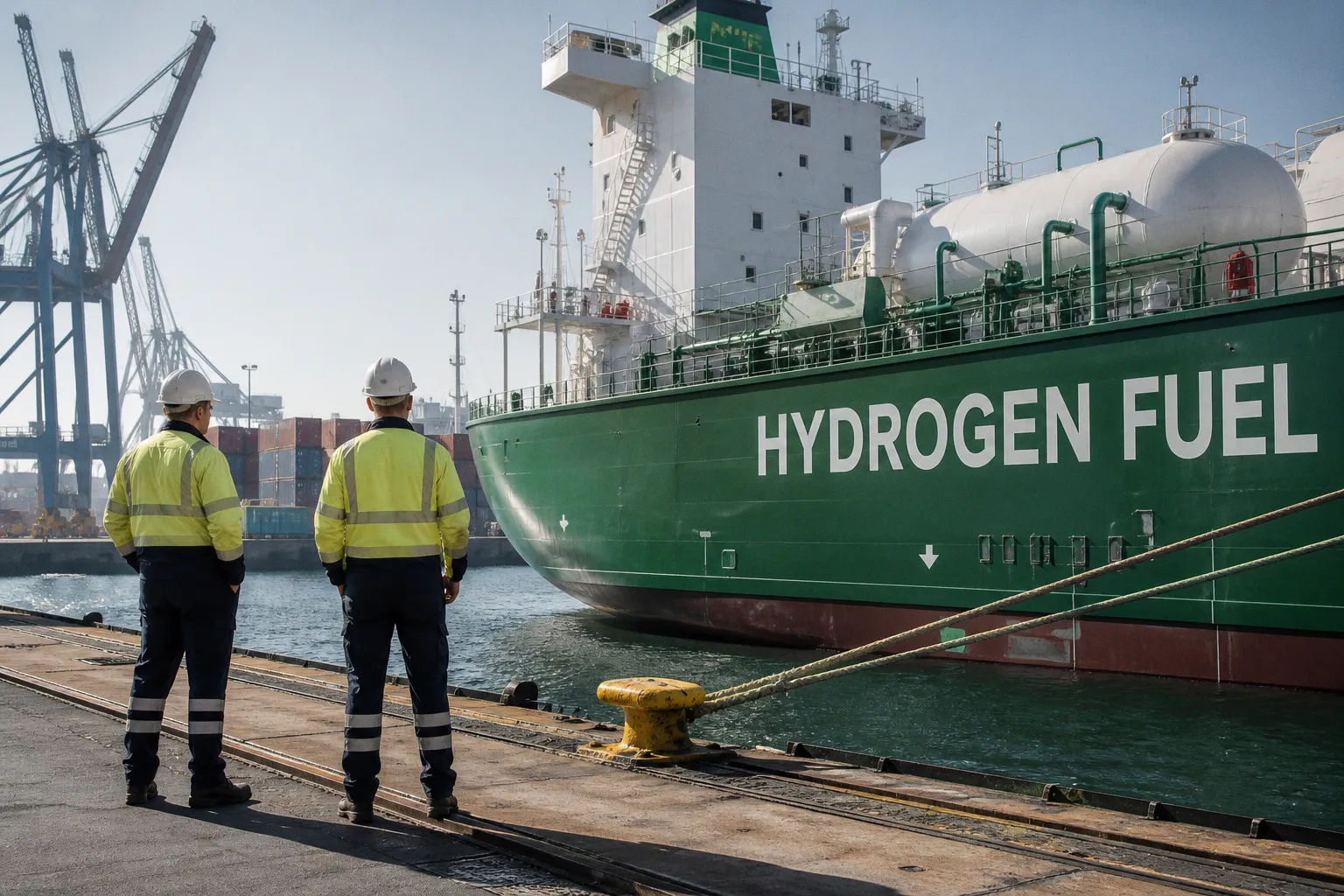
According to a peer-reviewed Nature Communications study led by Professor Steve Hung-Lam Yim at Nanyang Technological University's Asian School of the Environment, replacing heavy fuel oil with green hydrogen across the global merchant fleet could avert 129,458 premature deaths and deliver US$284 billion in annual health benefits, driven by reductions in PM2.5 and ozone precursors. Shipping has long been treated as a peripheral climate file. The model says otherwise.
The engineering math
The study models three scenarios, but the headline figure rests on a single substitution: marine bunker fuel out, electrolytic hydrogen in. Health gains scale directly with reductions in PM2.5 and ozone precursors. The $284 billion figure reflects externalized mortality and morbidity costs, not new revenue. It is a public balance sheet line, not an investor pitch.
Cost curve and the credibility gap
Recent reporting points to modeling suggesting green hydrogen production costs could fall 68% by 2035. Industry voices remain unconvinced. Electrolyzer capex, renewable baseload allocation, and shipping's tolerance for hydrogen's low volumetric energy density remain unresolved. A 68% cost decline is plausible in a high-renewable, high-utilization scenario. It is not guaranteed where hydrogen competes with direct ship electrification, ammonia fuels, or wind-assisted propulsion on the same hull. Adjacent signals matter here: carbon market mechanisms are being positioned as a financing route for Africa's green economy, and South African grid modeling indicates that a 45 GW wind-and-solar buildout can deliver high renewable penetration, provided firm power covers the winter deficit. Both threads — hydrogen supply chains and renewable build rates — feed directly into port-side bunkering economics.
Commercial viability, soberly
The Yim study's value is forcing a cost column onto a ledger the maritime sector has historically externalized. Whether the substitution actually happens depends on three variables: hydrogen cost per kilogram delivered at the dock, vessel retrofit economics, and regulatory enforcement of fuel sulfur caps. The health dividend is documented. The transition timeline remains the open variable.