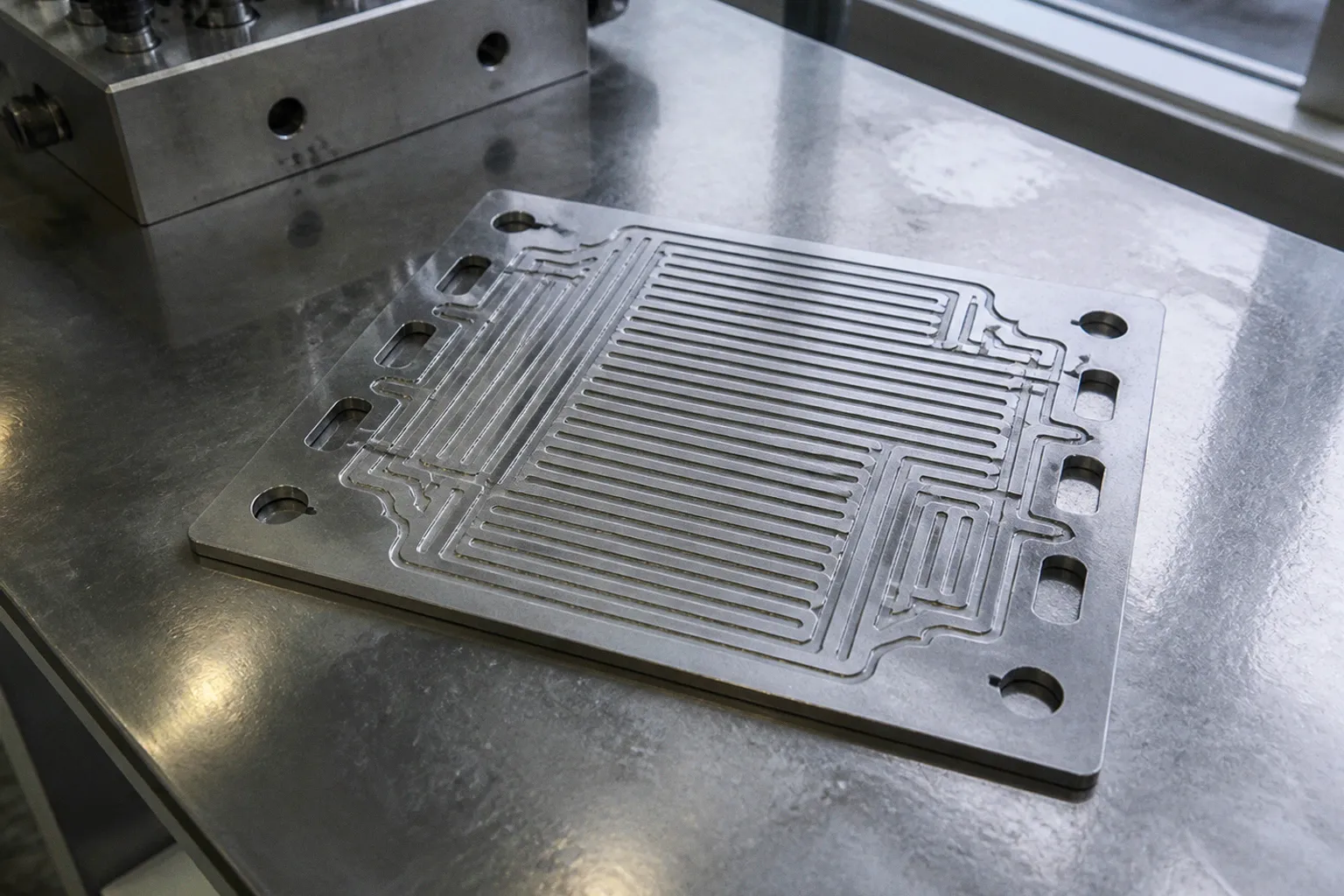
Yet the apparent simplicity of the PEM electrolyzer hides a demanding industrial problem: every kilogram of hydrogen carries a substantial electricity bill, and the stack can never operate below the physical energy required to split water.
That is the starting point for understanding PEM electrolyzer green hydrogen efficiency limits. Commercial proton exchange membrane systems typically consume around 50–55 kWh of electricity for each kilogram of hydrogen, while the thermodynamic minimum is about 33.3 kWh/kg on an LHV basis. The gap is not a sign that the technology has failed. It is the price of moving from a reversible reaction on paper to a working machine with catalysts, membranes, pumps, heat, pressure and real materials that age over time.
Water splitting has a hard floor
A PEM electrolyzer uses electricity to reverse the chemistry of a fuel cell. In a fuel cell, hydrogen and oxygen combine to produce water and electricity. In an electrolyzer, electricity drives water in the opposite direction, producing hydrogen and oxygen.
The overall reaction is:
- water is supplied to the cell;
- hydrogen forms at the cathode;
- oxygen forms at the anode;
- the proton exchange membrane allows hydrogen ions to cross while helping keep the gases separated.
At standard conditions, the reversible voltage for water splitting is about 1.23 volts. This corresponds to the minimum electrical energy associated with the hydrogen’s lower heating value, or LHV: approximately 32.68–33.3 kWh/kg of hydrogen.
There is another figure that often appears in efficiency discussions: 39.4 kWh/kg, based on the higher heating value, or HHV. The distinction matters because LHV and HHV treat the heat contained in the reaction products differently. A calculation that quotes an efficiency without saying whether it uses LHV or HHV is missing part of the story.
The thermoneutral voltage, associated with the HHV basis, is about 1.48 volts. Below that point, external heat would be needed to sustain the reaction in a fully reversible accounting. Above it, the additional electrical energy appears partly as heat inside the system. Commercial cells operate well above both theoretical voltage markers, generally in the range of 1.8–2.2 volts.
That difference is where the practical losses live.
The theoretical minimum is not a target that a machine simply “misses”; it is the lower boundary set by the chemistry itself.
The useful way to read these numbers is not to ask why a commercial electrolyzer cannot reach 33.3 kWh/kg, as if the remaining energy were waste caused by poor engineering. Instead, we should ask which parts of the system consume the extra electricity, how much of that burden belongs to the stack, and how much belongs to the equipment around it.
Why the commercial system needs 50–55 kWh per kilogram
The water-splitting reaction happens at the interface between electrodes, catalysts and membrane. Each component introduces a different resistance to the clean movement of charge and mass.
Activation losses: getting the reaction moving
The electrochemical reactions do not proceed at useful industrial rates merely because the correct materials are present. The electrodes need additional voltage to overcome the activation barrier at their surfaces. Catalysts reduce that barrier, but they do not erase it.
In a PEM electrolyzer, the oxygen evolution reaction at the anode is particularly demanding. It involves several intermediate chemical steps and the transfer of multiple electrons. The hydrogen evolution reaction at the cathode is generally faster, but it still requires an operating voltage above the reversible level when the cell is producing hydrogen at industrial current densities.
Commercial PEM stacks commonly operate at current densities from roughly 0.5 to 2.0 A/cm². These are useful production rates, not laboratory demonstrations under barely loaded conditions. As current density rises, the stack produces more hydrogen from a given footprint, but the electrochemical penalties also become harder to manage.
Ohmic losses: electricity meeting resistance
Electric current has to pass through the membrane, catalyst layers, porous transport layers, bipolar plates and electrical connections. None of these materials is perfectly conductive.
The membrane is designed to conduct protons while restricting the passage of electrons and limiting the mixing of hydrogen and oxygen. That selectivity is essential, but it comes with resistance. The thicker or less hydrated the membrane, the more difficult it can be for protons to cross. The system therefore has to balance conductivity, mechanical strength, gas separation and chemical durability.
The same principle applies to the rest of the stack. Metal plates, coatings, porous layers and contact points all contribute to the electrical path. Even small resistances become significant when a stack carries a large current continuously.
Mass transport losses: moving water, gases and heat
An electrolyzer is not just a set of reaction sites. Water has to reach the catalyst layer, hydrogen and oxygen have to leave it, and heat has to move away from the active area. Gas bubbles can block parts of the electrode surface. Poor water distribution can leave some regions under-supplied while others are overworked.
At higher current densities, these transport effects become more visible. The system must circulate water, control temperature and manage the two product streams without allowing them to mix beyond safe operating limits. Pumps, valves, sensors, cooling equipment and power electronics add their own demand outside the cell stack.
This is why a stack’s direct-current efficiency and the total system’s alternating-current efficiency are not interchangeable. A stack may appear efficient when measured alone, while the complete installation consumes more once water treatment, circulation, controls and auxiliary equipment are included.
The practical efficiency range
Taken together, activation overpotentials, ohmic resistance and mass transport limitations explain why commercial PEM electrolyzers generally consume 50–55 kWh/kg of hydrogen, corresponding to approximately 65–70% efficiency on an LHV basis.
That range is not a universal constant. It changes with operating pressure, temperature, current density, system design, age, power supply and the boundary used for the calculation. A figure for stack DC consumption should not be presented as though it were the same as total plant AC consumption.
| Energy figure | What it describes | Why it matters |
|---|---|---|
| 33.3 kWh/kg H₂ | Approximate thermodynamic minimum on an LHV basis | The lower electrical boundary for the idealized reaction |
| 39.4 kWh/kg H₂ | Thermodynamic requirement on an HHV basis | Includes the higher heating-value treatment of the reaction energy |
| 50–55 kWh/kg H₂ | Typical commercial PEM system consumption | Reflects electrochemical and balance-of-plant losses |
| 51 kWh/kg H₂ | U.S. DOE 2026 system target | A near-term benchmark for low-temperature PEM systems |
| 46 kWh/kg H₂ | U.S. DOE ultimate system target | A longer-term ambition, equivalent to about 72% LHV efficiency |
The comparison is most useful when the labels stay attached. Switching between LHV and HHV without warning can make an efficiency improvement look larger than it really is.
The PEM electrolysis process, step by step
The phrase “green hydrogen electrolyzer” can make the process sound almost weightless: renewable electricity goes in, clean hydrogen comes out. Inside the equipment, the route is more physical and more exact.
1. Water is prepared before it reaches the stack
PEM systems require highly purified water. Minerals and ions that are harmless in a glass or a cooling loop can interfere with the membrane and catalysts, increase conductivity where it is not wanted, and contribute to contamination or degradation.
The water-treatment system therefore sits upstream of the electrochemical stack. It is part of the production chain, not a minor accessory. For every kilogram of hydrogen generated, the reaction itself consumes exactly 9 kilograms of water and produces 8 kilograms of oxygen.
The stoichiometric requirement is straightforward, but a working plant may need additional water for flushing, treatment losses, cooling and operational management. The exact total depends on system design and site conditions. What matters is that the hydrogen molecule is not created from electricity alone: it is reclaimed from a carefully controlled water stream.
2. The anode makes oxygen
At the anode, water molecules give up electrons and form oxygen, protons and heat. The oxygen stream is a genuine co-product, although its commercial value depends on purity, local demand, storage and transport.
This side of the cell places significant demands on catalyst durability. The anode operates in an acidic, oxidizing environment, which narrows the range of materials that can remain stable over long periods. The choice of catalysts and protective components therefore affects not only today’s energy consumption but also how the stack behaves after years of cycling.
3. Protons cross the membrane
The proton exchange membrane performs several jobs at once. It allows positively charged hydrogen ions to pass from the anode to the cathode, while helping prevent electrons from crossing through the membrane and limiting direct mixing of the product gases.
The membrane must remain hydrated enough to conduct protons, but it must also withstand pressure differences, chemical attack and repeated changes in load. That combination is one reason PEM electrolysis is an engineering problem rather than a single-material breakthrough waiting on a shelf.
4. The cathode forms hydrogen
At the cathode, protons receive electrons and become hydrogen gas. PEM electrolyzers can produce hydrogen with purity up to 99.999%, or Grade 5.0, and can deliver it at approximately 20–80 bar directly from the cell stack, reducing the need for external compression in some applications.
Pressure is useful because hydrogen is difficult to store compactly. Producing it at elevated pressure can simplify downstream equipment, but it also increases the mechanical and electrochemical demands on the stack. As with efficiency, the benefit has to be considered alongside the energy and materials required to obtain it.
5. The plant conditions and routes the products
The stack is only the centre of the installation. The complete plant must separate, dry, monitor and route hydrogen and oxygen. It must manage water quality, heat, pressure and electrical input, while keeping the two gases within controlled operating limits.
That broader system boundary is where many simplified comparisons lose their footing. When we ask how efficient a PEM electrolyzer is, we should first define whether we mean:
- the electrochemical stack under direct-current conditions;
- the complete electrolyzer system using alternating-current electricity;
- the hydrogen output at a particular pressure and purity;
- or the full pathway from renewable electricity to stored or delivered hydrogen.
Each answer can be technically correct and still describe a different slice of the lifecycle.
Why renewable electricity changes the question, not the physics
PEM electrolysis is often paired with wind and solar power because the technology can respond comparatively quickly to changing electrical input. That flexibility is valuable in a grid with a growing share of variable renewable generation, particularly when electricity would otherwise be curtailed or when hydrogen production can follow periods of abundant low-carbon power.
But renewable electricity does not make the thermodynamic minimum disappear. A PEM electrolyzer still needs at least around 33.3 kWh of electrical energy per kilogram of hydrogen on an LHV basis, and commercial systems still consume considerably more.
The carbon outcome therefore depends on the electricity supplying the machine. Hydrogen produced with renewable electricity can be a low-emissions fuel, but the label “electrolytic” alone does not tell us whether the input power was clean, fossil-heavy, dedicated, contracted or drawn from a mixed grid. Energy transition projects have to connect the electrolyzer to the wider power system rather than treating the stack as an isolated green box.
This is also why the timing of operation matters. An electrolyzer running on a low-carbon grid at a modest capacity factor may have a different emissions profile and cost structure from one running more continuously on electricity with a higher fossil share. The chemistry is the same; the surrounding energy system is not.
Green hydrogen is only as clean as the electricity that reaches the stack, and only as practical as the system that carries the hydrogen away.
The hidden cost of running harder
Higher current density allows a PEM stack to make more hydrogen from a smaller physical footprint. That can reduce the amount of equipment, building space and material needed for a given nameplate capacity. Yet the same push can raise voltage and heat losses, increase stress on catalysts and membranes, and accelerate the conditions associated with degradation.
The trade-off is familiar across industrial systems: compactness and productivity can come at the expense of efficiency and service life.
What degradation looks like
PEM electrolysis degradation is not one single failure mode. It can involve catalyst loss, changes in catalyst-layer structure, membrane thinning or chemical damage, corrosion and coating problems in porous transport components, and contamination from the water or balance of plant.
Load cycling can add another layer of stress. A stack designed to operate steadily may experience different ageing behaviour when it repeatedly moves between low load, high load and shutdown. Renewable electricity makes this operational flexibility attractive, but the control strategy has to account for what repeated cycling does to the materials.
As the stack ages, its voltage may rise for the same current. If the operating point is held constant, electricity consumption per kilogram can increase. If the system instead limits voltage or current, hydrogen output may fall. In both cases, degradation connects the technical life of the stack to the real cost and emissions of the hydrogen it produces.
There is no single degradation number that can be applied to every PEM system. It depends on membrane and catalyst design, operating pressure, water quality, temperature, current density, start-stop behaviour and maintenance. A credible comparison should describe those conditions rather than offering a neat lifetime figure detached from the machine’s duty cycle.
Efficiency improvements are incremental, but they matter
The path from 55 kWh/kg toward the thermodynamic minimum is unlikely to come from one dramatic change. It is more likely to involve a series of gains across the stack and the surrounding plant:
1. Lower-resistance membranes and interfaces can reduce the voltage needed to move protons through the cell, provided they maintain gas separation and durability.
2. More active and durable catalysts can reduce activation losses while limiting the use of scarce or costly materials.
3. Improved water and gas transport can keep catalyst surfaces supplied and prevent bubbles from blocking productive area.
4. Better thermal management can maintain a stable operating window without spending unnecessary electricity on cooling or circulation.
5. Smarter power electronics and controls can reduce balance-of-plant consumption and match operation more effectively to renewable generation.
6. Longer-lasting components can preserve efficiency over more operating hours, reducing the material and energy burden of replacing stacks too early.
The U.S. Department of Energy has set a system efficiency target of 51 kWh/kg of hydrogen by 2026, corresponding to about 65% LHV efficiency, with an ultimate target of 46 kWh/kg, or approximately 72% LHV efficiency. These figures are ambitious because they concern the system rather than an idealized cell alone.
They also show why efficiency should be treated as a moving operating characteristic. An electrolyzer that meets a target when new may perform differently after years of use, and a plant operating at high pressure or under a highly variable renewable profile may face a different balance of losses from a steady industrial installation.
Pressure, purity and the value of the product
Energy consumption is not the only measure of a useful electrolyzer. Hydrogen has to meet the requirements of the application waiting downstream.
High purity can be important for fuel cells, industrial processes and chemical synthesis. Directly producing hydrogen at elevated pressure can reduce the work required from later compressors. Oxygen may have value in wastewater treatment, steelmaking, healthcare or other nearby applications, but only if the site can use it and the product meets the relevant requirements.
This is where an electrolyzer’s location becomes part of its design. A plant near renewable electricity may have access to low-carbon power but limited water infrastructure. A plant near an industrial hydrogen user may be able to reclaim oxygen and use the hydrogen without long-distance transport. A coastal project may have access to abundant water, but desalination and purification add equipment and energy needs.
The lifecycle is therefore a chain of linked decisions:
- where the electricity comes from;
- how water is sourced and purified;
- how the stack is operated;
- how hydrogen is dried, compressed and stored;
- whether oxygen is used or discarded;
- and what happens to membranes, catalysts and other components at the end of service.
Looking only at the moment when bubbles appear at the electrodes leaves out the infrastructure that makes the product useful.
The physics is a boundary, not a verdict
PEM electrolyzers will not make hydrogen from water without consuming substantial electricity. That is not an unfortunate detail to be engineered away; it is the central physical fact of the technology. The thermodynamic minimum sets the floor, while real materials and real operating conditions determine how far above that floor a system must work.
Commercial consumption of 50–55 kWh/kg H₂ leaves room for improvement, but it also places the scale of the challenge in view. Every efficiency gain has to survive contact with pressure, purity, fluctuating power, water treatment, maintenance and degradation. The most useful future systems will not simply claim a better number at the stack boundary. They will reclaim energy across the entire plant, preserve performance as components age, and fit cleanly into grids where renewable electricity is available when the electrolyzer needs it.
For us as consumers of energy, the practical takeaway is simple: green hydrogen is not a magical replacement fuel waiting to be poured into the old system. It is a way of carrying renewable electricity into sectors that are difficult to electrify directly, and it carries the costs of that conversion at every step.
The route forward is not to discard the physics, but to work with it—tightening the loop between clean power, purified water, durable stacks, useful oxygen and hydrogen that arrives where industry can actually use it.