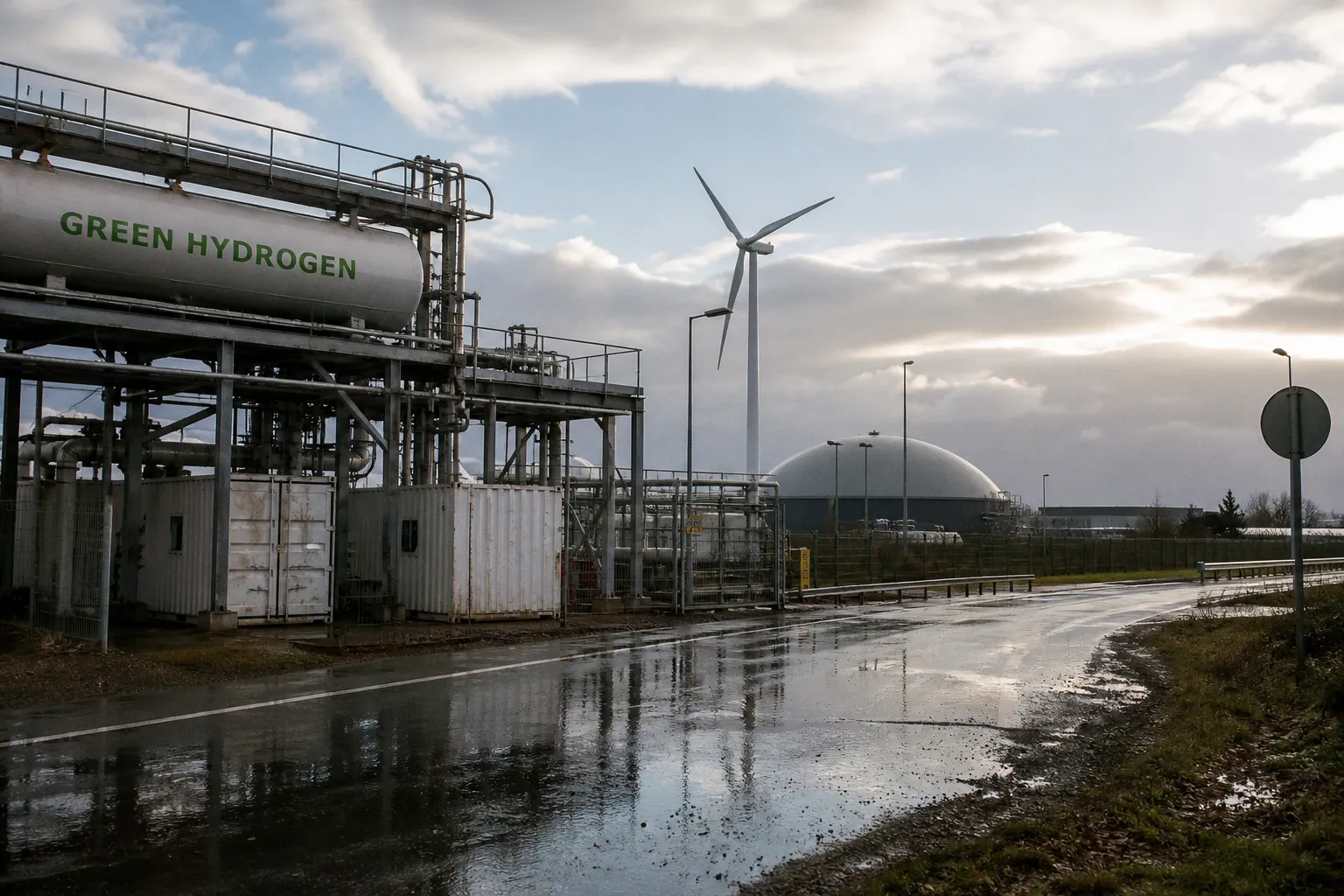
India's National Green Hydrogen Mission, launched in January 2023, targets 5 million metric tonnes per annum by 2030. By August 2025, the Institute for Energy Economics and Financial Analysis tracked 158 projects at various stages of development. Roughly 94% remain at the announcement stage. Approximately 3% are operational. RMI's analysis confirms the disconnect: announced production capacity has crossed the 2030 target by more than 2.5 times, while actual implementation lags. The International Energy Agency's Global Hydrogen Review 2024 reaches a similar conclusion at the global level: low-emission hydrogen capacity reaching final investment decision has nearly doubled, yet over 90% of announced production capacity sits at early stages with limited firm offtake.
The demand bottleneck
The constraint is no longer electrolyzer supply chains or renewable generation. It is offtake certainty. Green hydrogen in India remains more expensive than grey hydrogen produced via steam-methane reforming, restricting uptake in the hard-to-abate sectors the mission targets: steel, fertilizers, refining, chemicals, ammonia, long-distance transport. These sectors face their own margin pressure, which limits their tolerance for premium-priced inputs. Without bankable long-term contracts, financiers cannot underwrite the capex. Producers cannot commit to multi-year build-out. Buyers cannot lock in offtake. The loop stalls.
Demand aggregation is the most credible lever currently on the table. The mission identifies it explicitly. Germany's H2Global mechanism, an intermediary model that purchases green hydrogen derivatives under long-term contracts and resells to buyers via short-term contracts using public funding to bridge the price gap, offers a tested template. Pooled procurement across industrial clusters, refineries, steel plants, smaller offtakers, can convert fragmented interest into the kind of volume that justifies project finance.
Policy scaffolding versus engineering reality
Washington State's Office of Renewable Fuels, established under RCW 43.330.565 and 43.330.570, is structured around a similar logic: target hard-to-decarbonize sectors (aviation, heavy-duty transport, specific industrial processes) where direct electrification faces physics or density constraints. The state defines green electrolytic hydrogen by production method, separation of water via electricity, with renewable sourcing for both feedstock and process energy. The framework is coherent. The harder question remains the same one facing every jurisdiction with a hydrogen roadmap: whether the cost curve on electrolysis, renewable electricity, and downstream infrastructure declines fast enough to close the gap with incumbent fuels before subsidies expire.
Green ammonia is emerging as a more practical near-term vector than pure hydrogen for shipping and fertilizer applications, given existing handling infrastructure and modest retrofit requirements. That is not a theoretical preference; it is a logistics constraint.
What to track
Three data points will indicate whether the announced volumes convert into delivered molecules. First, the share of announced Indian projects that reach financial investment decision quarter over quarter, the metric IEEFA already tracks. Second, the cost differential between green and grey hydrogen at the point of consumption, after factoring in any bridge subsidy, rather than at the project gate. Third, the volume of demand aggregated through intermediary mechanisms modeled on H2Global, and whether public funding for price-gap bridging scales with that volume. Until offtake is bankable, electrolyzer announcements remain press releases, not infrastructure.