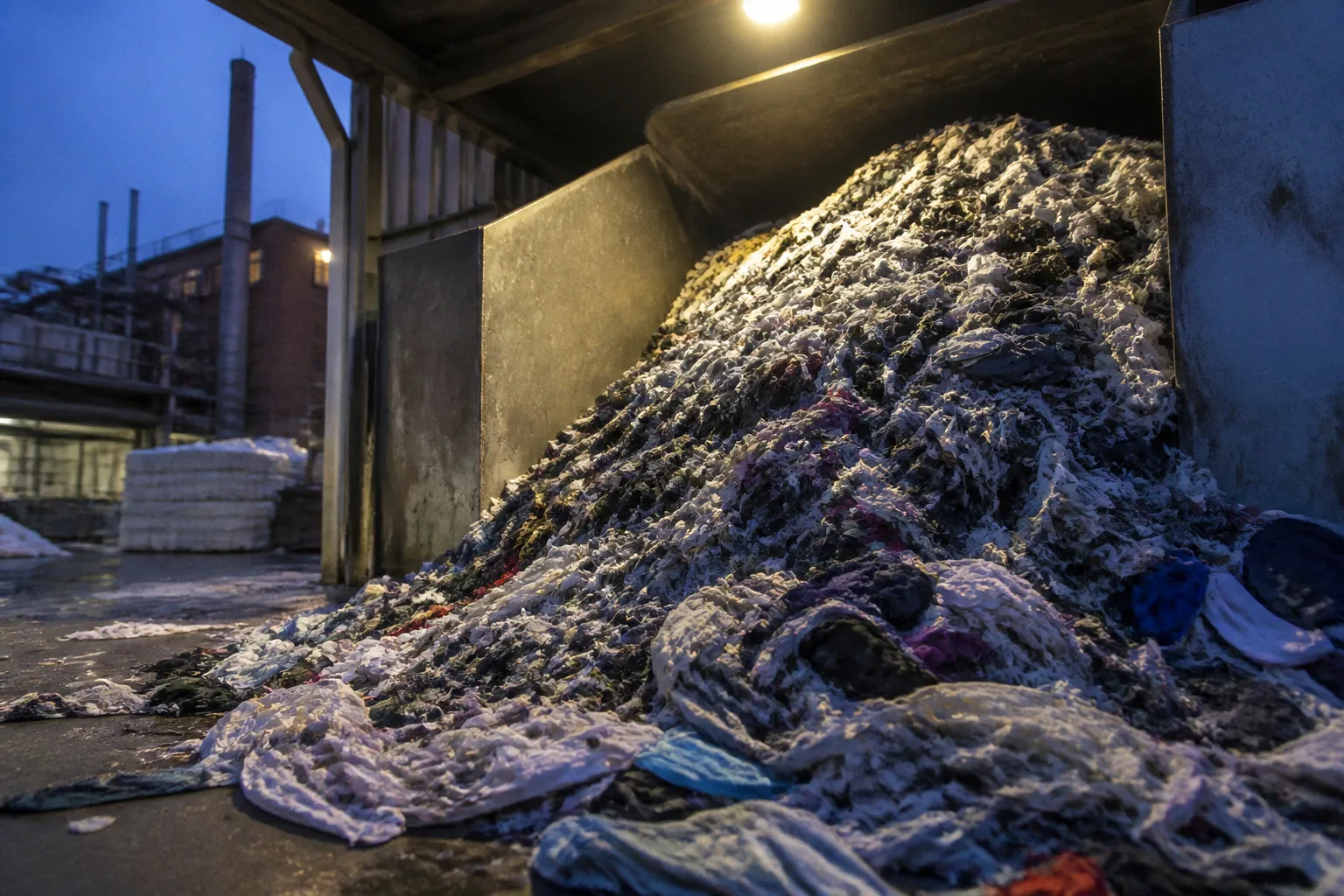
When the company’s assets were offered for sale in June, they included roughly 12,000 tons of dissolving pulp and 4,000 tons of recycled fiber. The inventory was tangible evidence that the process could produce material at scale. It was also evidence of the problem: production had moved further than demand.
The product was ready. The customers were not.
Eighteen months after opening what was presented as the world’s first commercial-scale textile-to-textile recycling plant, Renewcell entered insolvency with an operational asset, a working chemistry, and an order book that did not match the offtake agreements and sustainability commitments fashion brands had made over the previous years.
The collapse is the most informative stress test the circular fashion sector has produced so far. The technology demonstration succeeded. The bottleneck sat further down the value chain — in feedstock sorting infrastructure, in the contractual discipline of buyers, and in the working-capital structure of a process-industrial asset financed too much like a software startup.
Those failure modes are not unique to Renewcell. They are the issues that the next generation of textile-recycling investments will have to solve before adding more capacity becomes a virtue rather than another source of stranded inventory.
The Industrial Promise of Circulose: Beyond the Pilot Phase
Renewcell was founded in 2012 and spent a decade moving its recycling chemistry from laboratory demonstration to industrial operation. The flagship facility, Renewcell 1, opened in 2022 inside a converted paper mill in Sweden.
The site choice was deliberate. A former pulp asset offered existing material-handling systems, water treatment and bulk storage. Converting a brownfield facility could compress construction and commissioning compared with building an entirely new plant. It also made the business logic familiar: the company was not simply developing a new material in a laboratory, but trying to establish a new feedstock stream inside an industrial process environment.
The output was Circulose®, a branded dissolving pulp made from cellulosic textile waste. Downstream spinners can feed this pulp into the same regenerated-cellulose production lines used for viscose and lyocell made from wood-based dissolving pulp. That compatibility was the central strategic bet.
If the input could be substituted at the spinner, fashion manufacturers would not need to redesign their cutting and sewing operations. The garment factory would continue to make the same types of products. The major change would occur earlier in the supply chain: waste cotton would replace virgin wood as the source material for dissolving pulp.
That distinction matters. A recycling technology that requires brands to replace machinery, change garment construction or build a separate manufacturing system faces a long adoption cycle. A drop-in input has a more plausible route into an existing market. The qualification work still has to be completed, and the material still has to meet performance and color requirements, but the industrial proposition is easier to explain to a buyer.
Renewcell’s commercial thesis rested on several reinforcing assumptions:
- Fashion brands would need more verifiable recycled content as regulation and public scrutiny increased.
- Textile-to-textile recycling would provide a more credible response to waste concerns than relying primarily on recycled plastic bottles or downcycled fibers.
- Spinners could adopt Circulose without rebuilding their production lines.
- Brand commitments would eventually become recurring purchase orders.
- The economics would improve as the plant moved beyond commissioning and approached stable throughput.
The plant existed to service that demand. It produced to specification. But industrial production does not create a business on its own. A recycler needs a continuous supply of acceptable feedstock, customers willing to commit to volumes, and enough liquidity to carry material while those customers complete qualification and procurement processes.
That is where the pilot-era narrative broke down.
The chemistry worked. The inventory worked. The orders did not.
The Feedstock Paradox: Why 95% Cotton Purity Stalled Production
Renewcell’s dissolution chemistry had a strict feedstock requirement: the material had to be at least 95% cotton by fiber content. Polyester, elastane and other synthetic components interfere with the process. This is not a branding preference or a temporary quality target. It is an engineering constraint built into the route from textile waste to dissolving pulp.
The threshold divided the waste market into two very different categories.
Post-industrial scraps — cutting-room waste, deadstock and rejected rolls from garment factories — can meet the purity requirement relatively consistently. These materials are generated before a garment reaches the consumer. Their composition is usually easier to document, and the waste is often collected in a controlled manufacturing environment.
Post-consumer clothing is a much harder source. A garment may look like cotton to a buyer or a consumer while containing elastane, polyester stitching, synthetic trims, labels, coatings or other materials that complicate processing. Blended apparel dominates the clothing stream, while the recycler’s process requires a narrow and carefully controlled fraction of it.
That creates a paradox at the heart of textile recycling. The largest apparent resource is not necessarily the most usable resource. A city may collect huge volumes of unwanted clothing, but only a limited share can move directly into a process designed for high-purity cotton. The rest requires sorting, preparation or a different recycling chemistry.
The scale of the mismatch is substantial. Global textile waste is commonly estimated at approximately 92 million metric tons annually, but the cotton-rich post-industrial fraction suitable for Renewcell’s process is only a small part of that total. A plant designed around clean cotton waste cannot treat the full clothing mountain simply because the material is labeled textile waste.
Sorting is therefore not an accessory to the recycling system. It is one of its core industrial assets.
Near-infrared spectroscopy, mechanical fiber identification and chemical tracer systems can help identify material composition. The challenge is not whether these technologies exist. The challenge is whether they can operate with sufficient throughput, accuracy and cost control when the incoming stream is heterogeneous, contaminated and collected through fragmented channels.
A recycler may have a plant capable of processing thousands of tons of qualified feedstock, while the surrounding waste system can supply only a fraction of that material consistently. The plant then faces an uncomfortable choice: run below capacity, purchase expensive feedstock from a limited pool, or accept material that threatens yield and product quality.
The constraint can be expressed simply:
| Constraint | Source | Industrial implication |
|---|---|---|
| Feedstock purity of at least 95% cotton | Dissolution chemistry requirement | A hard limit on what can enter the process |
| Post-industrial cotton waste | Cutting-room waste and rejected production material | Relatively clean, but geographically concentrated and limited |
| Post-consumer clothing | Household collection and sorting systems | Large volume, but highly variable composition |
| Blended-fiber processing | Alternative chemical or enzymatic routes | A potential solution, but not yet a universal industrial substitute |
| Automated sorting | NIR, mechanical identification and related systems | Necessary for scale, but not yet deployed across the entire waste stream |
The lesson is broader than Renewcell. Building a recycling plant before building the feedstock network reverses the usual order of industrial development. In conventional pulp production, the supply base is part of the project finance case. In circular textiles, it is often treated as a sustainability infrastructure problem that will somehow resolve after the plant is built.
It does not resolve automatically.
A new dissolving-pulp facility does not create more high-purity cotton waste. It creates more demand for that waste. If several companies pursue the same feedstock, competition can increase costs before any of them reaches dependable utilization. The result is a feedstock paradox: the circular economy may have abundant waste in aggregate while still lacking the particular material specification required by a given process.
The Off-take Gap: When Fashion Brand Commitments Fall Short
The commercial failure was distinct from the technical failure, and that distinction matters more than the bankruptcy headline.
Major fashion companies, including H&M, Inditex, Levi’s and Ganni, were shareholders or commercial partners of Renewcell before its collapse. They invested equity, signed memoranda of understanding and publicly aligned themselves with the development of recycled textile fibers. Those actions signaled support. They did not necessarily provide the multi-year, volume-backed offtake contracts that a process-industrial recycler needs to amortize capital expenditure and manage working capital.
Equity investment and commercial offtake are different instruments.
Equity capital supports the company and gives the investor exposure to a future business. Commercial offtake creates a route for the plant’s output to become revenue. A company can have respected shareholders and still lack enough committed demand to keep an industrial line financially healthy.
That difference became visible in the inventory disclosed around the June 2024 asset sale. Roughly 12,000 tons of dissolving pulp and 4,000 tons of recycled fiber represented material that had been produced but had not translated into a stable commercial rhythm. The inventory was not proof that customers had rejected the technology outright. It was proof that qualification, procurement and sustainability intent had not moved at the same speed as production.
The gap usually appears in the transition between a pilot order and a recurring contract. A brand may test a recycled fiber in a limited collection, announce a partnership or make a public commitment to increase recycled content. None of those steps guarantees that the buyer will reserve enough volume for a plant to operate at a commercially viable rate.
Three pressures converged:
1. Sustainability commitments translated into memoranda, pilot programs and shareholder positions rather than firm recurring purchase contracts at industrial scale.
2. Procurement teams continued to rely on virgin dissolving pulp and established suppliers because those suppliers had passed qualification audits, offered predictable delivery and were already embedded in seasonal planning.
3. Buyers expected recycled material to approach conventional pricing even while the recycler was carrying the costs of new technology, restricted feedstock and low utilization.
The first pressure is visible to the public. The second and third determine whether a plant survives.
Fashion brands operate with sustainability targets, but they also operate with strict procurement systems. A sourcing team is responsible for cost, quality, delivery, supplier reliability and production continuity. A new material must satisfy all of those criteria, not only the sustainability department’s objectives.
A brand can genuinely support circularity and still hesitate to sign a long-term purchase commitment. It may be waiting for the material to qualify across more product categories. It may be concerned about price. It may want the option to increase or reduce volumes depending on demand. That flexibility is rational for the brand. It is dangerous for a recycler that must purchase feedstock, operate a plant and carry inventory regardless of whether the next order arrives on schedule.
This is the point at which fashion’s short planning cycles collide with process industry economics. Collections change every season. Brand forecasts move with consumer demand. Industrial assets require a steadier base load. The customer wants optionality; the plant needs utilization.
The distance between a sustainability narrative and a procurement commitment is where working capital disappears.
Financial Fragility in the Circular Economy Startup Ecosystem
Renewcell’s capital structure was poorly matched to the asset class it was trying to build.
The company secured roughly $10.6 million in venture funding before filing for bankruptcy. That level of funding can support technology development, pilot operations and commercial preparation. It is not the same as the financial architecture required to carry a process-industrial plant through ramp-up, qualification and uncertain demand.
A facility such as Renewcell 1 needs liquidity for feedstock procurement, inventory, customer credit terms, maintenance, plant uptime reserves and the inevitable delays associated with commissioning. Those needs do not disappear when the chemistry has been proven. In some respects, they become more demanding at the moment a company begins selling at scale.
Venture capital is generally structured around technology de-risking and a future liquidity event. A pulp or fiber plant has a different profile. It produces a physical commodity, ties up cash in inventory, depends on contracted supply and demand, and may require years of operations before the economics are clear. The asset’s value is not captured by a demonstration alone.
Renewcell did not fail because it had no product. It failed because commercial risk remained unresolved after the plant had been built.
That risk is often described as the valley of death between pilot validation and recurring unit economics. The phrase is familiar, but in circular materials it has a specific meaning. The pilot may prove that waste can be converted into a useful input. The first commercial facility must prove something harder:
- that enough qualifying waste can be secured continuously;
- that the conversion process can operate at the required throughput;
- that customers will accept the material in routine production;
- that those customers will commit to volumes rather than occasional trials;
- and that the company can finance the time between production and payment.
Each condition can be met individually while the overall business remains fragile. A plant can produce high-quality pulp but lack orders. A brand can place an order but not renew it. A recycler can have demand but no affordable feedstock. A project can have all three and still run out of liquidity before the operating model stabilizes.
Textile recycling increasingly resembles conventional pulp production in its operating profile: relatively low-margin output, substantial fixed assets, contracted fiber supply, a concentrated customer base and a long asset life. The circular version adds complexity because the feedstock is collected from a waste system rather than harvested from a relatively standardized resource base.
| Characteristic | Conventional pulp mill | Renewcell 1 before bankruptcy |
|---|---|---|
| Capital model | Project finance and long-term industrial debt | Venture and equity-led funding |
| Feedstock | Long-term forest supply arrangements | Spot or developing procurement of high-purity textile waste |
| Offtake | Established customers with recurring demand | Memoranda, partnerships and developing purchase commitments |
| Working capital | Structured around stable industrial operations | Vulnerable to ramp-up delays and inventory accumulation |
| Planning horizon | Long asset life and long contracts | Shorter financing cycles and pressure to demonstrate rapid scale |
The comparison is not intended to suggest that all circular-economy companies should copy a pulp mill’s financing model immediately. Early-stage chemistry companies still need equity to develop their process. The problem begins when the financing model does not change as the company crosses into asset-heavy production.
Once a commercial plant exists, the business needs more than a promising technology story. It needs bankable contracts. Those may include term lending, customer-backed financing, minimum-volume commitments, advance payments, purchase guarantees or project finance linked to offtake. The exact structure can vary, but the underlying principle does not: the parties that benefit from a new circular supply chain must share the risk of building it.
If the recycler alone carries the risk, the buyer retains the option to participate when the economics are attractive and withdraw when they are not. That arrangement can work for a pilot. It cannot reliably support a plant.
The Altor Acquisition: Can Rebranding Save Textile Recycling?
Altor acquired Renewcell’s assets out of bankruptcy in June 2024 and continued the business under the Circulose name. The acquisition created a second chance for the facility, but not a clean slate for the industrial problem.
Ownership structure changed. Private equity brings different incentives from venture capital: tighter operating discipline, a longer view of asset management and an investment thesis built around commercial scale rather than technology validation alone. A new owner may be able to restructure costs, renegotiate supplier relationships and approach financing on terms better suited to a process-industrial operation.
If Altor can secure term financing or offtake-backed capital, it may lower the pressure created by repeated equity fundraising. That would not make the feedstock or demand problem disappear, but it could give the plant more time to solve them. Industrial businesses often fail not because their long-term economics are impossible, but because they cannot finance the period in which those economics are being established.
The product and corporate identity also changed. The Circulose brand had a chance to distance the material from the previous capital structure and reset conversations with customers. Procurement teams that had not completed qualification of Renewcell’s output could approach the restructured business as a new commercial relationship.
That effect is real but limited. Rebranding can change the negotiating position. It cannot change the chemistry.
The 95% cotton feedstock constraint remains. The sorting infrastructure gap remains. The post-consumer waste stream remains fragmented. The economics of recycled dissolving pulp relative to virgin wood-based dissolving pulp remain central to every purchasing decision. The inventory disclosed during the asset sale shows why a new owner must solve both supply and demand rather than concentrating only on plant operations.
The key questions for the Circulose business are therefore operational and contractual:
- Can it secure a dependable stream of high-purity cotton waste without paying away the margin?
- Can it convert that material at a consistent rate and quality?
- Can it persuade spinners and brands to qualify the output across recurring product lines?
- Can it replace broad sustainability intent with minimum-volume commitments?
- Can the business carry inventory without turning production into a cash drain?
- Can it compete with virgin dissolving pulp on the dimensions buyers actually use to make decisions?
The specific per-ton cost differential between Circulose pulp and conventional viscose-grade dissolving pulp at steady-state operations is not disclosed in the available public information. That figure matters because the commercial model changes depending on the price relationship.
If recycled pulp reaches price parity with virgin dissolving pulp while sustaining an acceptable margin, regulation and brand commitments may provide enough incentive for buyers to shift volume. If the recycled material carries a premium, buyers may still adopt it, but likely in a more limited way unless regulation or consumer demand makes the premium defensible. If the product can undercut virgin pulp while meeting performance and sustainability requirements, demand would have a much easier path to scale.
None of those outcomes follows from a new logo.
Equity investment and commercial offtake are different instruments. The first writes down on exit. The second provides a route to recurring cash flow.
The acquisition can work if it changes the contract structure around the plant. Altor’s most important task is not to persuade the market that Circulose is a compelling concept. The market already understands the concept. The task is to secure commitments that make the plant’s output financeable.
That may require brands to accept less flexibility. It may require spinners to complete qualification before a large facility is fully ramped. It may require buyers to commit to volumes even when their own seasonal demand is uncertain. It may also require the recycler to be more transparent about the conditions under which it can supply consistent quality and price.
In other words, the second life of Renewcell depends on whether the surrounding value chain is prepared to behave less like a marketing partnership and more like an industrial supply chain.
What the bankruptcy means for circular fashion
Renewcell’s collapse should not be read as an obituary for textile recycling. It should be read as a warning against confusing a successful material demonstration with a successful circular business.
The technology proved that discarded cotton textiles could become a new dissolving-pulp input. The plant proved that the process could move beyond the laboratory. But the business also demonstrated that recycling capacity is only one part of the system.
Circular fashion needs infrastructure before and after the recycler:
- collection systems that preserve material quality instead of mixing every textile stream together;
- sorting capacity that can identify usable cotton at industrial speed;
- feedstock contracts that protect plants from unpredictable supply;
- spinning and manufacturing partners willing to qualify recycled inputs;
- brand commitments that include volume, duration and commercial terms;
- and financing structures that recognize the working-capital needs of physical production.
Without those components, a new plant can become a warehouse with a technology story attached to it.
The apparel industry is a roughly $2.5 trillion sector generating approximately 92 million metric tons of textile waste annually. That combination creates an enormous theoretical market for recycling, but theoretical volume is not the same as usable feedstock or bankable demand. A circular economy is built from specifications, contracts and logistics as much as from chemistry.
The Renewcell bankruptcy lessons for circular fashion are consequently uncomfortable but useful. Fashion brands can support innovation without underwriting industrial scale. Recyclers can produce a technically valid material without having a commercially secure market. Investors can fund a plant without fully financing the years of working capital required to make it dependable.
The Altor-Circulose acquisition is a credible attempt to correct that mismatch. It may give the asset the ownership, cost discipline and financing strategy it lacked before. But rebranding alone cannot solve textile recycling scaling challenges. Nor can another round of fashion brand sustainability commitments if those commitments remain non-binding at the point where the recycler has to buy feedstock, run the plant and carry inventory.
The next phase of circular fashion will be determined less by who can announce a recycling breakthrough than by who can make the entire chain move together. Until that happens, the sector will continue to produce impressive pilots, ambitious commitments and commercially stranded capacity — a circular economy startup failure pattern that repeats even when the underlying chemistry is sound.