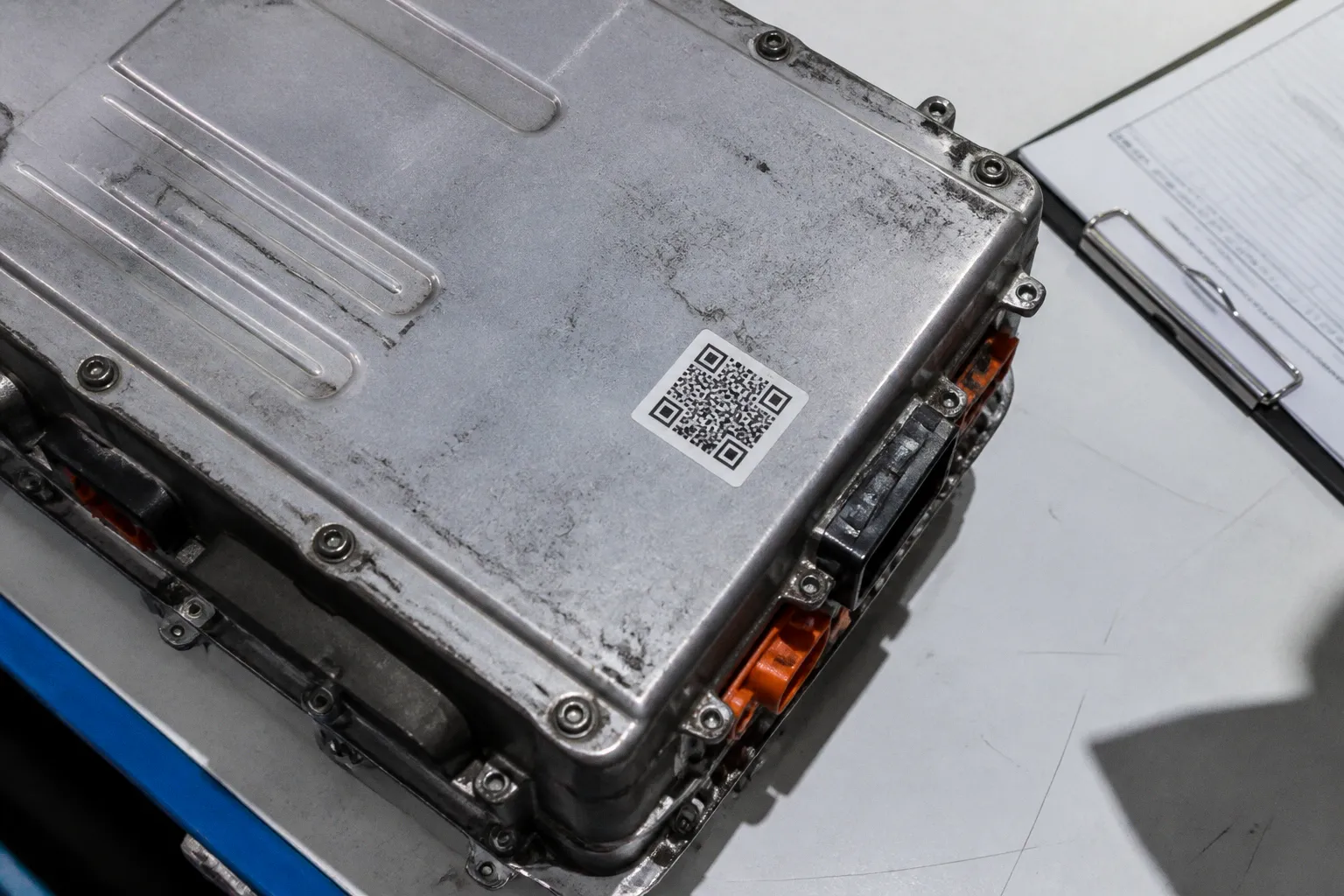
The EU Battery Passport is not primarily a consumer-facing label. It is a compliance system attached to a physical battery, with a QR code acting as the access point to lifecycle data that manufacturers, authorities, service providers and recyclers will use under different permissions.
From 18 February 2027, every electric vehicle battery, light means of transport battery and industrial battery above 2 kWh placed on the EU market must carry a Digital Battery Passport under Regulation (EU) 2023/1542. The requirement changes the economics of battery compliance. Data that previously sat across supplier records, technical files, warranty systems and recycling documentation must become traceable at product level.
The engineering challenge is not generating another PDF. It is maintaining a reliable chain of data across production, ownership, repair, repurposing and recycling. The commercial challenge is larger still: the company legally responsible for the finished battery must coordinate information it may not directly control.
The February 2027 deadline is about market access, not reporting quality
The scope of the EU battery passport requirements is defined by battery category and capacity. The February 2027 obligation applies to:
- electric vehicle batteries;
- batteries for light means of transport, including relevant micromobility applications;
- industrial batteries with a capacity exceeding 2 kWh.
Portable consumer batteries are currently outside the Digital Battery Passport requirement for this deadline. A standard battery used in consumer electronics remains subject to other parts of the EU Batteries Regulation, but it should not be presented as covered by the February 2027 passport mandate.
The passport must be accessible through an external QR code on the physical battery. That detail matters. The data system is digital, but the compliance object is still the battery itself. The QR code must remain associated with the battery as it moves through the value chain. For EV packs, this creates an operational question around placement, durability, replacement and access after the pack leaves the vehicle manufacturer’s original logistics environment.
The legal accountability is also deliberately concentrated. The obligation to create and maintain the passport rests with the economic operator placing the finished battery on the EU market. It does not sit directly with every cell manufacturer, component supplier or raw material processor.
That allocation simplifies enforcement from a regulator’s perspective. Authorities need a responsible market-facing operator rather than a fragmented chain of upstream entities. It complicates governance inside the supply chain. The operator placing the finished pack on the market must obtain credible data from suppliers and ensure that the resulting record is complete, current and internally consistent.
A battery producer may therefore face a mismatch between legal responsibility and operational control. The final pack integrator may not own the mining data, cell chemistry records, recycled content declarations or upstream due diligence files. Yet incomplete upstream information can still create a downstream compliance problem.
The passport makes the finished-battery operator accountable for a data chain that extends far beyond the factory gate.
The date should be treated as a systems deadline. Companies that begin only with QR-code generation will be addressing the most visible layer and missing the harder work: data ownership, validation, version control and lifecycle events.
The 71 data points are not one universal checklist
European Commission guidance identifies 71 specific data points relevant to EV, light means of transport and industrial batteries. The number is useful because it signals the breadth of the system. It is misleading if treated as a flat list of mandatory fields that every battery must populate in the same way from day one.
The fields vary by battery category and by legal status. Some are mandatory. Others are optional or conditionally required. The compliance task is therefore a classification problem before it becomes a software problem.
The data architecture must accommodate several distinct information groups:
| Data domain | What the passport is designed to capture | Operational pressure |
|---|---|---|
| Product identity | Information linking the digital record to the physical battery | The identifier and QR code must remain usable across the product lifecycle |
| Carbon footprint | Lifecycle emissions data and associated reporting status | Requires consistent boundaries, methodologies and supplier inputs |
| Recycled material content | The share and type of recycled material used where applicable | Depends on evidence from material and cell supply chains |
| Supply chain due diligence | Information connected to responsible sourcing and supply-chain oversight | Requires governance beyond the battery plant |
| State of health | Data relevant to the battery’s condition during use | Needs reliable measurement and controlled updates |
| End-of-life requirements | Information needed for dismantling, treatment and recycling | Must be usable by service and recycling operators, not only designers |
This is where green claims tend to become expensive. A company can state that a battery contains recycled material. A passport regime requires the claim to be connected to a structured record with an accountable source and an appropriate access level.
The same applies to carbon footprint. The requirement is not satisfied by attaching a broad sustainability statement to a product page. Data must be associated with the relevant battery and maintained within the passport architecture. Final maximum carbon footprint thresholds that could prohibit non-compliant batteries from the EU market are still being phased in through secondary delegated acts. The existence of a passport does not mean every future performance threshold is already settled.
The distinction between disclosure and permission is equally significant. A data point can exist in the system without being visible to every user. A public user may receive a limited product profile. A market surveillance authority may require more detailed compliance information. A recycler may need technical and end-of-life data that has no value to a retail customer.
That creates a requirement for field-level governance. A business must know:
- who owns each data field;
- which supplier or internal system is the source;
- whether the field is mandatory, optional or conditional;
- when the field is created;
- who may read it;
- who may update it;
- what evidence supports the value;
- how corrections are recorded.
This is battery passport data tracking in the practical sense. It is not simply the ability to retrieve a record. It is the ability to defend that record when a regulator, service operator or recycling contractor challenges its accuracy.
The passport follows the battery through changing use cases
Battery value does not end when the first vehicle or industrial system stops using it. A pack can be repaired, repurposed, resold, reassigned to stationary storage or routed directly to recycling. Each transition changes the information required by the next operator.
State-of-health data becomes commercially relevant at this point. A battery with reduced automotive performance may still have value in a less demanding application. That value depends on credible information about remaining capacity, degradation and operating history. Without reliable data, second-life markets discount the asset because buyers cannot separate a usable battery from a hidden liability.
The passport can reduce that information asymmetry, but only if the data is maintained during use. A record created at production and never updated is not a lifecycle passport. It is a product certificate with an ambitious name.
This is a direct connection between regulation and circular economy economics. Reuse, remanufacturing and second-life deployment depend on lower inspection costs and better residual-value estimates. If every used battery requires a costly manual assessment because its operating history is incomplete, much of the theoretical value of circularity disappears into transaction costs.
The EU Battery Regulation circular economy framework therefore moves beyond the conventional recycling question. It treats the battery as an asset whose material value, functional value and compliance status must remain legible over time.
The required information will not be identical at every stage. A vehicle manufacturer may need production and warranty records. A second-life operator needs condition and performance data. A recycler needs information that supports safe handling, dismantling and material recovery. The passport must connect those stages without exposing every piece of commercial information to every participant.
Permission-based access is a control system, not a user-interface feature
The regulation establishes three broad access categories:
1. The general public, with access to the information intended for public disclosure.
2. Market surveillance authorities, with broader rights to inspect compliance-related information.
3. Battery service and end-of-life processors, with access relevant to maintenance, treatment, dismantling and recycling.
These categories imply different read and write rights. The passport is not a single open database where every participant sees and edits the same record. It is a permission-controlled structure.
That architecture is necessary for two reasons. First, battery data has commercial sensitivity. Supply-chain information, manufacturing specifications and performance records may not be appropriate for unrestricted public access. Second, uncontrolled editing would undermine the record’s evidentiary value. If a recycler can modify a production field, or a manufacturer can silently overwrite an end-of-life event, the system becomes difficult to audit.
A credible implementation needs separation between data publication and data authority. The company placing the battery on the market remains the accountable operator, but different lifecycle participants may generate or update specific information. The system must preserve both facts: who supplied the data and who was responsible for its inclusion in the passport.
That is an enterprise architecture problem. It touches product lifecycle management, enterprise resource planning, supplier portals, warranty systems, telematics, service databases and recycling documentation. A standalone compliance application can display the result, but it cannot manufacture trustworthy inputs.
The same logic applies to data quality. A passport record should not merely contain a value. It should carry enough context to establish what the value refers to, which battery configuration it covers and whether it remains current. Otherwise, companies will create records that appear complete while remaining weak under scrutiny.
Why access design affects commercial viability
The commercial value of a passport depends on whether participants trust the data enough to make decisions with it.
For a fleet operator, state-of-health information can influence replacement planning. For a second-life company, it can shape acquisition pricing. For a recycler, technical data can reduce preparation uncertainty. For authorities, it can support market surveillance without requesting the same documentation from every supplier in an unstructured format.
But each use case has a cost. Data must be collected, normalized, validated, secured and maintained. Small operators may not have the systems or personnel to perform that work internally. Large manufacturers may have the systems but face integration problems across regions, brands and suppliers.
The result will not be a uniform market response. Companies with mature product data infrastructure can treat the passport as an extension of existing systems. Companies operating through fragmented supplier and service networks will experience it as a new layer of capex and process control.
The EU registry is an index, not a central warehouse
One of the more consequential technical details is what the central EU Digital Battery Passport Registry does not do. It should not be understood as a single centralized database containing every lifecycle data point for every battery.
The registry acts as a decentralized index. It points to data maintained by economic operators and other authorized systems. That distinction affects architecture, cybersecurity and accountability.
A centralized warehouse would concentrate information and simplify some forms of access. It would also create a large single target and a single point of failure. A decentralized model distributes responsibility, but it requires stronger interoperability. The registry can point to a record only if the record exists, remains reachable and follows the required access rules.
For operators, this means that registry registration is not the end of implementation. It is one connection in a wider chain.
The unresolved technical details matter. Specific APIs and data exchange formats for private platform integration remain dependent on final implementing acts. Companies can prepare their internal data model and governance processes now, but they should avoid treating any provisional integration design as permanently fixed.
A sensible approach is to separate stable compliance logic from replaceable technical interfaces:
- keep the internal battery identity model independent of a single vendor platform;
- maintain a clear mapping between internal fields and regulatory data points;
- preserve an evidence trail for supplier submissions and revisions;
- design access permissions by user role rather than by application screen;
- ensure the QR code resolves through a controlled, updateable service;
- plan for changes to delegated acts and implementing rules.
This is not glamorous work. It is the part that determines whether the system scales.
A registry can index a battery record. It cannot repair missing supplier data, ambiguous product identities or undocumented lifecycle changes.
The deadline intersects with wider regulatory milestones
The February 2027 passport deadline sits inside a broader sequence of obligations. Supply-chain due diligence requirements under Regulation (EU) 2025/1561 begin on 18 August 2027. That creates a narrow interval between the passport requirement and the start of another governance burden.
The implication is straightforward: companies should not build the passport as an isolated QR-code project. Supply-chain due diligence, carbon footprint reporting and recycled material content will draw on overlapping data sources. Separate systems may satisfy individual departments while producing contradictory records at product level.
Recycled content requirements also introduce a longer planning horizon. The first phase of mandatory recycled content thresholds begins in 2031, with a second phase in 2036. The dates are far enough away to encourage delay and close enough to affect product strategy now. Battery design decisions, supplier contracts and material procurement cycles often run across several years. A pack designed for today’s documentation regime may become commercially constrained when future recycled-content requirements become enforceable.
This is where the passport becomes more than a reporting mechanism. It can become the information layer used to verify whether a product remains eligible for the market as obligations tighten.
However, the passport does not automatically create circularity. It does not guarantee recycled material availability, profitable recovery or sufficient processing capacity. It makes claims and lifecycle conditions more visible. The physical economics still depend on chemistry, collection logistics, dismantling cost, material prices and recovery yields.
For manufacturers, the priority is to connect regulatory data to design and procurement decisions. If the company treats recycled content as a disclosure field added after production, it will struggle to change the underlying bill of materials. If it treats the passport as a product-management input, it can use the data to assess supplier resilience, future compliance exposure and residual value.
What economic operators should build before 2027
The operator placing the finished battery on the EU market carries the legal obligation. That does not mean the operator should attempt to own every data-generating activity. It means the operator needs a controlled system for obtaining, testing and retaining the information.
A practical implementation sequence has five parts.
1. Map the covered portfolio.
Identify which battery products fall within the EV, LMT or industrial categories, and isolate industrial batteries above the 2 kWh threshold. Keep portable consumer batteries separate from the February 2027 scope to avoid both under-compliance and unnecessary implementation work.
2. Assign ownership to each data point.
Do not assign responsibility to a general sustainability team and stop there. Carbon footprint, recycled content, state of health, supply-chain due diligence and end-of-life information will usually come from different functions and suppliers.
3. Create a battery identity model.
The digital record must correspond to the physical product, not merely to a product family or marketing model. Configuration changes, replacement packs and repaired units need a defined identity policy.
4. Test evidence, not just data transfer.
A populated field is not necessarily a defensible field. The operator should be able to show where the value came from, which supplier or internal process generated it and when it was last validated.
5. Run lifecycle scenarios.
Test what happens when a battery is repaired, transferred to a second-life application, sold to another operator or sent to recycling. A system that works only at the point of sale is not ready for the regulation’s lifecycle logic.
The last scenario has a precise endpoint. Under Article 77(8), the battery passport ceases to exist once the physical battery has been recycled. That rule draws a line between the battery as a managed product and the materials that remain after recycling. It also means that end-of-life processors are not an afterthought. Their status update closes the regulated record.
For recyclers, the value of access will depend on data usability. A passport with inconsistent chemistry labels, outdated state-of-health information or inaccessible technical fields will not eliminate the need for inspection. The system has commercial potential only if it reduces uncertainty in real operations.
The cost-benefit case is uneven across the value chain
The benefits are easiest to identify at the system level:
- better traceability of battery materials and production claims;
- lower information friction in repair and second-life markets;
- more structured market surveillance;
- clearer evidence for recycled content and carbon-footprint reporting;
- improved handover between manufacturers, service firms and recyclers.
The costs are concentrated at the implementation layer:
- supplier data integration;
- software development or platform procurement;
- identity management;
- cybersecurity and permission control;
- audit and validation processes;
- updates across the battery lifecycle;
- training for service and end-of-life partners.
Large manufacturers can spread these costs across high-volume product lines and existing digital infrastructure. Smaller producers and importers may face a less favorable capex profile. The legal model does not remove that asymmetry. It may make it more visible.
There is also a risk of compliance fragmentation. If each operator implements a proprietary data structure, recyclers and service companies will face multiple interfaces, inconsistent field definitions and varying access procedures. The result would be a digital layer that exists formally but does not deliver operational scalability.
The strongest implementations will therefore be judged by more than passport availability. They will be judged by whether the data can support decisions outside the compliance department.
A battery passport that helps a recycler identify handling requirements, helps a service provider assess remaining performance and helps an authority verify a market claim has functional value. A passport that only proves a QR code was printed is administrative overhead.
A sober assessment of the EU battery passport
The EU battery passport requirements are a significant expansion of product-lifecycle accountability. They force the market-facing battery operator to link physical products with structured information on carbon footprint, recycled content, supply-chain due diligence, state of health and end-of-life treatment.
The regulation is technically ambitious but not magical. It cannot resolve weak supplier records, unclear product identity or poor recycling economics by itself. It can expose those weaknesses earlier and make them harder to hide behind broad sustainability claims.
The immediate deadline is 18 February 2027. The strategic deadline is earlier. Companies need enough time to map products, negotiate supplier data obligations, design permissions, test lifecycle updates and adapt to future implementing rules. The registry will not provide that work, and a QR code will not substitute for it.
Commercial viability will depend on whether the passport becomes part of product and asset management rather than a narrow reporting exercise. If operators build it as a controlled data layer for the full battery lifecycle, the system can improve traceability and residual-value decisions. If they build it as a late-stage compliance label, the result will be more capex, more manual reconciliation and limited circular-economy value.
The regulation’s basic proposition is sound: batteries cannot circulate efficiently through complex industrial systems if their condition, composition and obligations remain opaque. The hard part is making the information accurate enough, accessible enough and standardized enough to support real decisions.