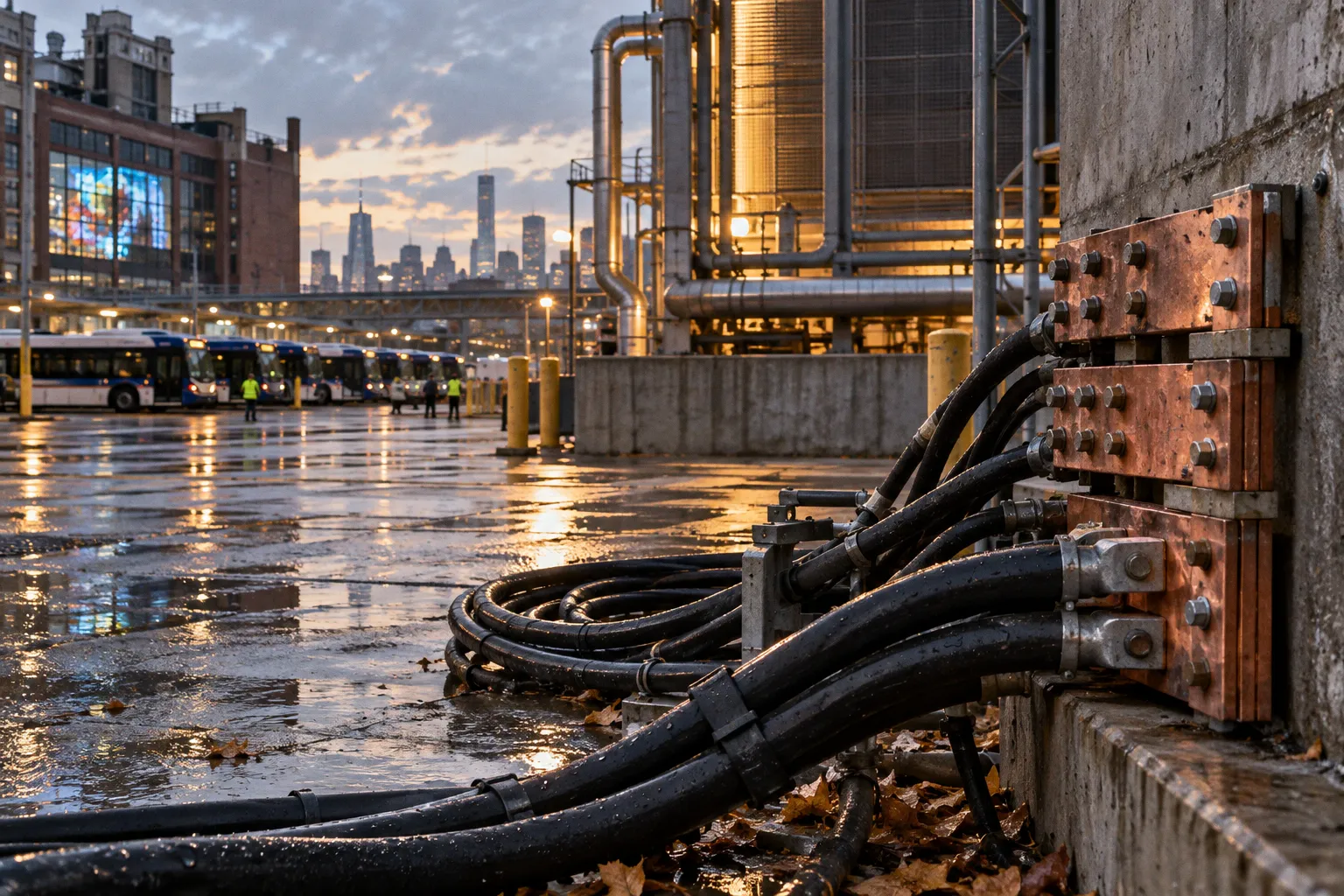
Art no longer hangs on the wall; it surrounds the visitor, responds to movement and expands until the room itself appears to dissolve.
Tickets and prices
Available at short noticePrices recorded on September 14, 2026 — today's fare on the partner page.
Official website — artechouse.com
- Time to spend: 2–3 h
- Best time to visit: evening
Prices are a guide only: the final fare and open dates appear on the partner page.
Booking through our partner GetYourGuideThe less theatrical fact is that the environmental accounting is much less immersive. ARTECHOUSE does not publicly disclose a detailed energy audit for its projection infrastructure, nor does it publish a verified carbon footprint for the New York venue. Visitors can book timed-entry tickets to an impressive digital art exhibition, but they cannot yet book a clear account of what the experience costs in electricity, equipment and emissions.
That does not make the venue unsustainable by definition. It does make the sustainability conversation rather one-sided — technologically ambitious on the visitor-facing side, comparatively non-binding when it reaches the ledger.
A historic boiler room, rebuilt as a digital canvas
ARTECHOUSE NYC occupies a roughly 100-year-old former boiler room beneath Chelsea Market, in the Chelsea–Meatpacking area of Manhattan. The setting matters because it gives the venue a physical identity that many immersive exhibitions otherwise lack. Before the projection mapping begins, there is already an architectural story: brick, industrial proportions, underground rooms and the slightly theatrical knowledge that a former utility space has been repurposed for cultural consumption.
The building is not an empty gallery waiting for an installation. It is a historic subterranean structure being asked to carry a new technical load. That distinction is useful when considering the environmental profile of the venue. Reusing an existing space can avoid the material burden of constructing a new cultural building, but adaptive reuse does not erase operational energy demand. It simply moves the sustainability question from concrete and steel toward electricity, cooling, maintenance and replacement cycles.
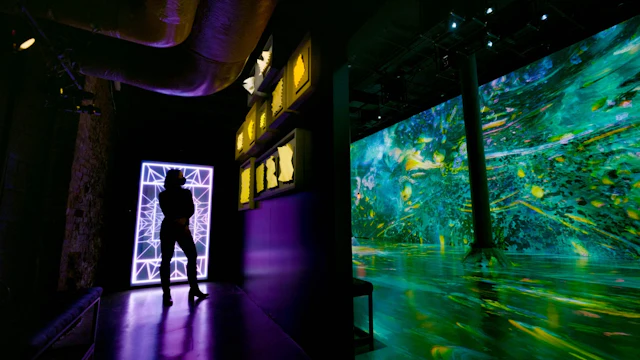
Inside, high-resolution laser projection creates what ARTECHOUSE describes as the largest seamless megapixel canvas of any cultural institution. The visual effect is designed to remove the normal borders of an artwork. Walls, floor and ceiling become part of one continuous field, while spatialized Hyperreal Sound supplies the corresponding acoustic pressure.
The installation is not merely a sequence of large video files played against a wall. ARTECHOUSE uses generative algorithms, infrared sensors and motion-tracking cameras to make parts of the work responsive. The visitor’s position and movement can become an input. Digital particles shift, images react, and the room behaves less like a cinema than a controlled visual environment.
That responsiveness is also where the environmental issue becomes more complicated. A conventional static exhibition may require lighting, climate control and security systems, but an interactive digital installation adds projection hardware, computing, sensors, networking and continuous technical support. The work exists through an infrastructure that has to remain operational for every timed-entry group, whether the room is full or only lightly occupied.
The art may be ephemeral, but the electricity required to make it appear is not.
How to book tickets for ARTECHOUSE New York
The practical mechanism is straightforward: admission operates through timed entry. Visitors select an available date and time rather than arriving with a general museum pass and expecting the doors to absorb the decision. That arrangement helps regulate the flow through the installation, where crowd density can affect both the experience and the ability to move through interactive areas.
Those planning to book tickets for ARTECHOUSE New York should treat the time slot as part of the ticket, not as a decorative detail. Availability can vary by date, current exhibition and booking channel. Advance booking is the sensible approach for weekends, holidays and periods when a new program is attracting attention. The venue presents several admission and tour options depending on the listing, while the exact ticket terms should be checked at the point of purchase because prices and bundles are subject to change.
The usual visit lasts between 45 and 75 minutes. That estimate generally includes a complete projection loop, the interactive mezzanine displays and time at the XR Bar. It is long enough to justify planning around the visit, but short enough that ARTECHOUSE works more naturally as one part of a Chelsea itinerary than as an all-day museum commitment.
The essential logistics look like this:
| Practical detail | What to expect |
|---|---|
| Entry format | Timed admission for a selected date and entry window |
| Typical duration | Approximately 45–75 minutes, depending on how long you spend with the installations |
| Venue | Subterranean former boiler room beneath Chelsea Market |
| Area | Chelsea–Meatpacking District |
| Nearby transit | The 14th Street / 8th Avenue subway area is the most useful reference point |
| Booking approach | Reserve ahead when the date or exhibition is in demand; confirm the live terms before paying |
| Current programming | Exhibition names, schedules and availability can change, so do not treat an older listing as a permanent timetable |
ARTECHOUSE New York opening hours should be checked against the selected date rather than copied from a static travel page. Immersive venues frequently adjust sessions around exhibition programming, private events and seasonal demand. A page that says the venue is generally open on a particular day is not the same thing as confirmation that the time you want is available.
This is one of the minor bureaucratic facts of digital culture: the art may be fluid, generative and algorithmic, while the visitor still has to submit to a fixed arrival window.
What the installation is doing technically
The easiest way to misunderstand ARTECHOUSE is to call it a collection of oversized screens. The space is closer to a coordinated system of projectors, software, sensors and sound. The visual field depends on careful alignment across multiple surfaces, which is why the seamless effect is central to the venue’s identity.
Projection mapping is particularly effective in a former industrial room because it turns architectural irregularities into part of the composition. Columns, corners and changes in surface depth can be incorporated into the image rather than concealed behind a neutral white wall. The building becomes a display instrument.
Yet projection mapping is not environmentally weightless. High-resolution laser projectors require electricity, and their operation is only one part of the load. Servers and control systems process and distribute the content. Sensors and cameras remain active to detect movement. Networked equipment has to be maintained. The venue also needs lighting, ventilation, climate control and staff operations, none of which become less real because the finished work looks immaterial.
The same applies to the content itself. Generative art can create variation without requiring a new physical object for every variation, which is one sense in which digital work may avoid material consumption associated with fabrication, shipping and storage. But software-based production has its own technical footprint. Content must be rendered, stored, updated and delivered through hardware that has a finite service life.
There is no responsible basis for translating this into a precise emissions figure for ARTECHOUSE New York. The venue’s public-facing information does not provide the necessary electricity consumption data, equipment inventory, operating schedule, cooling demand or renewable-energy accounting. Any neat calculation offered without those inputs would be decorative arithmetic.
That missing data is not a minor footnote. It determines whether claims about energy efficiency can be tested. A venue may use efficient laser projectors, for example, but the relevant question is not simply whether one device is more efficient than an older device. It is how much electricity the entire installation consumes across its operating hours, how often equipment is replaced, what happens to retired hardware and whether the electricity supply is matched by credible renewable procurement.
The sustainability question behind immersive art
The environmental debate around immersive exhibitions is often trapped between two unhelpful positions. One treats digital art as automatically clean because it uses fewer physical materials than a conventional exhibition. The other treats every large projection as an ecological offense. Both are convenient, and neither is a serious accounting method.
A better assessment separates several layers.
The building
ARTECHOUSE benefits from occupying an existing historic space rather than requiring a new purpose-built cultural building. That may reduce the embodied emissions associated with new construction, but the scale of any benefit depends on what would otherwise have happened to the building and what upgrades were required for the venue.
A repurposed boiler room still needs to be made safe, accessible and technically suitable. Electrical systems, ventilation, fire protection, acoustic treatment and visitor infrastructure all carry material and operational consequences. Adaptive reuse is potentially valuable; it is not a sustainability certificate.
The equipment
The projection system is the visible core, but it is not the whole equipment stack. Projectors, servers, sensors, cameras, control systems and sound hardware all consume resources during manufacture and replacement. A responsible venue would ideally disclose expected equipment lifetimes, repair practices, procurement standards and end-of-life handling.
Those details are rarely as glamorous as the artwork. They are also where a large portion of the real environmental story may reside.
The operating schedule
A timed-entry system can improve crowd management and help a venue plan staffing and operations. It does not automatically improve energy efficiency. Much depends on whether systems remain fully active between sessions, how the building is conditioned during quiet periods and whether the venue can match technical operation to actual visitor demand.
An installation that runs continuously for a lightly attended afternoon has a different profile from one operating at capacity. Without public operating data, the difference remains invisible to the visitor.
The visitor journey
The footprint of a cultural experience is not limited to the building. Visitors travel to Chelsea, often by subway, taxi, car or a combination of modes. The same exhibition can therefore have very different overall impacts depending on how people reach it and whether they combine the visit with other activities in Manhattan.
That is not an argument for turning a night at an art venue into a personal carbon audit. It is an argument against pretending that the projector is the only relevant machine in the system.
“Digital” describes the medium. It does not describe the footprint.
Visiting ARTECHOUSE New York as an eco-conscious traveler
For visitors who want the experience without treating sustainability as a marketing accessory, the practical decisions are modest but meaningful.
First, use public transportation where it fits the rest of your route. The venue sits near one of Manhattan’s dense transit corridors, and a subway journey is generally more compatible with an eco-conscious visit than making a separate car trip for a 45-to-75-minute exhibition. Chelsea Market and the surrounding Meatpacking District also make it possible to combine the visit with other plans, reducing the likelihood of a single-purpose journey.
Second, choose a time that works rather than booking a slot you are likely to miss. A timed-entry ticket is an operational commitment. If a visitor fails to arrive, the projection system and building may still be running for the scheduled session, while the unused admission produces no cultural benefit. The carbon consequence of one missed booking is not something the venue publishes, and it would be foolish to dramatize it, but reducing avoidable waste is still a reasonable habit.
Third, do not confuse the absence of physical shipping crates with an absence of material impact. Digital art can avoid some of the materials associated with conventional installations, but it depends on sophisticated hardware. The more persuasive sustainability standard is transparency: energy use, procurement, replacement, waste and renewable-energy claims should be available for scrutiny rather than hidden behind the adjective immersive.
For a broader look at how cultural institutions are approaching environmental responsibility, readers can also consult this guide to sustainability in the arts — though no framework should be accepted merely because it has acquired a polished acronym.
How to use the 75-minute experience well
The first viewing is usually the least analytical. The projections are designed to overwhelm the normal hierarchy of attention, and the installation succeeds precisely because it makes the visitor look everywhere at once. The practical mistake is to rush through that effect as if the venue were a conventional gallery with a fixed sequence of objects.
Allow enough time for the main projection loop. If the first few minutes feel visually dense, stay with the room rather than immediately trying to document it. Phone footage rarely captures the scale, sound or changing relationship between the image and the architecture. It does, however, capture the backs of other visitors with impressive efficiency.
The interactive mezzanine deserves separate attention. Its displays use sensors and motion tracking differently from the large-scale projection environment, making the visitor’s movement more explicit. This is where the distinction between watching digital art and participating in a responsive system becomes clearest.
The XR Bar completes the venue’s carefully assembled experience economy. It is not simply a refreshment stop appended to an exhibition. It extends the logic of the venue, where the cultural experience is packaged as a sequence of visual, spatial and social encounters. Visitors should decide whether that adds to the visit or merely gives the ticket a longer tail.
A sensible rhythm is:
1. Arrive early enough to pass through the entry process without sacrificing the timed slot. The installation is immersive, but the admission system remains stubbornly punctual.
2. Watch at least one full projection cycle. Leaving after the first visual sequence means judging the work before its structure has had time to emerge.
3. Move through the interactive displays at a slower pace. The sensors and generative elements reward attention more than hurried photography.
4. Use the XR Bar according to interest, not obligation. It can be part of the experience, but it is not a compulsory annex to the artwork.
5. Leave room in the schedule for the neighborhood. ARTECHOUSE is best treated as a concentrated cultural stop in Chelsea rather than a claim on an entire day.
The exhibition may change, including seasonal or current programs such as Blooming Wonders, so the balance between projection rooms, interactive areas and ancillary spaces should be confirmed when booking. The underlying format, however, remains consistent: a timed, technologically intensive encounter housed in a repurposed industrial environment.
What ARTECHOUSE should disclose next
ARTECHOUSE New York occupies an interesting position in the climate conversation. It offers an experience about transformation, systems and new forms of perception, while operating through a technical infrastructure whose environmental consequences are not fully visible. That tension is not a reason to dismiss the venue. It is a reason to ask better questions.
A credible sustainability disclosure would include annual electricity consumption, the share attributable to projection and computing equipment, the energy used outside visitor hours, cooling requirements, equipment replacement cycles and the treatment of retired hardware. If the venue purchases renewable electricity or uses offsets, those claims should be identified clearly, with the distinction between actual emissions reductions and accounting instruments kept intact. An offset is not a time machine, however enthusiastically the framework is presented.
Until such information is available, the fairest description is limited. ARTECHOUSE New York is an inventive and technically sophisticated digital art venue in a historically reused space. It offers timed-entry access, a 45-to-75-minute visit and an immersive experience that cannot be reduced to a standard gallery tour. It is not yet possible to make a verified claim about the installation’s total carbon footprint or environmental efficiency.
Visitors can still book tickets, use public transportation, combine the trip with nearby plans and enjoy the work without pretending that enjoyment settles the accounting. The unresolved question is not whether digital art can be beautiful. ARTECHOUSE has already answered that. The harder question is whether an institution built to make invisible systems visible is prepared to show visitors its own.