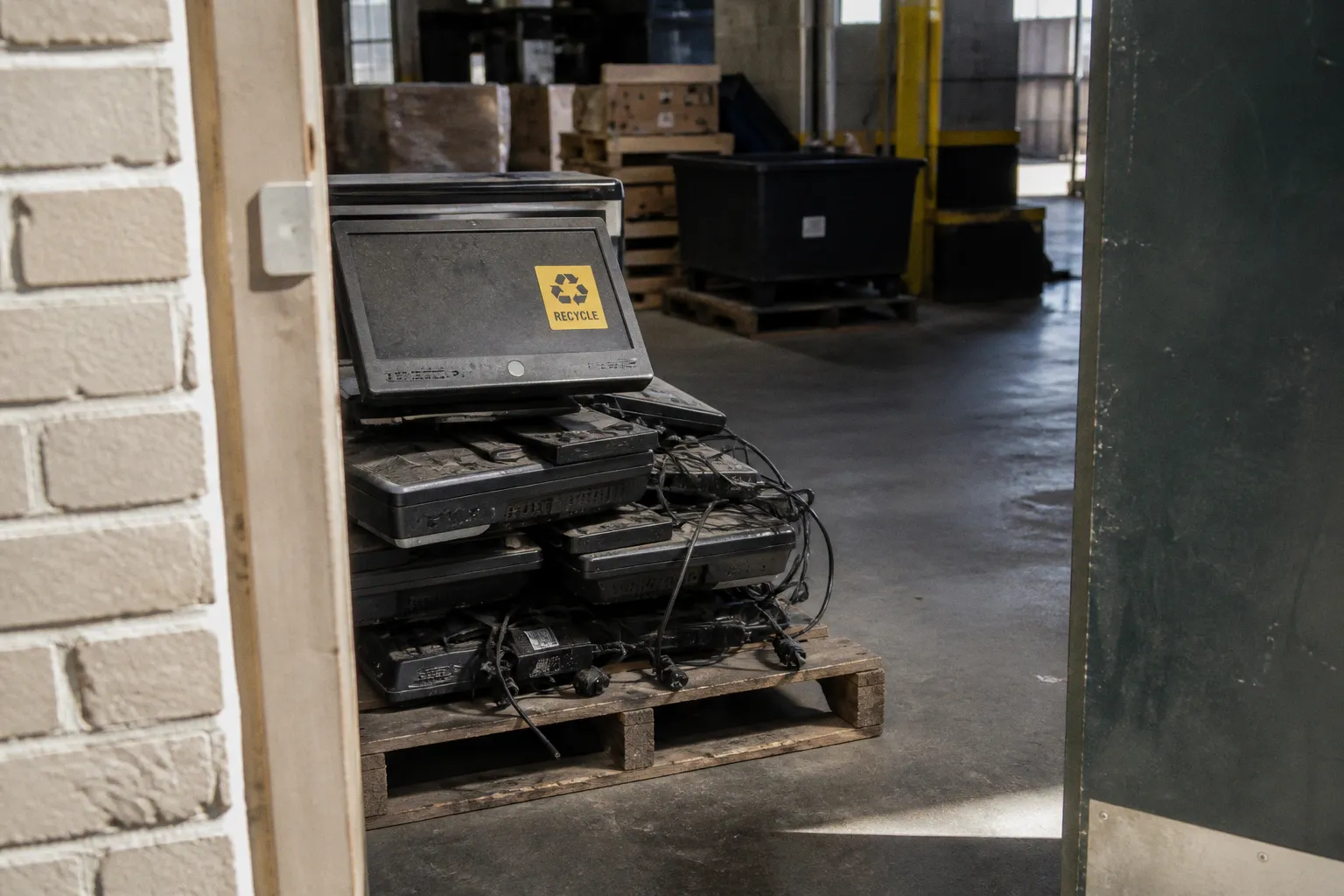
A company laptop remains in a spare bedroom, a monitor disappears into a garage, and a swollen battery waits in a desk drawer while the organization records another year of progress against its environmental framework.
More than 80% of unused corporate IT devices fail to enter a compliant IT asset disposition pathway and remain uncollected in home offices. That is not merely an inconvenience for the IT department. It creates data-security exposure, weakens asset recovery, complicates e-waste reporting, and leaves the company with a circular-economy policy that works mainly in presentation decks.
A credible remote employee e waste disposal policy must therefore do more than tell departing workers to recycle their equipment. It needs a controlled return process, documented chain of custody, certified data sanitization, clear deadlines, and a separate route for hazardous batteries. The bureaucracy is not decorative. In this case, the paperwork is what proves the device went somewhere other than an unmanaged cupboard.
The hidden environmental cost of stranded home-office hardware
Remote work changes the geography of corporate waste. The equipment is still owned by the organization, but it is dispersed across thousands of private addresses, where corporate controls become suggestions and the reverse-logistics budget quietly becomes someone else’s problem.
A standard office makes collection comparatively simple. An employee leaves, the laptop goes to an IT desk, the asset is tagged, wiped, assessed, and either redeployed or sent to a vendor. Remote offboarding breaks that sequence. The worker may receive a termination notice before anyone explains how to return the equipment. A manager may assume IT has arranged collection. IT may assume the employee still has the original packaging. Everyone may be acting in good faith, which is one of the more efficient ways to produce an undocumented asset trail.
This matters for three separate reasons.
First, the company loses control of the physical asset. A laptop that is not returned cannot be reliably reused, refurbished, harvested for parts, or recycled through an approved channel. The environmental cost is not limited to the final disposal event. Manufacturing a replacement device creates additional material demand and embedded emissions, while the original hardware may still contain recoverable value.
Second, remote hardware can become part of the organization’s Scope 3 emissions picture. Remote work and home-working impacts are addressed under Scope 3, Category 7 calculations. The accounting is not a perfect description of every device’s life cycle, but it establishes an uncomfortable connection between distributed work arrangements and environmental reporting: the emissions profile does not stop at the office boundary.
Third, equipment left in homes creates a compliance problem that cannot be solved by a general recycling instruction. A local municipal drop-off point may accept electronics, but that does not establish corporate chain of custody or demonstrate that company data was securely destroyed. A keyboard may be harmless from a privacy perspective; a laptop containing customer records is not.
A remote device is not “recycled” merely because someone has carried it to a recycling center. Until custody, data, and final disposition are documented, the organization has only outsourced its uncertainty.
The first design principle is therefore straightforward: treat every company-issued device as an asset requiring a controlled exit, not as household waste that happens to carry a logo.
Standardizing the chain of custody with mail-back logistics
The most reliable remote process is usually a standardized mail-back system. It is not glamorous, and no one will nominate the return label for an innovation award. It is effective because it removes improvisation from the moment when improvisation is most likely to fail.
A return kit should be prepared around the assets assigned to the worker. At minimum, it needs tamper-evident packaging, protective inserts, pre-labeled shipping documents, and prepaid transport. The packaging should accommodate the actual equipment: laptop, docking station, monitor, mobile device, power adapters, and other company-owned peripherals. Telling an employee to “send back the laptop” while leaving the monitor in the house is how a partial inventory becomes a permanent one.
The kit should also arrive with plain-language instructions. A policy written in legal prose may satisfy a governance committee, but it will not necessarily tell a departing worker whether the charger belongs in the same box, whether the device should be reset, or what to do if the original packaging vanished during a move.
A workable process generally has four timed stages:
1. Initiate the return when offboarding begins.
The return request should be triggered as part of the offboarding workflow rather than handled as a separate favor from IT. Prepaid shipping should be issued within 24 hours of offboarding initiation, so the employee is not left waiting for instructions while access credentials and asset records move in different directions.
2. Confirm the assigned inventory.
The organization should send the employee a clear list of equipment recorded against their name. This is the point to identify missing items, damaged hardware, personal devices accidentally mixed into the inventory, and equipment that was transferred informally between colleagues.
3. Set a defined handover deadline.
A standard return window of five business days after offboarding gives the process a firm edge without pretending that every household and shipping route is identical. If the deadline cannot be met, the exception should be recorded rather than silently tolerated.
4. Record receipt and inspect the shipment.
The asset register should be updated when the package is received, not when a label is generated. Damage, missing components, serial-number mismatches, and battery issues should be logged before the item moves to data sanitization or reuse assessment.
The chain of custody should be visible in the organization’s systems. That does not mean creating a ceremonial avalanche of forms. It means preserving enough information to answer basic questions later: who was assigned the asset, when the return was initiated, which carrier handled it, when it arrived, who received it, and what happened next.
| Control point | What the policy should establish | Why it matters |
|---|---|---|
| Asset assignment | A current record of device type, serial number, user, and location | Prevents equipment from becoming invisible when staff move roles or addresses |
| Return initiation | Automatic trigger during offboarding, with prepaid shipping issued promptly | Avoids the familiar gap between termination and practical instructions |
| Packaging | Tamper-evident materials, protective inserts, and correct shipping documents | Reduces transit damage and supports documented custody |
| Employee deadline | A standard handover period, with exceptions recorded | Turns a polite request into an operational control |
| Receipt | Confirmation of delivery, condition, and included components | Separates a generated label from an actual recovered asset |
| Final disposition | Reuse, refurbishment, resale, parts recovery, or recycling decision | Shows where the device went after collection |
| Data destruction | Certificate or equivalent vendor documentation | Demonstrates that disposal did not leave corporate data behind |
The same process should cover equipment that is easy to overlook. Headsets, mobile phones, security tokens, external drives, and docking stations may have lower resale value than laptops, but a circular system built only around high-value assets is not circular so much as selective.
Navigating data privacy and regulatory compliance in offboarding
An e-waste policy becomes materially more serious once the device contains personal data, health information, customer records, credentials, or internal documents. The environmental objective and the privacy objective are not competing programs. They are sequential controls: first preserve custody, then sanitize data, then determine the device’s next use.
The legal landscape is not one tidy rulebook. The Resource Conservation and Recovery Act can be relevant to electronic waste management in the United States, while HIPAA becomes material where protected health information is involved. GDPR may apply to personal data associated with individuals in the European Union, including data stored on equipment that is being returned from a home office. The precise obligations depend on the organization, the data, and the jurisdictions involved. A universal sentence promising that one disposal method satisfies every requirement would be the sort of non-binding confidence usually found in a weak corporate framework.
The policy should assign responsibilities rather than merely name regulations. IT should control the asset record and technical sanitization process. Information security should define acceptable erasure methods and exceptions. Legal or privacy teams should map the process to the relevant obligations. Procurement and sustainability teams should verify that downstream vendors can document their work. The employee’s role should be limited and clear: package the equipment, return it through the designated route, and do not attempt unapproved data deletion or disposal.
That last point deserves attention. Employees should not be asked to factory-reset corporate hardware as a substitute for certified sanitization. A reset may remove visible user accounts while leaving recoverable data, depending on the device and the storage medium. Nor should an employee be told to take a laptop to a local recycling facility and assume the company’s compliance burden has been transferred with it.
A robust workflow separates three records:
- The asset record: what the device is, where it was assigned, and whether it was received.
- The data record: what sanitization method was used, when it occurred, and whether the process produced a certificate.
- The disposition record: whether the hardware was redeployed, refurbished, sold, dismantled for parts, or recycled.
Certified ITAD vendors commonly work against standards such as R2v3, e-Stewards, and NAID AAA. These standards are not interchangeable magic words, and certification does not remove the need for procurement diligence. They do, however, offer a more verifiable basis for evaluating data destruction, environmental controls, downstream handling, and documentation than a vendor’s promise that everything will be dealt with responsibly.
The organization should also decide what happens when a device cannot be returned. A lost laptop, an employee who has moved abroad, and an unresponsive contractor are not the same operational event. Each needs an escalation route, an asset-status update, and, where appropriate, a security response. The policy should avoid pretending that financial penalties alone solve the problem. A chargeback may recover some value; it does not recover data, reduce emissions, or make a missing device reappear.
The policy language that quietly determines whether the system works
The most useful wording is specific enough to remove discretion from routine cases:
- Company-owned devices remain subject to return procedures regardless of whether the worker is fully remote, hybrid, or temporarily working elsewhere.
- Employees must not place damaged or potentially hazardous batteries in ordinary return packaging.
- The organization provides packaging and shipping instructions rather than expecting workers to improvise.
- Equipment must be returned within the defined timeframe, or the exception must be documented.
- Data sanitization is performed through an approved internal process or certified ITAD provider.
- Final disposition is recorded for every asset, including low-value peripherals where the organization claims they are within scope.
- Any failure to return equipment triggers an escalation path involving IT, security, and the relevant manager.
That is not particularly poetic language. It is also not supposed to be. A policy is a control surface, not a corporate values poster.
Managing hazardous battery risks in a distributed workforce
Lithium-ion batteries make remote office e-waste more complicated than a box of obsolete keyboards. They are present in laptops, phones, tablets, power banks, wireless peripherals, and some backup devices. When damaged or swollen, they can present fire risks during storage and transport.
The critical distinction is between ordinary returns and hazardous-condition returns. A standard prepaid mail-back kit is appropriate only for equipment that can be safely shipped under the carrier’s rules. A swollen battery must not be placed in an ordinary postal mailer simply because the label has already been generated. It requires specialized fire-rated isolation containers and a handling route suited to hazardous-material transport.
Employees need an obvious way to report battery damage before packing anything. The instructions should describe practical warning signs without encouraging amateur repairs: visible swelling, a distorted case, separation of the chassis, unusual heat, smoke, leakage, or a device that no longer rests flat. The policy should tell the worker to stop using the equipment, keep it away from combustible materials where safe to do so, and contact the designated support channel for instructions. It should not ask the worker to puncture, compress, open, or “discharge” the battery.
For the organization, the battery protocol should include:
1. A pre-return condition question.
The employee should confirm whether any device is swollen, damaged, unusually hot, or otherwise unsafe to package.
2. A quarantine route.
Hazardous devices should be routed to a trained specialist or approved facility, not folded into the ordinary parcel stream.
3. Carrier and packaging controls.
The shipping method must reflect the battery’s condition and applicable transport requirements. A generic prepaid label is not a compliance strategy.
4. Incident documentation.
The organization should record the condition reported, the instructions given, the carrier or specialist involved, and the final outcome.
5. Training for help-desk staff.
The first person receiving a battery-related call may be a support agent, not an environmental manager. That agent needs a script that directs the worker to safety rather than to the nearest box.
This is one of the places where a seemingly efficient policy can become recklessly efficient. Reducing every return to one standardized parcel may look good in a process diagram, but batteries do not recognize the organization’s preferred workflow.
Partnering with certified ITAD vendors for circular recovery
Once equipment reaches the organization or its vendor, the central question is no longer simply whether it can be recycled. The better question is what level of value can be retained before material recovery becomes necessary.
A laptop in working condition may be redeployed internally. A device that is too old for the organization’s security requirements may still be suitable for refurbishment, resale, or parts recovery, subject to data sanitization and contractual controls. Only after those options are assessed should recycling become the default destination. This is the practical hierarchy of circular IT asset management: extend useful life where possible, recover components where sensible, and recycle materials when the product itself has reached the end.
That hierarchy needs to be reflected in vendor contracts. A company should be wary of broad language promising responsible recycling without describing the decision process. The contract should address:
- accepted asset categories and excluded hazardous materials;
- data sanitization methods and certificates of destruction;
- serial-number-level reporting;
- repair, refurbishment, resale, and parts-recovery options;
- downstream vendor disclosure;
- handling of batteries and damaged equipment;
- environmental compliance documentation;
- treatment of assets with no recoverable market value;
- timelines for receiving disposition reports.
The financial incentives are not mysterious. Refurbishable equipment has value. Recovered components may have value. Recycled commodities have value, although that value varies by material, condition, and market. Vendors therefore have a reason to prioritize assets that are easy to process and profitable to resell. The organization’s policy should make sure that the difficult items—the damaged monitor, obsolete peripherals, mixed shipments, and battery-afflicted laptop—do not disappear into a so-called downstream solution.
A vendor’s certification is useful, but it should be treated as evidence rather than absolution. R2v3, e-Stewards, and NAID AAA can support confidence in environmental and data-destruction controls, yet the organization still needs to understand what is covered, which facilities are certified, and how subcontractors are governed. A logo on a proposal is not the same thing as an auditable disposition trail.
Measuring whether the program is more than a policy document
The right metrics are operational. Counting the number of sustainability clauses in the policy will not reveal whether hardware is being recovered. A remote office e-waste management program should monitor indicators such as:
- the share of assigned assets with a current user and location;
- the proportion of offboarding events that trigger a return kit within 24 hours;
- the percentage of assets received within the standard five-business-day window;
- the number of devices returned with missing components;
- the volume of assets requiring escalation;
- the rate of certified data-sanitization documentation;
- the proportion of equipment redeployed, refurbished, sold for reuse, recovered for parts, or recycled;
- the number of battery-related incidents and the time taken to resolve them;
- the share of assets with a documented final disposition.
These measurements do not need to become another grand framework. They are useful precisely because they expose where the framework fails. If return kits are issued promptly but assets are not delivered, the obstacle is employee communication, packaging, carrier access, or enforcement. If equipment is received but certificates are missing, the weakness lies downstream. If the company reports recycling volumes without distinguishing reuse from material processing, it may be overstating its circular performance.
There is also a political economy to the process. Procurement may favor the lowest-cost ITAD contract. IT may prefer the simplest shipment. Security may want every device destroyed rather than assessed for reuse. Sustainability teams may want maximum recovery rates. Employees want clear instructions and minimal friction. A workable program has to reconcile these interests without allowing one department’s convenience to masquerade as environmental policy.
Building the policy into the offboarding system
The strongest approach is to make e-waste disposition part of the same controlled workflow used for access removal, payroll changes, and equipment inventory. That means the return process begins automatically, assigns ownership, and generates reminders when deadlines pass.
At the start of employment, the organization should record which equipment was issued and explain that the same inventory will govern eventual return. During employment, transfers between employees and changes of address should update the record. At offboarding, the system should produce the return instructions, identify any special handling requirements, and notify the responsible teams. After receipt, the asset should move through sanitization and disposition with status changes that can be audited later.
This is also where the organization can reduce the environmental burden before disposal becomes necessary. Standardizing device models can improve parts availability and simplify repair. Repairable laptops should not be replaced merely because a component is inconvenient to source. Procurement specifications can favor replaceable batteries, modular components, longer support periods, and packaging designed for repeated transport. Circularity begins at the buying decision, long before the courier collects the box.
The policy should remain readable to the people expected to follow it. A worker leaving the company does not need a dissertation on international waste governance. They need to know what belongs in the package, when it must be sent, where to ask about a damaged battery, and what the company will do with the equipment afterward. The governance apparatus can remain extensive behind the scenes, where it belongs.
A remote employee e-waste disposal policy succeeds when the employee cannot reasonably misunderstand the next action and the organization cannot reasonably lose track of the outcome. That standard is less dramatic than a pledge to eliminate waste, but more useful.
The corporate promise is usually framed as a journey toward circularity, complete with a non-binding framework and an optimistic arrow pointing toward the future. The actual journey begins with a shipping label, a serial number, a battery question, and someone willing to follow the asset after it leaves the home office. Until then, the circular economy remains what it often is in corporate reporting: a closed loop on paper, with the device still sitting in the drawer.