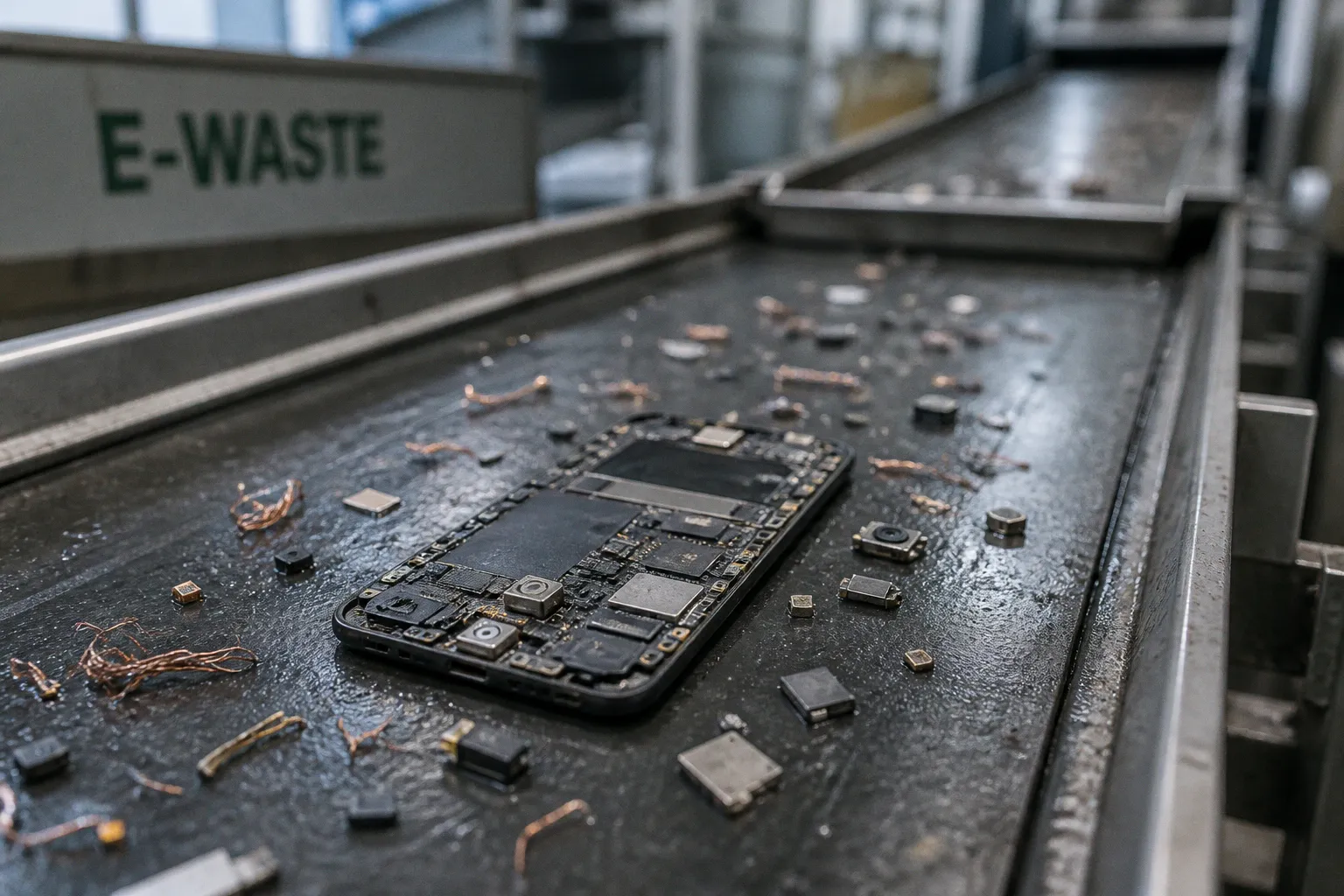
It is where that responsibility should land once a phone, laptop, refrigerator, or power tool has left the shop and entered the waste stream.
Compare car rental deals in United Kingdom
See available offersPartner link — DiscoverCars comparisonUnder individual producer responsibility, each manufacturer finances and manages the end-of-life treatment of its own branded products. Under collective producer responsibility, companies pool those obligations through a Producer Responsibility Organization, or PRO. The distinction looks administrative on paper. In practice, it reaches into product design, collection logistics, repairability, recycling economics, and the physical composition of the material arriving at a treatment plant.
This is the real question behind the debate over individual vs collective extended producer responsibility for e-waste: should the waste trail remain attached to the brand, or should the system be built around shared infrastructure and pooled costs?
EPR began as a design idea, not a waste invoice
Extended Producer Responsibility was formally introduced in a 1990 report by Swedish researcher Thomas Lindhqvist for the Swedish Ministry of the Environment. The original concept was broader than a fee added to a product or an annual compliance return. It moved responsibility upstream, toward the companies that decide what a product contains, how it is assembled, how long it can remain in service, and whether its materials can be separated after use.
That upstream shift matters because an electronics product is already partly a waste-management decision when it leaves the factory.
A battery may be glued into a device or mounted with standard fasteners. A circuit board may contain recoverable metals but sit behind layers of mixed plastics, adhesives, and shielding. A display can be designed for replacement or made economically irreparable after a single failure. None of these choices is made at the recycling plant. By the time the device reaches a collection cage or dismantling line, the most consequential design decisions have already hardened into plastic, solder, glass, and composite assemblies.
EPR frameworks now operate in more than 100 countries across waste categories including electronics, packaging, mattresses, and batteries. Their structure varies considerably, but the underlying pressure is consistent: manufacturers are expected to carry at least part of the financial and operational burden created by products after sale.
The European Union’s WEEE Directive illustrates the institutional choice clearly. Under Article 12, producers may fulfil their financial responsibility for end-of-life electronic products individually or through a collective take-back scheme. The law does not force every manufacturer to build a proprietary collection network. It permits a shared system, because e-waste does not respect brand boundaries once it enters municipal collection, commercial returns, repair channels, or informal handling routes.
That is where the clean theory of responsibility meets the dirty geography of waste.
EPR is strongest when the cost of disposal can still influence the product before it is manufactured.
A refrigerator, smartphone, server, and electric drill do not move through the same recovery system. They differ in weight, hazardous components, repair cycles, resale value, transport requirements, and the market for recovered materials. A successful e-waste model has to connect those differences to a funding structure without making compliance impossible for smaller producers.
Individual Producer Responsibility keeps the brand attached to the waste
Individual Producer Responsibility, or IPR, assigns each manufacturer responsibility for the waste generated by its own products. In the most direct version, a company finances collection, arranges treatment, and reports recovery outcomes for its branded equipment.
The appeal is straightforward. If a manufacturer pays for the products it places on the market, it has a reason to reduce the future cost of handling them. A product that is easier to open, sort, repair, refurbish, and disassemble should create fewer obstacles at the end of its first life. The link between design and disposal is visible rather than diluted across an industry pool.
This is the strongest argument for IPR in the e-waste management policy comparison: it can make design for recovery commercially legible.
A producer that uses modular batteries, accessible fasteners, labelled polymers, replaceable components, and fewer inseparable material combinations may eventually reduce its treatment burden. The same design choices can support repair and refurbishment before recycling becomes necessary. For electronics, that hierarchy matters. Recovering a functioning device or component generally preserves more value than shredding it for metal and plastic fractions.
IPR can also support more precise performance data. A manufacturer may be able to track the return rate, failure profile, refurbishment potential, and material recovery of its own product family. That information can feed into the next generation of devices. Instead of receiving an industry-wide average, the company sees how its own design behaves once exposed to humidity, abrasion, battery degradation, obsolete software, and the rough handling of collection and transport.
But the system becomes difficult when the waste stream is mixed.
Consumers do not usually sort discarded electronics by the future treatment contractor selected by each brand. Municipal depots need practical collection arrangements. Retail take-back points require space and predictable pickup. Logistics providers need to consolidate loads. Treatment facilities need enough volume to operate safely and efficiently. A manufacturer selling a relatively small quantity of equipment may struggle to justify a separate infrastructure, even if its products are distinctive.
IPR also faces an attribution problem. Products change hands. Brands merge or disappear. Components are manufactured by one company and assembled by another. A device may be imported through several channels before being sold, repaired, resold, exported, and finally discarded. Identifying which producer should pay for which unit is possible in some categories, but it is not frictionless.
For that reason, individual producer responsibility electronics programs tend to require strong product identification, reliable reporting, and enough market scale to support dedicated operations.
Where IPR has the greatest leverage
IPR is most persuasive where the waste stream can be traced with reasonable accuracy and design choices have a measurable effect on treatment.
Examples may include:
- Products with distinctive components or established take-back channels, where returned units can be linked to a manufacturer.
- High-value equipment for which refurbishment, component harvesting, or material recovery can offset part of the handling cost.
- Product categories with significant differences in repairability or dismantling time.
- Manufacturers with sufficient scale to influence collection, treatment contracts, and product architecture.
- Companies that want verified information about failure modes and end-of-life performance rather than a pooled sector average.
The benefit is not automatic. A company can operate an individual scheme without redesigning anything. IPR creates the possibility of a stronger design signal; it does not guarantee that the signal will be used.
Collective schemes solve the infrastructure problem
Collective Producer Responsibility, or CPR, pools producer obligations through shared entities known as Producer Responsibility Organizations. The PRO may organize collection, contract recyclers, manage reporting, distribute compliance costs, and coordinate treatment across a large number of manufacturers.
This is the dominant practical route for many small and medium-sized businesses. Their reason is not difficult to understand. Building a proprietary reverse-logistics network for a modest product portfolio can be administratively heavy and operationally expensive. A collective scheme turns that burden into a shared service.
The physical advantages are substantial. A PRO can aggregate volumes from many brands, negotiate treatment contracts, establish collection points, and maintain specialist capacity for hazardous or technically complex components. It can also manage the uneven geography of waste. Electronics are sold everywhere, but they do not return evenly. One region may generate large volumes of small appliances; another may receive commercial equipment, screens, or cooling units. Pooling allows the system to move material toward suitable facilities instead of requiring every producer to reproduce the same network.
The collective model is also more compatible with the way consumers discard electronics. A person bringing a broken charger, router, kettle, or monitor to a municipal site generally wants a functioning collection point, not a brand-by-brand sorting exercise. Retailers and local authorities can work with fewer operational interfaces. Treatment facilities receive more consistent flows. Administrative complexity falls, particularly for businesses without the staff to manage registrations, contracts, audits, and recovery reporting on their own.
Funding arrangements can vary widely. In the available EPR data, rates range from 5 euro cents per kilogram of packaging waste to 1.3 euros per kilogram of plastic packaging in the Netherlands. These figures concern packaging rather than electronics, so they should not be transferred to e-waste as if they were universal prices. They do, however, show how sharply producer fees can differ according to material, policy design, collection system, and national market conditions.
For electronics, a single weight-based fee can obscure important differences. A heavy product is not necessarily more difficult to process than a lighter one. A device containing a removable battery, valuable metals, and standardised components may be easier to recover than a lighter item made from bonded composites. If collective fees are too blunt, they can fail to reward the design choices that make recovery safer and more productive.
Collective recycling schemes: the operational case
The main strengths of CPR are practical:
| Dimension | Individual Producer Responsibility | Collective Producer Responsibility |
|---|---|---|
| Cost allocation | Costs are tied more directly to a manufacturer’s own products | Costs are pooled across participating producers |
| Collection network | Producer may need to arrange or finance dedicated routes | PRO coordinates shared collection and logistics |
| Administrative burden | Higher, especially for smaller producers | Lower because reporting and operations are centralized |
| Design signal | Stronger potential link between product design and end-of-life cost | Weaker when fees do not reflect product-level differences |
| Treatment scale | Can be tailored to a specific product family | Benefits from aggregated volumes and shared contracts |
| Data ownership | More detailed information may remain with the producer | Data is often managed at scheme or category level |
| Main risk | Fragmented, costly infrastructure | Free-riding and diluted incentives for better design |
The table describes tendencies, not fixed outcomes. A well-designed collective scheme can use eco-modulated fees, performance targets, audits, and differentiated treatment requirements to strengthen its design signal. An individual scheme can still be superficial if the manufacturer chooses the cheapest compliant route and treats end-of-life data as a paperwork obligation.
The free-rider problem is built into the collective model
The main weakness of CPR is not that shared infrastructure exists. Shared infrastructure is often necessary. The problem arises when manufacturers share the costs of a waste stream without sharing equal responsibility for the design decisions that shape it.
Academic studies indicate that IPR provides stronger incentives for design for recovery than CPR. In a collective scheme, a company may improve dismantlability while paying into a pool whose fees are calculated broadly across a product category. Another company may keep using glued assemblies, difficult-to-separate materials, or short-lived components while paying a similar rate. The first producer bears the cost of redesign, but the benefits are dispersed. The second can benefit from the common system without making equivalent improvements.
That is the free-rider problem.
It does not mean that every collective PRO is ineffective, nor that IPR is universally superior in practice. Collective schemes can reduce transaction costs, expand collection, and make regulated treatment possible at a scale individual companies cannot reach. Their weakness is more specific: the pooled structure can dilute the connection between a product’s design and its future waste burden.
The design issue becomes visible at the dismantling stage. A technician may need to remove a screen before reaching a battery, cut through adhesive to separate a housing, or handle mixed materials that cannot enter the same recovery process. Each additional step consumes labour and increases the chance of damage or contamination. A product designed for straightforward disassembly leaves a different physical legacy from one designed only for fast assembly.
Yet the cost difference may not appear in a simple collective fee.
How collective schemes can recover the missing signal
The answer is not necessarily to abandon PROs. It is to make pooled systems more discriminating.
Possible mechanisms include:
- Eco-modulated fees, with higher charges for products that are hazardous, difficult to dismantle, or poorly recyclable and lower charges for products with better recovery characteristics.
- Design-for-recovery criteria, such as accessible batteries, standard fasteners, material marking, and documented disassembly procedures.
- Separate treatment targets, preventing high-performing products from being averaged into a broad category with lower-performing ones.
- Audited reporting, so recovery claims reflect actual treatment outcomes rather than only the mass entering a facility.
- Repair and refurbishment metrics, recognising that extending product life can be more valuable than immediate material recycling.
- Transparent PRO governance, giving producers, recyclers, municipalities, and public authorities visibility into how fees are calculated and contracts are awarded.
These measures can make a collective scheme more responsive to product design while preserving the logistical benefits of shared operations. The challenge is institutional: the PRO must have enough information and authority to distinguish between products, and regulators must be willing to require more than a generic per-kilogram contribution.
E-waste does not move in a straight line from sale to recycling
The most important comparison between IPR and CPR is often described as a choice between incentives and efficiency. That is accurate, but incomplete. E-waste is a shifting material stream, and both models have to deal with what happens between purchase and disposal.
A laptop can move through a workplace, a household, a repair shop, and a resale market before it becomes waste. A phone may be stored in a drawer for years because its owner is uncertain how to dispose of it. A damaged battery can leave the normal stream entirely if it is removed by an informal operator or placed in general waste. A cooling appliance requires a different treatment pathway from a small electronic accessory. The branded object is still present, but the chain of custody is not.
This weakens simplistic claims about producer control. IPR can generate better information only if the manufacturer can capture a meaningful share of its products at end of life. CPR can provide wider access only if the shared system reaches the places where products actually become waste.
The contrast can be mapped across the ecosystem:
1. At the point of sale, the manufacturer controls product architecture, materials, component access, and information supplied to the user.
2. During use, repairability, software support, spare parts, and battery replacement affect whether an item remains a product or becomes waste.
3. At return, convenience determines whether the device reaches an authorised channel, a retailer, a municipal depot, a repair network, or no formal system at all.
4. During sorting and treatment, composition, contamination, hazardous content, and disassembly time determine the real cost of recovery.
5. After treatment, the value and quality of recovered metals, plastics, glass, and components determine whether circular use is technically and economically viable.
No EPR model controls all five stages by itself. A manufacturer may design a repairable product but lose visibility after resale. A PRO may operate a broad collection network but have limited influence over product design. A regulator may set recovery targets while lacking reliable data about leakage from the formal system.
This is why the choice between individual and collective responsibility should be made by product category rather than ideology.
Choosing between IPR and CPR without pretending the trade-off disappears
The right model depends on the structure of the market, the physical nature of the product, and the maturity of the recovery network.
IPR is more defensible when individual products can be identified, manufacturers have enough volume to organise take-back, and design differences materially affect treatment. It can also suit companies that use end-of-life data as part of product development. If a firm is serious about modular construction, repair, refurbishment, and component recovery, a more direct responsibility structure can help it measure whether those choices work outside the engineering department.
CPR is more practical when the market contains many smaller producers, products are collected through common municipal or retail channels, and treatment requires volume. Most small and medium-sized businesses choose collective EPR schemes because setting up proprietary collection and recycling infrastructure creates an administrative burden they cannot efficiently carry alone.
A decision framework should therefore ask questions that reflect the waste stream itself:
- Can products be reliably attributed to one producer at the point of collection?
- Does the manufacturer sell enough volume to support dedicated logistics and treatment contracts?
- Are design differences visible in dismantling time, repair potential, hazard management, or material recovery?
- Does the existing collection system already depend on municipal, retailer, or shared infrastructure?
- Can a PRO apply differentiated fees rather than charging all products as if they created the same burden?
- Will the scheme measure reuse, repair, refurbishment, and component recovery, or only tonnes collected?
- Are data about treatment outcomes available to the companies making design decisions?
- Can the regulator audit the system strongly enough to prevent under-reporting and weak treatment?
The answer may be a hybrid arrangement. A collective PRO can handle collection and baseline compliance while individual producers retain responsibility for product-specific design, take-back pilots, refurbishment channels, or higher recovery standards. This avoids forcing every company to recreate a national logistics network while preserving a route for manufacturers that want more control over their material flows.
The critical distinction is between shared operations and shared accountability. They are not the same thing.
A common collection network does not require common indifference to product design.
The policy question is moving upstream
EPR began as an attempt to make producers account for what happens after sale. In e-waste, that accounting cannot stop at the weight of material collected. A tonne of mixed electronics says little about how much was repaired, how safely hazardous components were removed, or how much material returned to productive use.
The next phase of EPR will be judged by the quality of the connection between design and recovery. Collective schemes will need more precise fees and better treatment data. Individual schemes will need to prove that brand-specific responsibility is operationally credible rather than merely attractive in theory. Regulators will have to distinguish between compliance that moves waste and compliance that changes products.
The physical end point remains a treatment floor crowded with cables, casings, boards, batteries, and screens. But the decision that shapes that floor was made much earlier: in a procurement specification, a materials list, a fastening system, a warranty policy, or a fee schedule.
IPR offers the sharper incentive. CPR offers the broader operating system. Neither is sufficient when isolated from the other.
For e-waste, the durable approach is likely to combine collective infrastructure with individual design accountability: shared where the waste stream demands scale, specific where product choices determine whether recovery is possible at all. That is the point at which circular economy policy stops being a financing arrangement and begins to alter the material life of electronics.