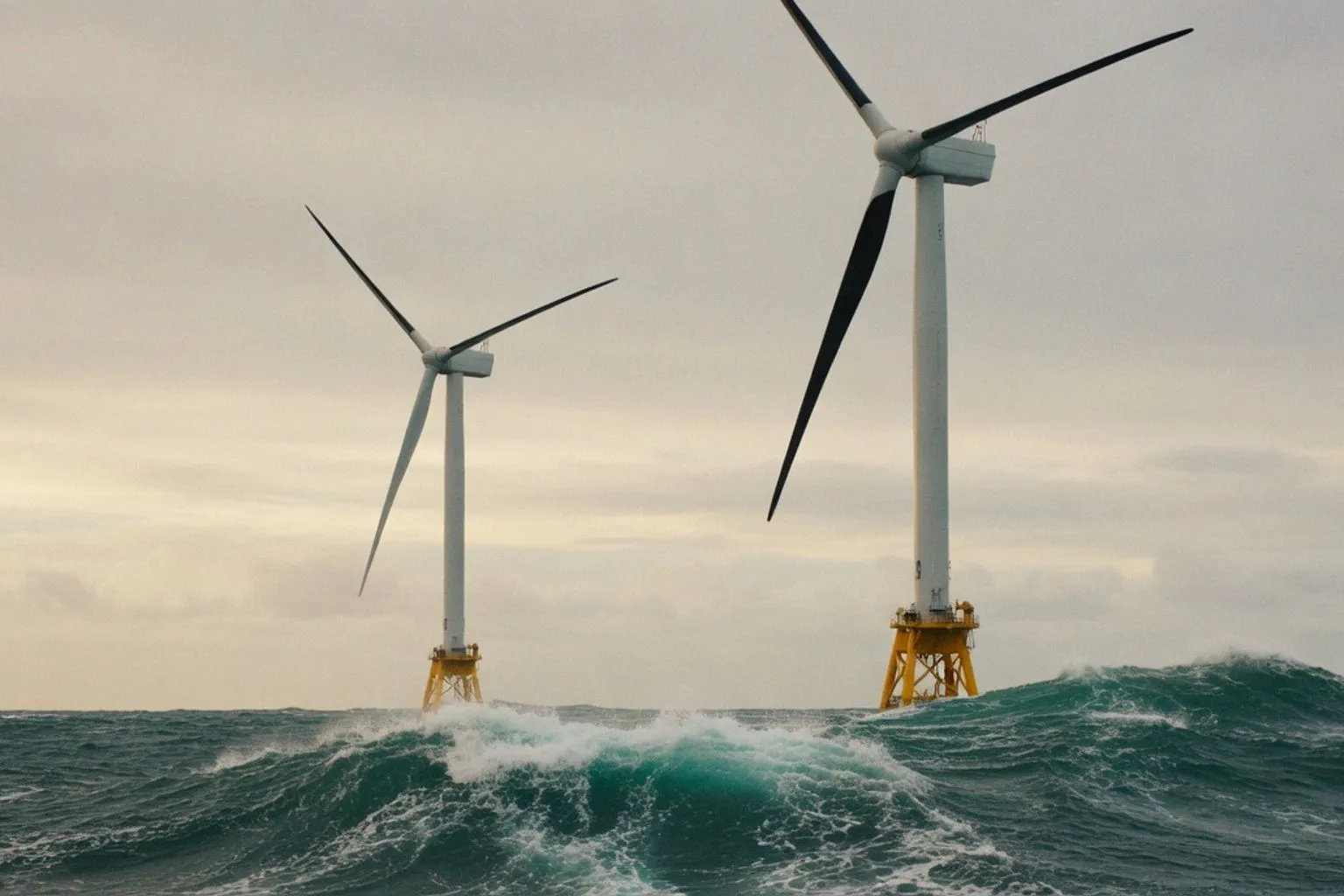
According to the U.S. Department of Energy, offshore wind has a modeled technical resource potential exceeding 4,200 gigawatts of capacity and 13,500 terawatt-hours of annual generation. That is three times total U.S. electricity consumption, but it is not a construction pipeline or a guarantee of delivered power. The engineering bottleneck is clear: much of the resource lies in deep water, where conventional fixed foundations are impractical.
The resource is large. The buildout is not simple.
The DOE says offshore wind could supply substantial electricity to cities along U.S. coastlines. Nearly 80% of U.S. electricity demand occurs in coastal and Great Lakes states, placing much of the potential generation close to major load centers.
That proximity matters. Offshore projects send electricity to shore through undersea cable systems buried in the seabed. Coastal load centers then route the power into the wider grid for homes, schools, and businesses. The transmission connection is therefore part of the asset, not an afterthought.
The headline resource estimate comes from modeled wind data produced by the National Laboratory of the Rockies using the Wind Integration National Dataset Toolkit. The map is intended for general educational purposes. In financial terms, the figure describes technical availability, not bankable capacity. Permitting, construction, grid connection, financing, and port logistics still determine what can be built.
Scale is another variable. Offshore turbines can reach roughly one-and-a-half times the height of the Washington Monument, with blades about the length of a football field. Larger machines can produce more electricity, reducing the number of turbines required for a given output and potentially lowering costs. That benefit must be weighed against the capital intensity of manufacturing, installation, maintenance, and specialized vessels.
Deep water changes the foundation equation
About two-thirds of U.S. offshore wind resources are in waters too deep for conventional foundations such as large steel piles or lattice structures fixed to the seabed. This is the central engineering distinction between shallow-water and deep-water development.
Floating platforms are being researched for these sites. The DOE identifies four platform types: spar-buoy, tension-leg platform, semi-submersible, and barge. Each represents a different approach to stabilizing a turbine in deep water. The supplied material does not establish that any one design has achieved commercial dominance.
Floating wind expands the geographic envelope, but it also adds system complexity. The platform, mooring arrangement, subsea cable, port, and installation vessel must function as one integrated system. A larger theoretical resource does not automatically translate into lower capex or faster deployment.
The supply chain is already part of the investment case. Between 2022 and 2024, the U.S. offshore wind industry invested more than $6.8 billion in manufacturing facilities, ports, 25 vessels, and a transmission substation. That is evidence of industrial preparation. It is not evidence that the sector has eliminated its execution risks.
The DOE also says the U.S. wind industry is adapting to challenges and could support thousands of new jobs while expanding renewable-energy access for millions of Americans. Those are stated potential outcomes, not quantified employment or deployment results in the material provided.
The timing advantage is real—but incomplete
Offshore wind has a useful generation profile in some planned project areas. Wind speeds are often highest during the afternoon and evening, when electricity demand peaks. The DOE contrasts this with many land-based wind resources, which are stronger at night when demand is lower.
That alignment can improve the value of wind output, but it does not convert wind into baseload generation. Offshore production remains dependent on weather conditions, while grid operators must still manage variability and maintain transmission capacity.
For readers tracking the energy transition, the practical checklist is straightforward. Separate modeled technical potential from projects under construction. Check whether a proposal requires fixed or floating foundations. Examine the transmission route and coastal load center. Then look at the supply-chain requirements: ports, vessels, manufacturing capacity, and the substation needed to move power into the grid.
The commercial test is therefore narrower than the resource headline. Offshore wind has abundant modeled potential, large turbines, a demand-center advantage, and a growing industrial base. Its viability will be determined by whether deep-water foundations, transmission, and heavy infrastructure can be delivered at acceptable capex and schedule risk. The resource is not the constraint. Execution is.