Biochar Soil Application: Restoring Degraded Land Fertility
A single input cannot solve all of those constraints.
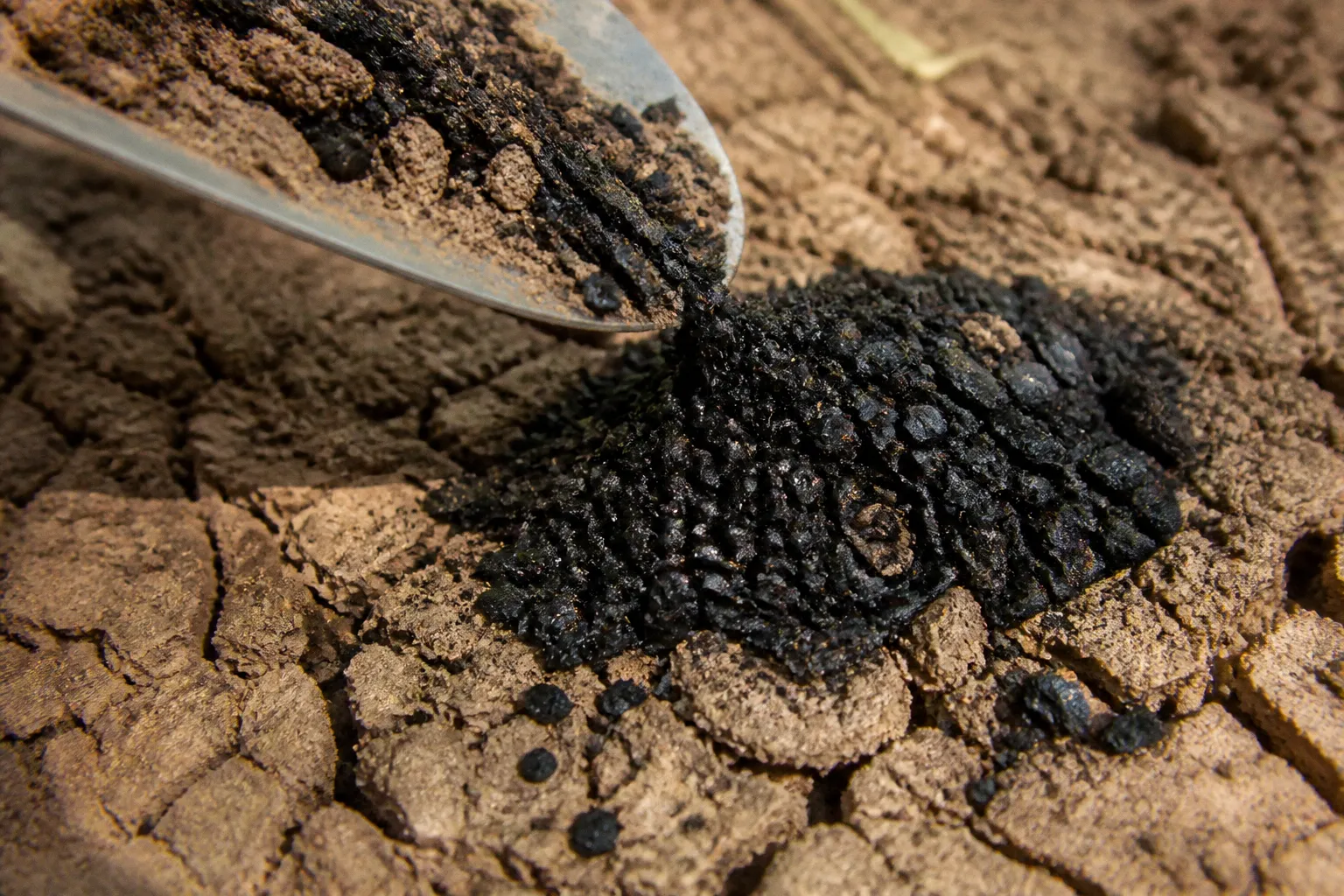
Biochar is useful because it is not simply a fertilizer. It is a porous, carbon-rich material produced by heating organic biomass in limited oxygen. Properly engineered, it can improve nutrient retention, immobilize selected contaminants, support soil carbon sequestration, and provide a durable substrate for rebuilding biological function. But its performance is conditional. Feedstock, pyrolysis temperature, soil chemistry, application rate, and the presence of compost or fertilizer all change the outcome.
That makes biochar application for soil health restoration an engineering decision rather than a universal recipe.
The science of pyrolysis: the feedstock becomes the system
Biochar is produced through pyrolysis. Biomass is heated with insufficient oxygen for full combustion, leaving a solid carbon-rich fraction alongside gases and liquids. The operating parameters determine the structure and chemistry of the final material.
Slow pyrolysis generally operates between 250°C and 500°C, with heating rates at or below 100°C per minute. This process produces a comparatively high proportion of solid biochar. Fast pyrolysis uses heating rates above 1,000°C per minute and is optimized more heavily toward liquid and gas products.
For soil restoration, the distinction is not academic. It determines the material’s pore structure, surface chemistry, carbon stability, ash content, and nutrient profile.
Lower-temperature biochar generally retains more volatile compounds and surface functional groups. These features can increase cation exchange capacity, allowing the material to hold positively charged nutrients such as ammonium, potassium, calcium, and magnesium. Higher-temperature biochar tends to be more carbonized and structurally persistent, but it may offer a different balance of nutrient content and surface reactivity.
The production feedstock is equally consequential:
- Woody biomass often produces a relatively carbon-dense, structurally stable biochar with lower nutrient content.
- Crop residues can generate biochar with more ash and mineral nutrients, depending on the feedstock and process conditions.
- Manure-derived biochar may contain more phosphorus and potassium, but it requires tighter screening for salts, pathogens, and contaminants.
- Biomass from polluted sites can transfer heavy metals or other undesirable compounds into the final product.
A restoration program therefore needs a material specification, not merely a tonnage target. “Biochar” describes a class of materials. It does not describe one standardized product.
Biochar is durable infrastructure for soil chemistry, not a bag of instant fertility.
The wrong material can produce weak results or create a new contamination pathway. The right material can function as a long-lived amendment that changes how water, nutrients, and pollutants move through the soil profile.
What biochar changes in degraded soil
The main biochar soil amendment benefits come from physical and chemical interactions rather than from direct nutrient supply alone.
Its pore network can improve water retention in coarse, degraded soils while also creating microsites that protect organic compounds from rapid decomposition. Its surfaces can adsorb dissolved nutrients and contaminants. Over time, oxidation at the particle surface can increase the number of reactive functional groups, changing how the biochar interacts with the surrounding soil.
The practical effects fall into several categories.
Nutrient retention
Degraded soils often lose fertility through erosion, leaching, or the removal of organic matter. Applying a porous carbon material can increase the soil’s capacity to retain nutrients within the root zone. This is particularly relevant where rainfall is intense, irrigation is poorly managed, or the soil has low cation exchange capacity.
Low-temperature pyrolyzed biochar can show high cation exchange capacity because it retains more surface functional groups. That does not mean it supplies a complete nutrient package. It means it can improve the holding capacity of the soil system.
This distinction matters. In severely nutrient-depleted land, biochar alone cannot be treated as a replacement for synthetic fertilizer. It may reduce nutrient losses or improve fertilizer efficiency, but plants still require an available supply of nitrogen, phosphorus, potassium, and micronutrients.
Water movement and soil structure
Degraded land frequently has one of two opposing problems: rapid drainage through coarse soil or poor infiltration through compacted soil. Biochar can influence both conditions, but not in the same way or at the same rate.
Fine particles and porous material can hold water in sandy soils. In compacted soils, the effect depends on incorporation, particle size, organic matter, and the existing pore network. Surface broadcasting without mixing may have limited influence below the upper soil layer. Deep incorporation can disturb roots, microbial communities, or recovering vegetation if undertaken without a site-specific plan.
The material should be evaluated as part of the soil profile. A field with shallow topsoil, a compacted sublayer, and seasonal saturation will not respond like an upland sandy site. The same application rate may improve one system and produce negligible results in another.
Soil biological recovery
Biochar can provide microsites for microbial activity and may help retain dissolved organic compounds. Its effect on soil biology is indirect and context-dependent. Microbial communities respond to carbon availability, moisture, pH, mineral surfaces, nutrient status, and the presence of plants.
Compost is often a more immediate source of biologically active organic matter. Biochar supplies persistence and structure. The combination can be more functional than either input alone because the compost provides decomposable carbon and nutrients while the biochar improves retention and habitat conditions.
This is one reason biochar should not be marketed as a standalone cure for ecosystem degradation. Soil recovery requires a functioning plant community, water management, organic inputs, and time.
Heavy metal immobilization: strong potential, narrow claims
Contaminated land is where biochar’s surface chemistry receives the most attention. Engineered biochar can adsorb or immobilize heavy metals, reducing their mobility in soil or water. The mechanism may involve surface adsorption, ion exchange, precipitation, and changes in pH.
Reported removal efficiencies for engineered biochar have reached:
| Contaminant | Reported removal efficiency |
|---|---|
| Chromium(VI) | Up to 85% |
| Cadmium ions | Up to 73% |
| Mercury ions | Up to 99.3% |
| Europium ions | Up to 99.2% |
These figures describe maximum reported performance under specific experimental conditions. They are not field guarantees. Soil texture, pH, dissolved organic matter, competing ions, moisture regime, contaminant concentration, and biochar properties can all change the result.
The distinction between removal and immobilization also matters. Biochar added to soil may reduce the fraction of a metal that is mobile or bioavailable without eliminating the metal from the site. The contaminant remains in the soil system. It has simply been shifted into a less mobile chemical form.
That can still be valuable. Lower mobility may reduce plant uptake, groundwater transport, and exposure risks. But the site requires monitoring. Changes in acidity, flooding, root exudates, decomposition, or redox conditions can alter the stability of the immobilized fraction.
For biodiversity and conservation projects, this is particularly relevant. A restored wetland or riparian corridor can become a contaminant transport pathway during seasonal saturation. An amendment that performs well under dry, aerobic conditions may behave differently when the soil is waterlogged.
A credible remediation program should therefore track:
- Soil and pore-water contaminant concentrations.
- Metal bioavailability rather than total concentration alone.
- Soil pH, electrical conductivity, and redox conditions.
- Plant tissue concentrations where food webs or wildlife exposure are relevant.
- Changes in groundwater or surface-water chemistry.
- The persistence of the immobilization effect over time.
Biochar can reduce risk. It does not erase the need for contaminant management.
Why biochar and compost often outperform biochar alone
The strongest yield result in the available research comes from combined application. Synthesized agricultural studies reported a 43.3% yield increase for standalone biochar, while a biochar–compost mixture increased crop yield by 155%.
Those figures should be read as comparative evidence, not as a universal production forecast. The studies combine different soils, crops, feedstocks, application rates, and baseline conditions. A 155% increase is possible within the tested conditions. It is not a dependable expectation for every degraded field.
The underlying logic is straightforward. Biochar is chemically persistent but often nutrient-poor. Compost is biologically active but decomposes more rapidly. Together, they can create a better balance between immediate fertility and long-term retention.
The mixture may improve performance through several pathways:
1. Nutrient loading. Compost supplies mineralizable nutrients that can occupy biochar surfaces and reduce early nutrient losses.
2. Microbial activation. Compost introduces organic substrates that support microbial activity during the initial restoration period.
3. Moisture management. Biochar can help retain water and dissolved nutrients released from compost.
4. Reduced nutrient volatility. In suitable conditions, porous carbon can capture compounds that would otherwise leach or volatilize.
5. Improved aggregation. Organic matter and mineral particles can bind into more stable aggregates, improving the physical condition of the soil.
6. Contaminant interaction. Biochar may reduce the mobility of selected metals while compost supports plant establishment and soil biological recovery.
The correct blend depends on the site. Excessive compost can raise salinity or nutrient loads. Excessive biochar can alter pH or create an imbalance in nutrient availability. Manure-based materials require additional scrutiny because their mineral and contaminant profiles can vary substantially.
A restoration manager should assess the amendment as a combined system. The question is not whether biochar is beneficial in isolation. The question is whether the biochar–organic matter combination improves the limiting process on that site.
Carbon sequestration: persistence is the commercial asset
Biochar’s carbon value comes from its resistance to rapid decomposition. Its recalcitrant carbon structure can persist in soil for hundreds to thousands of years. That makes it different from fresh plant residues or compost, which contribute to soil organic matter but are more readily decomposed.
This persistence gives biochar a role in soil carbon sequestration methods. Biomass that would otherwise decompose or be burned can be converted into a stable carbon fraction and placed in soils where it may remain for extended periods.
The climate accounting is not automatic. The full system includes:
- Biomass collection and transport.
- Drying requirements.
- Pyrolysis energy use.
- Methane and nitrous oxide emissions.
- The fate of pyrolysis gases and oils.
- The source and sustainability of the feedstock.
- Transport and incorporation into soil.
- Changes in fertilizer use or crop productivity.
- Potential carbon loss during production or handling.
A biochar project using waste biomass near the restoration site has a different emissions profile from one transporting wet residues over long distances. A project that clears standing vegetation to create feedstock is not a conservation project, regardless of the stability of the resulting carbon.
Feedstock governance is therefore central. Sustainable forestry residues, agricultural by-products, and carefully screened organic wastes may support a defensible carbon case. Removing coarse woody debris from sensitive habitats or diverting biomass from existing ecological functions may create costs that are not visible in a carbon balance.
Biochar’s persistence is commercially attractive because it can create a durable carbon storage claim. That claim depends on measurement, verification, and lifecycle accounting. The material’s long residence time does not compensate for poor sourcing or inefficient production.
Long-lived carbon is only an asset when the feedstock and process do not create a larger ecological liability.
Applying biochar to soil: the variables that control the outcome
There is no universal optimal application rate across all degraded soils, feedstocks, and climate zones. That remains a central limitation for large-scale deployment.
The correct rate depends on the baseline soil and the specific constraint being addressed. A sandy agricultural field, a mine tailings site, a saline soil, and a contaminated wetland require different treatment logic. The amendment should be tested at small scale before broad deployment.
Several variables deserve particular attention.
Feedstock quality
The material should be screened for contaminants, ash content, pH, electrical conductivity, nutrient concentration, and stability. Biochar made from polluted biomass may concentrate metals. A high-ash product may raise salinity or alkalinity. A poorly characterized material creates uncertainty at the point where restoration programs can least afford it.
Pyrolysis conditions
Temperature and heating rate influence carbon stability, surface chemistry, and yield. Slow pyrolysis between 250°C and 500°C produces higher biochar yields than fast pyrolysis, but the correct operating point depends on the intended use. Soil remediation may prioritize surface reactivity. Carbon storage may prioritize persistence. Agricultural use may require a different balance.
Particle size
Fine particles offer greater surface area but can create dust and may move through the soil profile. Coarser particles are easier to handle and may persist as structural pores, but they expose less surface area in the short term. Particle size also affects incorporation, erosion risk, and worker safety.
Soil chemistry
pH determines how metals, nutrients, and biochar surfaces interact. A strongly alkaline biochar may be useful in acidic soil but counterproductive where alkalinity already limits micronutrient availability. Salinity must be monitored, particularly when manure-derived biochar or high-ash feedstocks are used.
Application method
Broadcasting and incorporation produce different distributions. Surface application can reduce disturbance in recovering habitats, but it may have limited effect below the topsoil. Mechanical incorporation can improve contact with the soil matrix, but it also consumes fuel and may disturb roots, fungal networks, or soil fauna.
Plant establishment
Biochar does not restore a landscape without vegetation. In biodiversity projects, the endpoint is not simply higher crop yield. It may be native plant survival, reduced contaminant uptake, improved infiltration, habitat continuity, or the return of soil invertebrates.
The amendment strategy should follow the ecological objective. A biochar program designed for annual crops cannot be transferred directly to a wetland, forest edge, or wildlife corridor.
A practical decision framework for degraded land restoration
A robust program can be organized around five decisions.
1. Define the limiting failure. Determine whether the main constraint is nutrient loss, low water retention, compaction, contamination, erosion, salinity, or a combination of these.
2. Characterize the input. Test feedstock origin, pyrolysis conditions, pH, conductivity, nutrient profile, contaminant content, and carbon stability.
3. Run controlled trials. Compare untreated soil, biochar alone, compost alone, and a combined treatment where appropriate. Measure plant establishment and soil chemistry rather than relying only on short-term biomass.
4. Monitor the ecological response. Track contaminant mobility, water quality, vegetation composition, soil biology, and signs of unintended nutrient or salt accumulation.
5. Scale only after the constraint is demonstrated. Commercial deployment should follow evidence from the target soil and climate, not performance claims from unrelated systems.
This is slower than bulk application. It is also cheaper than correcting a poorly designed intervention across hundreds of hectares.
The conservation case is promising, but not automatic
Biochar fits best into restoration programs where organic residues are available, soils are degraded, and the target outcome includes improved nutrient retention or contaminant immobilization. It can support reforestation projects, agricultural rehabilitation, mine-land recovery, and some wetland buffer initiatives.
Its role in biodiversity conservation is more indirect. Biochar can improve the conditions under which native vegetation establishes. Better soil structure can reduce erosion into streams. Lower metal mobility can reduce exposure within recovering food webs. Stable carbon can extend the climate value of biomass that would otherwise return rapidly to the atmosphere.
But the material does not replace habitat protection. It does not compensate for deforestation, hydrological disruption, invasive species, or continued pollution. Applying biochar to a damaged ecosystem while leaving the original pressure in place is an expensive way to treat symptoms.
The commercial viability is strongest where biochar production can use local residues, generate useful heat or energy, and serve a clearly defined soil constraint. Projects dependent on long-distance transport, uncertain feedstock, or unverified carbon claims face a weaker business case. The capex and logistics must be matched by measurable agronomic or remediation value.
Biochar is not a universal fertility input. It is a persistent soil amendment with a flexible but highly conditional operating envelope. Used with compost, targeted nutrient management, and ecological monitoring, it can become a practical tool for degraded land restoration. Used as a generic black powder applied at scale, it is mostly a branding exercise with carbon attached.
The engineering case is credible. The deployment case depends on site chemistry, feedstock discipline, and whether the project measures restoration rather than material volume.