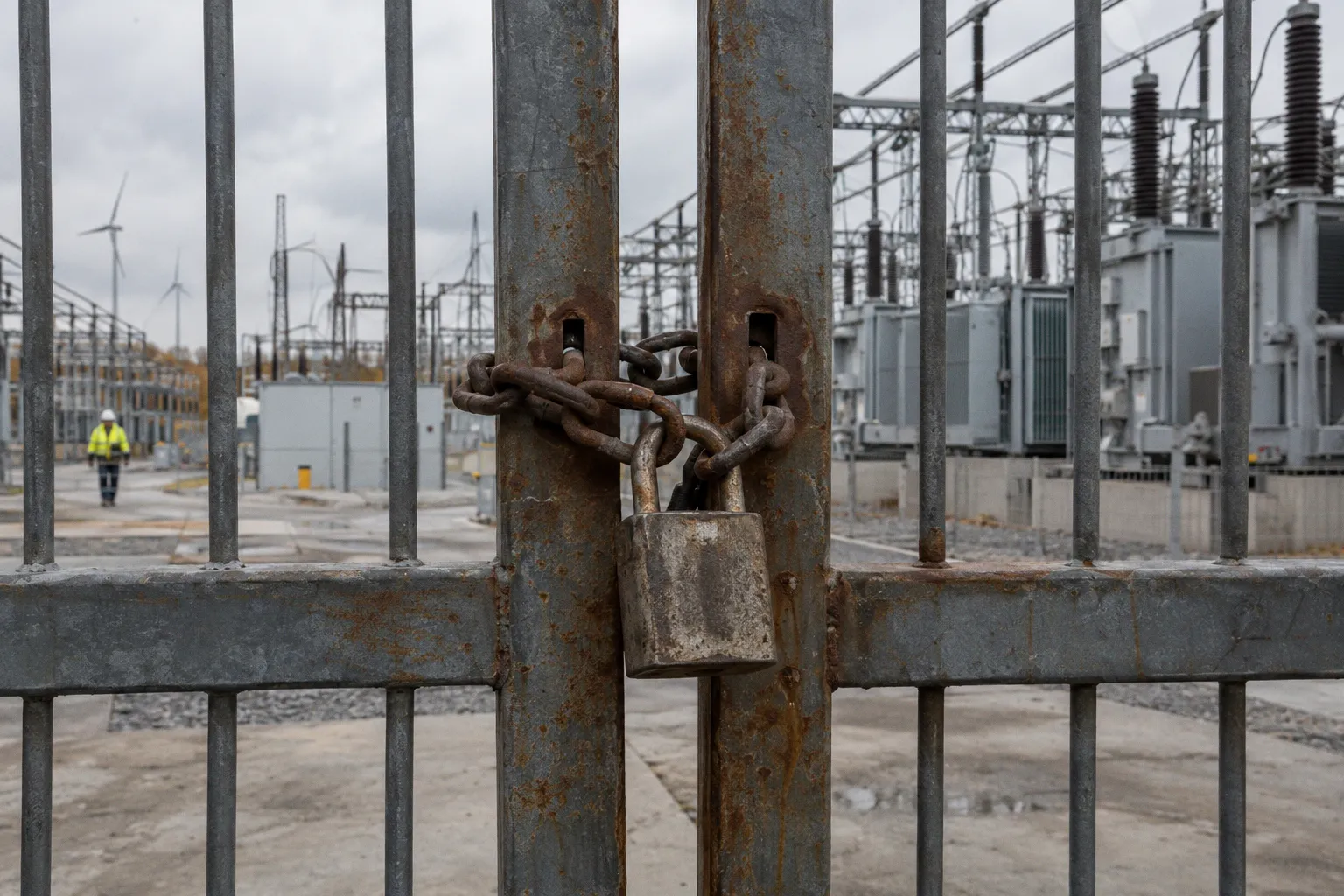
More than 2.5 terawatts of renewable, storage, and large-load projects sit in grid connection queues worldwide — a backlog that, according to new analysis from the World Business Council for Sustainable Development (WBCSD), already eclipses what most national grids can absorb. Curtailment is climbing in nearly every market tracked, with Brazil alone reporting roughly 20% of wind and solar output discarded through 2025 and into 2026. For the energy transition's industrial backers, the bottleneck has migrated decisively from the generating asset to the wire.
The queue is the cap
The fastest-growing constraint on clean power is no longer panels, turbines, or even capital — it is the permit-to-energize timeline. WBCSD's Business Breakthrough Barometer, published this year with Bain & Company and the Breakthrough Agenda, frames the structural mismatch bluntly: grid planning cycles typically run four to five years, while new generation capacity enters the pipeline annually at a much faster cadence. The result is a structural overhang of unconnected projects and a parallel climb in curtailment wherever surplus power cannot be moved.
The data is concrete. Brazil's grid operator reported roughly 20% of wind and solar output curtailed through 2025 and into 2026, up from a small fraction a few years prior. WBCSD cites steep increases in the United Kingdom, Australia, and Spain as well. Most of the global backlog sits in solar and storage — asset classes with build and permitting timelines that compress to a fraction of the lead time required for new transmission.
An industrial technology executive interviewed for the report described customers seeking connections for charging infrastructure only to be told sufficient capacity simply wasn't available. A steel industry executive named the pace of grid expansion, not the pace of decarbonization technology, as the factor most likely to determine how fast that company's own transition could move.
Reordering the queue
Some system operators are no longer treating connection order as inviolable. Denmark's Energinet formally abolished first-come, first-served allocation for large-load connections on February 1, 2026, replacing it with a framework that prioritizes projects closer to construction. Germany, Spain, and the UK have moved in similar directions since 2025. France has shifted its peak and off-peak pricing windows to drag demand toward hours when generation is cheapest and most abundant — in effect, asking load to meet supply halfway rather than waiting for supply to reach demand everywhere at once.
WBCSD's prescription runs further than queue reordering. The organization argues for capacity payments, dynamic tariffs, and standardized flexibility markets that let businesses and distributed assets shift consumption toward periods of abundant power. The intent is to extract more utilization from existing network capacity before committing to years of new line construction.
The new PPA math
For project developers and corporate buyers, the practical question has changed shape. A power purchase agreement signed against an asset still sitting in an interconnection queue now carries real delivery risk, and grid congestion is increasingly shaping contract terms and site competitiveness independent of the underlying generation economics.
Facilities teams in tight markets are already hedging that exposure. WBCSD documents a growing pattern of pairing behind-the-meter generation with grid supply, so a single connection delay does not stall an entire project. In capex-heavy, baseload-sensitive sectors — steel, large-scale electrified manufacturing, data centers — siting decisions are now being driven by queue position as much as resource quality, labor cost, or tax regime.
What to watch next: whether curtailment figures keep climbing through the 2026 reporting cycle; whether more operators adopt France-style tariff windows; and how quickly PPAs begin pricing interconnection status explicitly into contract terms. The technology story keeps improving. The grid story now determines how much of it actually runs.