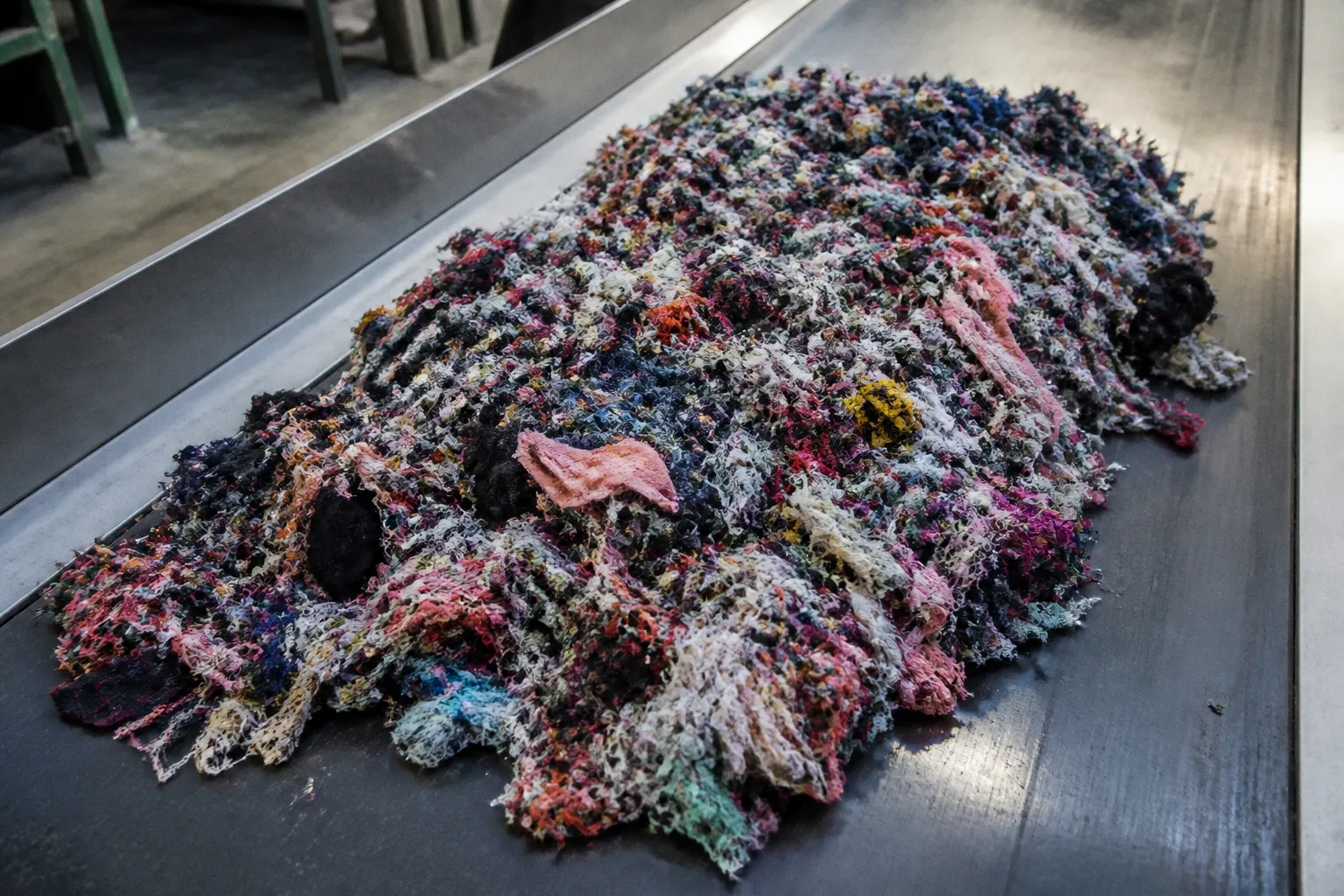
A garment made from cotton and polyester can be durable, inexpensive, and difficult to recycle at the same time. The two fibers are integrated into one fabric because their properties complement each other. Cotton provides moisture management and comfort. Polyester contributes strength, dimensional stability, and low cost. At end of life, those same properties become a process-engineering constraint.
More than 124 million tonnes of textiles are produced globally each year. Only about 10% of textile waste is recycled, and much of that output is downcycled into insulation, wiping cloths, or other low-value products. In the European Union, textile waste exceeds 15 kg per person annually. Landfill and incineration remain the dominant end-of-life routes.
That is the baseline for evaluating textile recycling technologies for mixed fiber waste. The relevant question is not whether a process can recover material in a controlled demonstration. It is whether the process can accept variable post-consumer feedstock, separate the fibers at usable purity, tolerate contaminants, and produce a material that can re-enter textile manufacturing without an uneconomic capex burden.
The 10% problem: why current textile recycling falls short
Mechanical recycling works best when the input stream is already simple. A relatively clean, single-fiber textile can be shredded, opened, carded, and converted into a new nonwoven product or yarn blend. The process is established and comparatively straightforward.
Polycotton is different. A cotton-polyester fabric contains fibers with different chemical identities and different responses to heat, solvents, and mechanical stress. Shredding does not separate them. It only reduces the textile to a smaller mixture.
That distinction matters because textile-to-textile recycling requires more than recovering bulk material. It requires a feedstock with sufficient purity and consistent physical or chemical properties. If polyester remains embedded in the cotton fraction, it can compromise the next product. If cotton remains in the polyester fraction, it can interfere with melting, polymer quality, filtration, or downstream spinning.
Mechanical treatment also shortens fibers. The resulting material may still have value, but usually in a lower-grade application. This is downcycling, not closed-loop fiber recovery. The output can delay disposal, but it does not necessarily displace virgin fiber production.
Post-consumer garments introduce additional complications:
- Dyes and finishing agents can remain attached to the fibers and contaminate recovered fractions.
- Elastane is present in many stretch garments and can disrupt separation and purification.
- Zippers, buttons, labels, coatings, and sewing threads add non-textile material to the feedstock.
- Garments often contain multiple fiber types rather than a simple cotton-polyester blend.
- Moisture, dirt, and inconsistent sorting increase the variability of the process input.
- The commercial value of recovered fibers depends on whether they meet the specifications of a fiber producer, not merely whether they can be isolated.
The result is an unfavorable economic structure. Collection and sorting generate cost before the recycler has produced a usable feedstock. The process then has to recover high-purity materials while managing variable composition. If the output is suitable only for insulation or rags, the revenue ceiling remains low.
Mechanical recycling can reduce the volume of textile waste. It does not automatically create a fiber-to-fiber circular supply chain.
This is why the most consequential technologies are targeting selective separation. They attempt to disassemble the blend at the fiber or polymer level, rather than treating the garment as a uniform mass.
Hydrothermal separation: using water, pressure, and controlled chemistry
Hydrothermal processing uses water, elevated pressure, heat, and chemical control to separate components that are difficult to divide mechanically. The principle is not new in industrial processing. Its relevance to textiles comes from the possibility of selectively weakening or dissolving one component while preserving another.
Circ has developed a hydrothermal process for polycotton waste. The company reports recovery of 90% of the original materials and acceptance of feedstock containing up to 5% elastane. Those figures address two practical problems: material yield and the presence of stretch fibers.
A 90% recovery rate is meaningful, but it needs to be interpreted correctly. Recovery is not the same as marketable output. The recovered fractions must also meet quality requirements for their intended use. A process can recover most of the incoming mass and still generate a product that needs further purification, blending, or downgrading.
The industrial questions are therefore more granular:
1. What proportion of the recovered cotton and polyester reaches fiber-grade specification?
2. How much water and process chemistry is required per tonne of input?
3. Can the chemicals be recovered and reused within the plant?
4. How much energy is required to heat and pressurize the process stream?
5. How sensitive is the system to dyes, finishes, soil, and non-textile attachments?
6. Does the process require tightly pre-sorted polycotton, or can it handle realistic post-consumer batches?
7. What happens to elastane above the stated tolerance?
Hydrothermal systems have a potential advantage in handling wet or contaminated streams because water is already integrated into the process. That does not remove the need for sorting and preparation. It shifts the engineering burden toward pressure equipment, thermal integration, chemical management, wastewater control, and separation of the resulting fractions.
The plant design also matters. Heat recovery can materially affect operating economics. A process that requires repeated heating and cooling cycles may have a very different energy profile from one designed around continuous operation and internal heat exchange. Without verified full-scale data, claims about sustainability remain incomplete.
Hydrothermal versus mechanical recycling
| Parameter | Mechanical recycling | Hydrothermal separation |
|---|---|---|
| Primary mechanism | Cutting, shredding, opening, and fiber processing | Water, pressure, heat, and controlled chemistry |
| Best-suited input | Cleaner, simpler textile streams | Selected mixed-fiber streams, including polycotton |
| Fiber purity | Limited when fibers are physically blended | Potentially higher through selective separation |
| Main output risk | Short fibers and downcycled products | Contaminated liquid streams and process residues |
| Elastane handling | Difficult to remove cleanly | Depends on process tolerance and operating conditions |
| Plant requirements | Lower process complexity | Pressure, thermal, chemical, and wastewater systems |
| Circularity potential | Often material-to-material but lower grade | Designed for higher-purity fiber recovery |
| Key scalability issue | Feedstock quality and output value | Energy, water, chemical recovery, and throughput |
The comparison is not a verdict in favor of one technology. Mechanical recycling remains relevant for streams that do not justify chemical or hydrothermal treatment. The issue is matching the process to the feedstock. A high-complexity plant should not be fed with material that a simpler line can handle. Conversely, a mixed polycotton stream should not be described as circular merely because it has been shredded into a new product.
Solvent treatment: selective removal instead of brute-force separation
Solvent-based technologies use differences in material chemistry to dissolve or remove one fiber fraction while leaving another substantially intact. This is attractive for mixed textiles because the process can be designed around selectivity.
Next Technology Tecnotessile has developed a solvent heat-treatment technology that reports selective removal of more than 96% of thermoplastic fibers from batches containing natural and synthetic mixed fabrics. The figure indicates a strong separation performance under the relevant process conditions.
It does not, by itself, establish that every resulting fraction is ready for direct fiber production. Solvent systems must still address residual chemicals, solvent recovery, emissions control, fiber damage, and the composition of the material left behind.
The term “solvent” also covers a wide range of industrial realities. A process may use a solvent that is recoverable and stable in a closed-loop plant, or one that creates a substantial environmental and operating burden. The solvent choice affects:
- Equipment materials and corrosion control.
- Boiling point and energy demand.
- Recovery efficiency.
- Worker exposure controls.
- Wastewater and residue management.
- Compatibility with dyes, coatings, and finishing chemicals.
- The number of purification stages required before the fiber can be reused.
The process economics are equally important. Solvent recovery is not an optional sustainability feature. It is central to the business case. Losing solvent into waste streams increases operating cost and can turn a theoretically elegant separation route into a difficult industrial proposition.
A credible assessment of solvent recycling technology therefore needs a mass balance. The operator should be able to show how much textile enters the line, how much cotton and polyester are recovered, how much solvent circulates, what leaves as residue, and what proportion becomes saleable product. Without that accounting, recovery-rate claims are incomplete.
Chemical depolymerization: reducing fibers to reusable feedstock
Chemical depolymerization takes a different route. Instead of preserving the original fiber form, it breaks a polymer into chemical building blocks that can be purified and used to manufacture new material.
For polyester, depolymerization can potentially create a feedstock suitable for producing new polyester. The advantage is that the process is not dependent on maintaining the original fiber length. The challenge is purification. Dyes, finishes, cotton-derived residues, elastane, and other additives must be removed or controlled before the recovered chemicals can meet production specifications.
Avantium has announced a patented process using concentrated hydrochloric acid to fully hydrolyze the cotton cellulose in polycotton waste into glucose while preserving the polyester as a solid fraction for fiber-to-fiber recycling. This is a selective route: the cellulose is chemically converted, while the polyester remains available for recovery.
The output streams have different commercial destinations. Glucose may serve as a chemical feedstock rather than returning directly to textile fiber. Polyester can potentially be processed into new textile material, assuming it reaches the required purity and molecular performance.
The RECIMAP project uses ionic liquids to separate cotton and polyester blends. In that route, the cotton component is converted into lactic acid for polylactic acid production, while polyester is recovered through mechanochemical techniques. This illustrates a broader point: circularity does not always mean returning every recovered molecule to the same product category.
A cotton fiber converted into lactic acid and then used for PLA may still be part of a circular materials system. But it is not the same as cotton-to-cotton recycling. The distinction should remain visible in any technical or commercial claim.
The real test is product specification
Textile manufacturers do not buy abstract recovery percentages. They buy polymers, fibers, yarns, and intermediates that must perform consistently in production.
For polyester, relevant parameters may include molecular weight distribution, color, contaminant load, thermal behavior, and spinning performance. For recovered cellulose, the critical specification depends on whether the output is used to make regenerated fiber, chemical intermediates, or another product.
This is where chemical recycling differs from a simple waste diversion project. The plant must produce a stable commodity. It must also compete with virgin feedstocks and established recycling routes.
A useful evaluation framework includes the following questions:
- Is the process genuinely fiber-to-fiber, or does it convert the textile into a lower-value chemical product?
- Which contaminants are removed before depolymerization, and which are managed inside the reactor?
- Is the recovered monomer or intermediate pure enough for direct reuse?
- Are catalysts, acids, solvents, or ionic liquids recovered at industrially relevant rates?
- Does the output require virgin material to achieve production specifications?
- Can the process maintain quality when the input composition changes?
- Is the technology designed for one defined blend, or does it claim to handle arbitrary mixed textiles?
The last question is decisive. A process optimized for polycotton is not automatically a solution for garments containing cotton, polyester, elastane, polyamide, acrylic, coatings, and metal components. Complex blends require more separation steps. More steps increase capex, residence time, energy use, and failure points.
Elastane is a small fraction with an outsized impact
Elastane, also known as spandex, is a recurring constraint in textile recycling. It is used in relatively small quantities but has strong effects on processing behavior. Stretch garments can contain elastane in waistbands, sportswear, denim, underwear, and fitted apparel. Its presence complicates melting, solvent treatment, and chemical purification.
Circ’s reported tolerance of up to 5% elastane is therefore a relevant process parameter. It suggests that the technology is not limited to perfectly clean cotton-polyester inputs. But a tolerance threshold is not the same as unlimited compatibility.
If the incoming batch exceeds that level, the operator may need additional sorting or a separate pre-treatment step. That has direct effects on throughput and operating cost. It also creates a commercial question: can a collection system reliably deliver feedstock within the required composition range?
This is one reason product design and producer responsibility policies matter to recycling economics. If manufacturers use fewer inseparable blends, reduce problematic coatings, and provide reliable material information, recyclers can operate with better feedstock predictability. If every garment is treated as a unique chemistry problem, no separation technology can eliminate the resulting complexity.
The practical boundary between design and recycling is often misunderstood. Recycling technology can compensate for poor product design to a point. It cannot make unlimited material complexity free to process.
The bottleneck is not only chemistry. It is feedstock discipline: composition, contamination, sorting, and predictable volume.
How to assess industrial scalability
The phrase “scalable technology” is used too easily in the circular economy. A laboratory result demonstrates chemical feasibility. A pilot line demonstrates process integration. A commercial plant must demonstrate reliable throughput, product quality, maintenance performance, compliance, and acceptable unit economics.
Those are different milestones.
For mixed-fiber textile recycling, scalability should be assessed across several linked systems rather than by looking at the reactor alone.
Feedstock logistics
A recycling plant needs a defined input specification. That includes fiber composition, moisture, contamination, elastane content, dyes, coatings, and the proportion of non-textile components.
Collection systems rarely deliver a uniform stream without sorting. Sorting may be manual, automated, or hybrid. Each option carries cost and throughput constraints. Near-infrared identification and other sensor systems can help classify textiles, but identification is not the same as removal of zippers, labels, and coatings.
The plant also needs enough feedstock within a viable transport radius. Textile waste has relatively low bulk density compared with many industrial feedstocks. Logistics can become a material part of the cost structure before processing begins.
Mass balance and yield
A reported recovery rate should be connected to a full mass balance. If 100 units of textile enter the process, the operator should distinguish between:
- Recovered cotton or cellulose.
- Recovered polyester or polyester intermediates.
- Elastane and other polymer residues.
- Dyes, finishes, and contaminants.
- Water or solvent losses.
- Waste requiring disposal or further treatment.
- Product that meets the intended grade.
This prevents a common form of greenwashing in which every recovered fraction is counted equally, regardless of its market value or processing requirements.
Energy and utilities
Hydrothermal systems require heat and pressure. Solvent systems require thermal control and solvent recovery. Chemical depolymerization may require reaction heat, purification, water treatment, and compressed utilities.
The energy profile depends on plant integration. Waste heat, continuous operation, local electricity intensity, and chemical recovery can materially change the result. A technology should therefore be evaluated using site-specific utility assumptions rather than a generic claim that chemical recycling is either inherently sustainable or inherently energy-intensive.
The relevant comparison is not between an idealized recycling plant and no energy use. It is between the proposed process, virgin material production, alternative recycling routes, and the disposal pathways it is expected to replace.
Output market
A recycler cannot build a durable business around an output with no stable buyer. Recovered polyester must compete with virgin polyester and established recycled polyester streams. Recovered cellulose or glucose must find an industrial application with consistent specifications and pricing.
The commercial case improves when the process can produce a material that displaces a high-value virgin input. It weakens when the output needs extensive upgrading or can only enter low-value applications.
Plant reliability
Textile feedstock is heterogeneous. A process that performs well on a clean, pre-sorted laboratory sample may behave differently under continuous operation with variable batches. Plugging, fouling, corrosion, solvent degradation, catalyst poisoning, and filtration loads are not secondary details. They determine uptime.
For a technology to move beyond demonstration, operators need evidence of sustained operation, not just peak separation performance. Throughput, downtime, maintenance intervals, and quality variation are as important as yield.
Chemical recycling is not a universal answer
The most credible emerging systems are specific about what they can process. They target defined blends such as polycotton. They state tolerances for elastane. They use selective chemistry rather than claiming that all textile waste can enter one universal line.
That specificity is a strength.
Complex blends containing three or more arbitrary fiber types remain a difficult industrial challenge. It is not accurate to describe current chemical recycling technology as a complete solution for all mixed textile waste. Pre-sorting remains necessary, and some garments may still be uneconomic to process.
The likely future is a portfolio of routes:
- Mechanical recycling for clean, single-fiber streams and products where lower-grade output is acceptable.
- Hydrothermal separation for selected mixed-fiber textiles where water, pressure, and thermal integration are manageable.
- Solvent-based treatment for streams that benefit from selective removal of thermoplastic or other components.
- Chemical depolymerization for polyester and other polymers that can be converted into purified feedstock.
- Alternative chemical conversion for cellulose fractions that can enter chemical or biomaterial markets.
- Residual treatment and energy recovery for materials that cannot be economically separated.
This is less dramatic than the promise of a single recycling breakthrough. It is also more consistent with industrial reality.
Designing the feedstock before building the plant
Textile recycling cannot be separated from product design. A garment designed with multiple inseparable fiber types creates a more expensive waste stream. A product made with a simpler material architecture gives the recycler a better chance of producing a high-purity output.
Extended producer responsibility schemes can reinforce this relationship by shifting part of the end-of-life cost toward producers. Fees or obligations linked to material complexity would give manufacturers a financial reason to reduce difficult blends, minimize unnecessary coatings, and improve labeling.
The strongest circular systems will likely combine several interventions:
1. Material simplification. Fewer fiber types make sorting and processing more reliable.
2. Digital and physical labeling. Better information reduces uncertainty in collection and sorting.
3. Design for disassembly. Removable components reduce contamination before processing.
4. Separate collection. Dedicated streams improve feedstock quality.
5. Targeted recycling capacity. Plants should be matched to defined material categories.
6. Stable offtake agreements. Recovered output needs buyers before large capex is committed.
7. Transparent mass balances. Recovery claims should distinguish gross separation from saleable product.
8. Measured environmental performance. Water, energy, chemical losses, and waste residues must be included in the assessment.
These measures are not substitutes for technology. They are the conditions that allow technology to operate at a reasonable scale.
The commercial outlook
Mixed-fiber textile recycling is moving beyond the assumption that shredding is sufficient. Hydrothermal separation, solvent treatment, and chemical depolymerization offer credible routes to higher-purity recovery, particularly for polycotton waste.
But the sector still faces the standard constraints of industrial infrastructure. Feedstock must be collected and sorted. The process must run continuously. Chemicals and water must be managed. Recovered materials must meet specifications. The output must compete with virgin and established recycled alternatives. None of these requirements disappears because a laboratory process has achieved a high separation rate.
The 90% material recovery reported for a hydrothermal process, the more than 96% selective removal reported for solvent treatment, and the use of hydrochloric acid or ionic liquids in chemical separation all point to real technical progress. They do not yet provide a universal answer for every mixed textile stream.
The prudent assessment is narrower and more useful. Selected polycotton waste can become a viable target for advanced recycling where sorting is controlled, elastane is within tolerance, process chemistry is recoverable, and the recovered fractions have a defined market. That is a meaningful opening for circular manufacturing.
It is not a license to ignore feedstock quality, plant economics, or product design. The future of textile recycling will be decided less by the most impressive recovery percentage than by the ability to convert inconsistent waste into a stable industrial commodity at commercial scale.