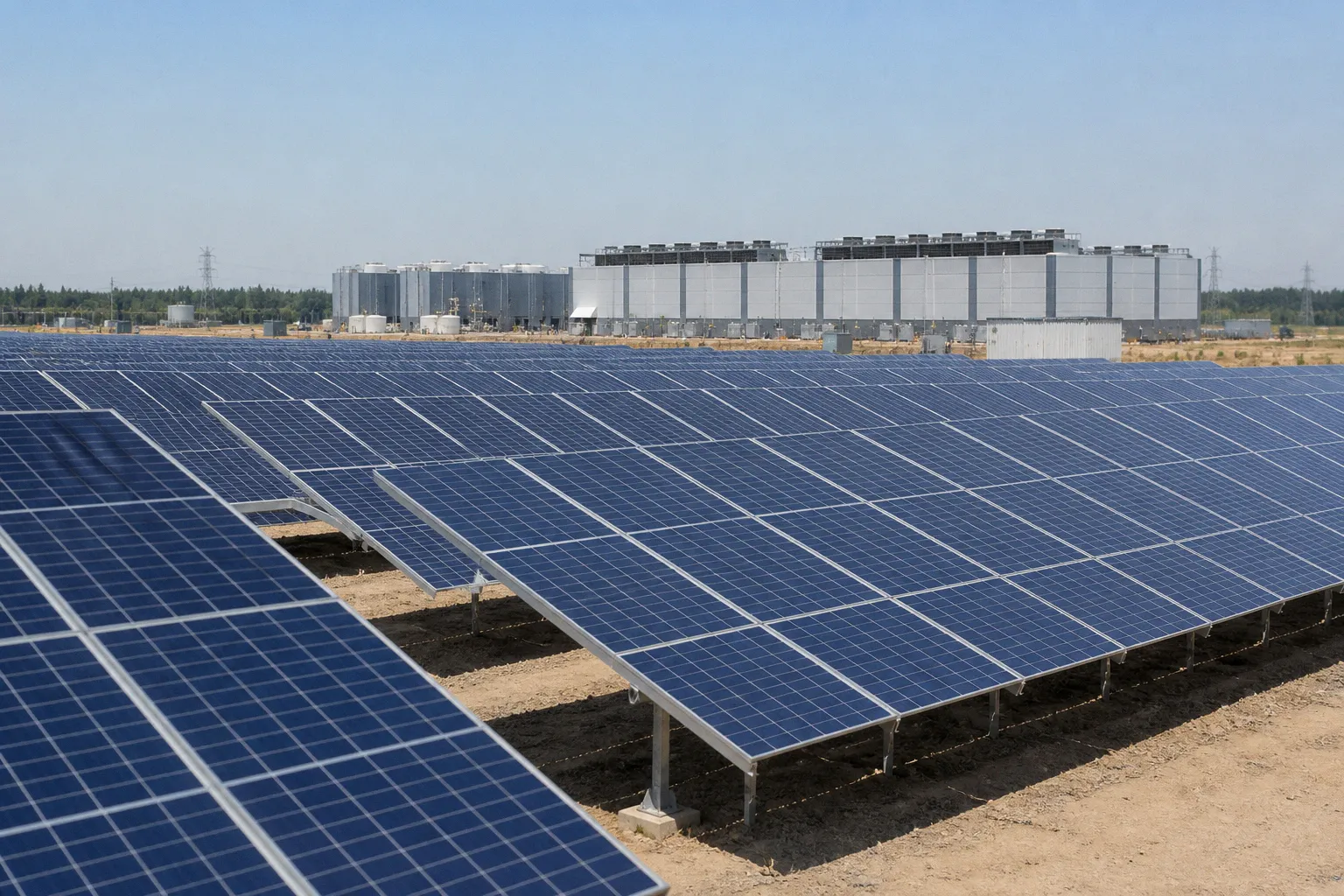
The U.S. Department of Energy is reframing a question the grid sector spent two decades avoiding: how do you supply clean, firm power to facilities that cannot tolerate a flicker? According to a recent DOE posting, data centers could account for as much as 9% of U.S. electricity generation annually by 2030 — up from roughly 4% of total load in 2023 — driven largely by AI compute buildouts. The agency pegs total U.S. electricity demand growth at 15–20% over the next decade, the first sustained climb since the early 2000s.
The Firm-Power Problem
Data center loads are not just large. They are concentrated, latency-bound, and round-the-clock — a profile that collides with the intermittency baked into solar and wind. DOE's framing is explicit: meeting this growth requires a portfolio approach pairing variable renewables with dispatchable clean resources — advanced nuclear, hydropower retrofits, and storage — alongside grid expansion and demand-side management. The capex varies across each leg, but the engineering constraint is non-negotiable: no firm power, no compute. Behind that statement lies a decade of deferred baseload investment and a transmission queue now measured in years rather than months.
Coal Sites and Grid Buildout
Redeveloping retired coal plant sites is one practical corridor highlighted by DOE — existing switchyards, transmission interconnects, and in some cases thermal infrastructure that can be repurposed rather than rebuilt from scratch. An LBNL assessment, mandated by Congress, is examining current and near-future data center energy and water consumption; its findings will likely sharpen the regional forecasts and force a clearer reckoning with siting constraints. Until the data lands, the 9% figure functions as a planning anchor rather than a ceiling — and one that already assumes aggressive efficiency gains on the demand side.
India as a Parallel Test
The U.S. is not the only grid feeling this pressure. India's non-fossil power capacity has crossed 300 GW, putting the country roughly 60% of the way toward its 500 GW clean-energy target by 2030. The parallel is instructive: similar appetite for renewables, similar strain on transmission, similar need for storage to firm the output. The pull on domestic manufacturing — solar modules, batteries, grid components — is reshaping supply chains in ways that will echo globally. Whether Indian deployment outruns its grid the way U.S. data centers risk outrunning theirs is the open variable, and the one that ultimately determines whether either transition delivers on its commercial promise.