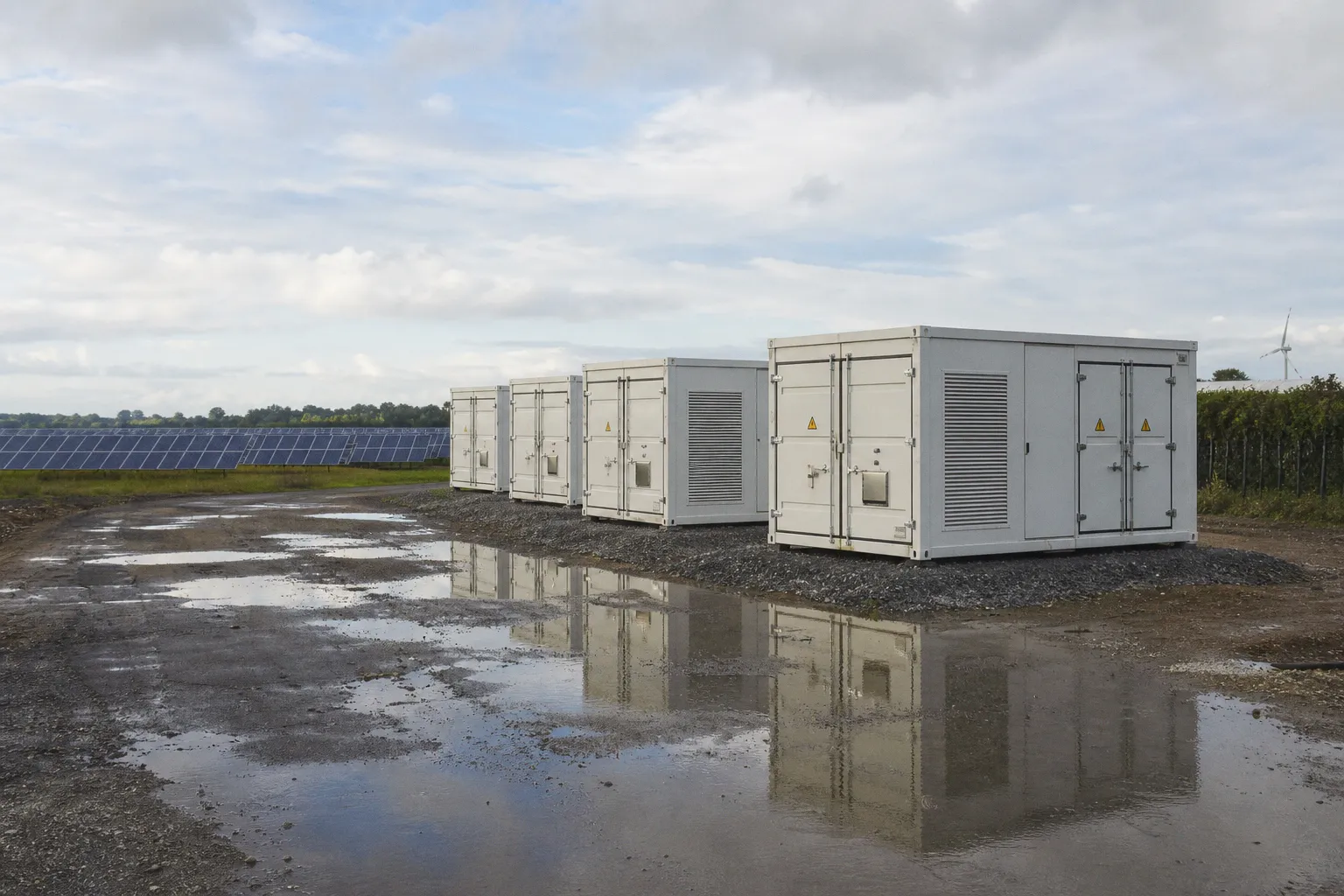
The deployment pattern — California, Texas, Florida, Nevada, and New York — is driven less by climate ambition than by the engineering problem of making variable renewable generation dispatchable at scale. For utilities and grid operators, storage is now the firming layer that keeps intermittency from dictating reliability outcomes.
The Intermittency Constraint Is Now the Binding One
California holds the top position because its daytime solar overgeneration requires evening discharge to avoid curtailing capacity and to meet the peak that arrives after sunset, when solar output falls but demand remains elevated. The same batteries also serve as a hedge during extreme weather events, when grid stress compounds. Texas follows a different logic: its independent power system absorbed rapid solar and wind buildouts, and the resulting volatility pushed grid-scale batteries into service as fast-response capacity during heat domes, winter storms, and sudden drops in renewable output. Florida, Nevada, and New York complete the five. Florida and Nevada are pairing storage directly with utility-scale solar to manage peak demand, flatten the duck curve, and reduce reliance on conventional fossil generation. New York's storage targets are explicitly designed to displace aging fossil-fuel plants and to firm future offshore wind capacity, where dispatchability will be non-negotiable.
Three Forces Converging on Storage Capex
The economics of deployment rest on three measurable trends. First, battery costs have fallen enough that storage now clears the levelized cost hurdle in most of these markets, shifting the question from "can we afford it" to "can we build it fast enough." Second, electricity demand is climbing — data centers, building electrification, EV charging, and population growth all tighten the supply-demand balance and improve the arbitrage case for time-shifting energy. Third, renewable penetration continues to rise, which raises the marginal value of each additional megawatt-hour of dispatchable clean capacity. Together, these forces convert storage from a side bet into the firming asset that allows variable renewables to approximate baseload behavior.
What to Watch
Two constraints will determine whether announced capacity actually reaches commissioning. Interconnection queues remain the primary bottleneck — storage projects can be permitted and financed faster than the transmission grid can absorb them. Transformer and power-conversion equipment supply chains are the second, less visible constraint, one that has already lengthened lead times across the sector. If either throttles deployment, the five-state model will slow, and the lessons it offers to other regions will take longer to propagate. For now, the metric worth tracking is not announcements but commissioned megawatts, and the speed at which they reach the grid.