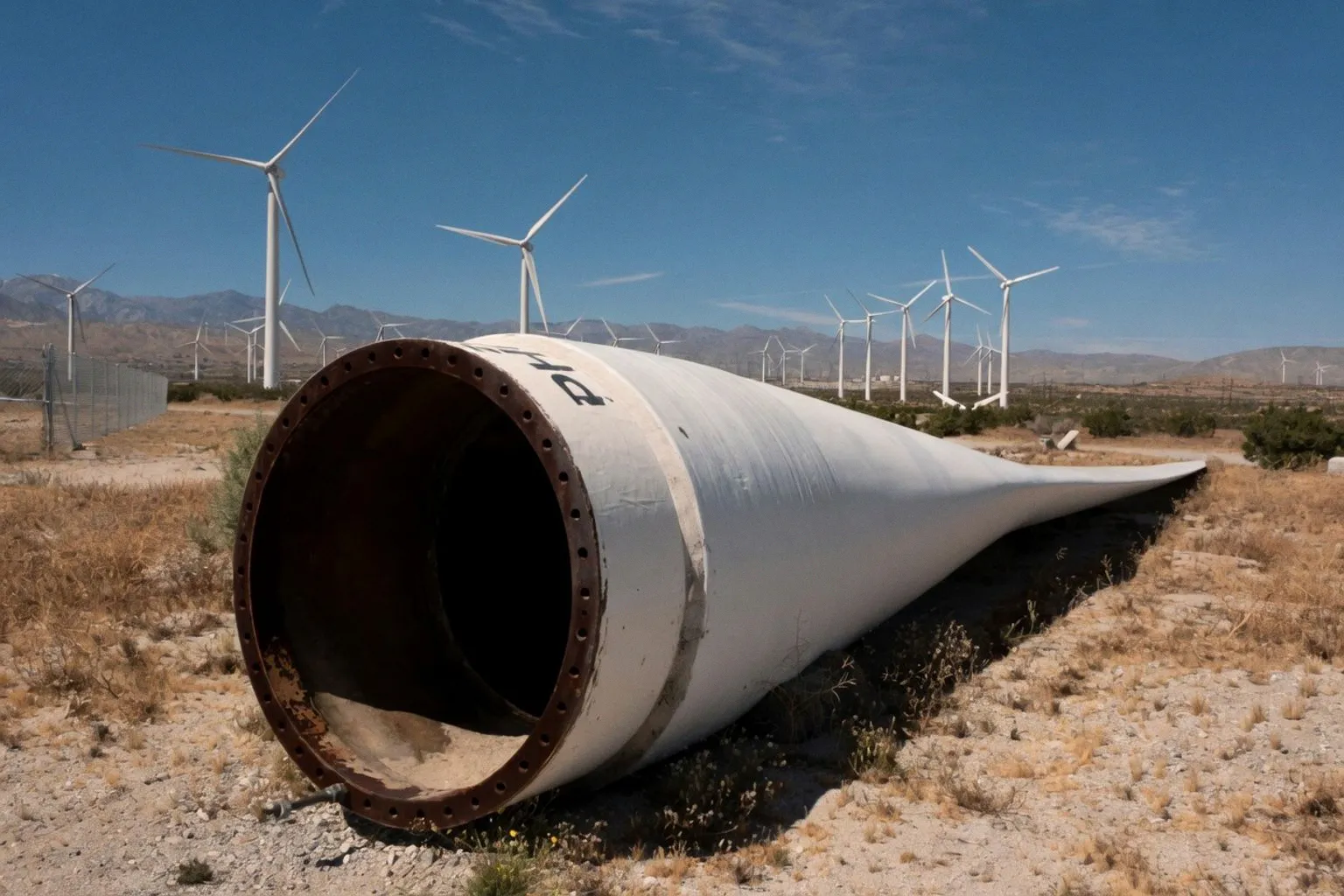
According to an IEC analysis carried by The Cool Down, the harder engineering problem sits two decades downstream — the first wave of modern wind turbines and solar panels is now approaching end-of-service, and the recycling infrastructure isn't ready. For grid planners and capital allocators, both stories point to the same structural mispricing: deployment capex has raced ahead of lifecycle logistics.
The retirement clock
Wind turbines installed in the early 2000s are nearing the end of their typical 20- to 30-year service life. Solar modules from the same vintage aren't far behind. Alistair Mackinnon, a wind energy expert with the IEC, noted that wind has matured into a multi-billion-dollar industry now confronting the lifecycle question it deferred during the build-out boom. Tony Sample, chair of IEC TC 82, framed the core difficulty directly: aluminum frames, cables, and glass are easy to recycle — the module itself is the problem.
That asymmetry will define the next phase of the transition. Blade epoxy resin cannot simply be remelted. Silicon recovery remains costly, and shipping end-of-life modules to specialized facilities can erode the economics of full recycling. Newer turbine blades are starting to incorporate thermoplastic composites designed for recyclability, and existing blades can be mechanically processed for use in cement, concrete, or fiber board. On the solar side, George Kelly of IEC TC 82 indicated that over 75% of a PV module can now be recycled through advanced processing and sorting, though industrial-scale capacity has not yet caught up with the volume curve.
What the biogas signal actually says
A "reality check" for biogas as wind and solar dominate the build-out is consistent with a familiar deployment pattern: intermittent renewables with collapsing per-megawatt costs absorb the marginal dollar first. That doesn't erase biogas's case — its dispatchability and methane-capture profile still serve specific niches — but it narrows the addressable market for broad-based scaling. The harder question for grid operators is whether dispatchable low-carbon assets can hold their capex premium as solar-plus-storage reshapes the merit order.
What to track
Three metrics will determine whether the lifecycle gap closes or widens. First, the build-out of industrial-scale PV recycling capacity — SolarCycle is expanding in Texas, and similar facilities will set the throughput benchmark. Second, the cost trajectory of thermoplastic blade production and mechanical blade-processing routes into construction materials. Third, how capacity markets price dispatchable low-carbon assets alongside rising solar and storage shares. Each is a leading indicator of whether the transition is pricing its own tail, or quietly mortgaging it.