The Insurance Doesn't Cover What You Think It Does
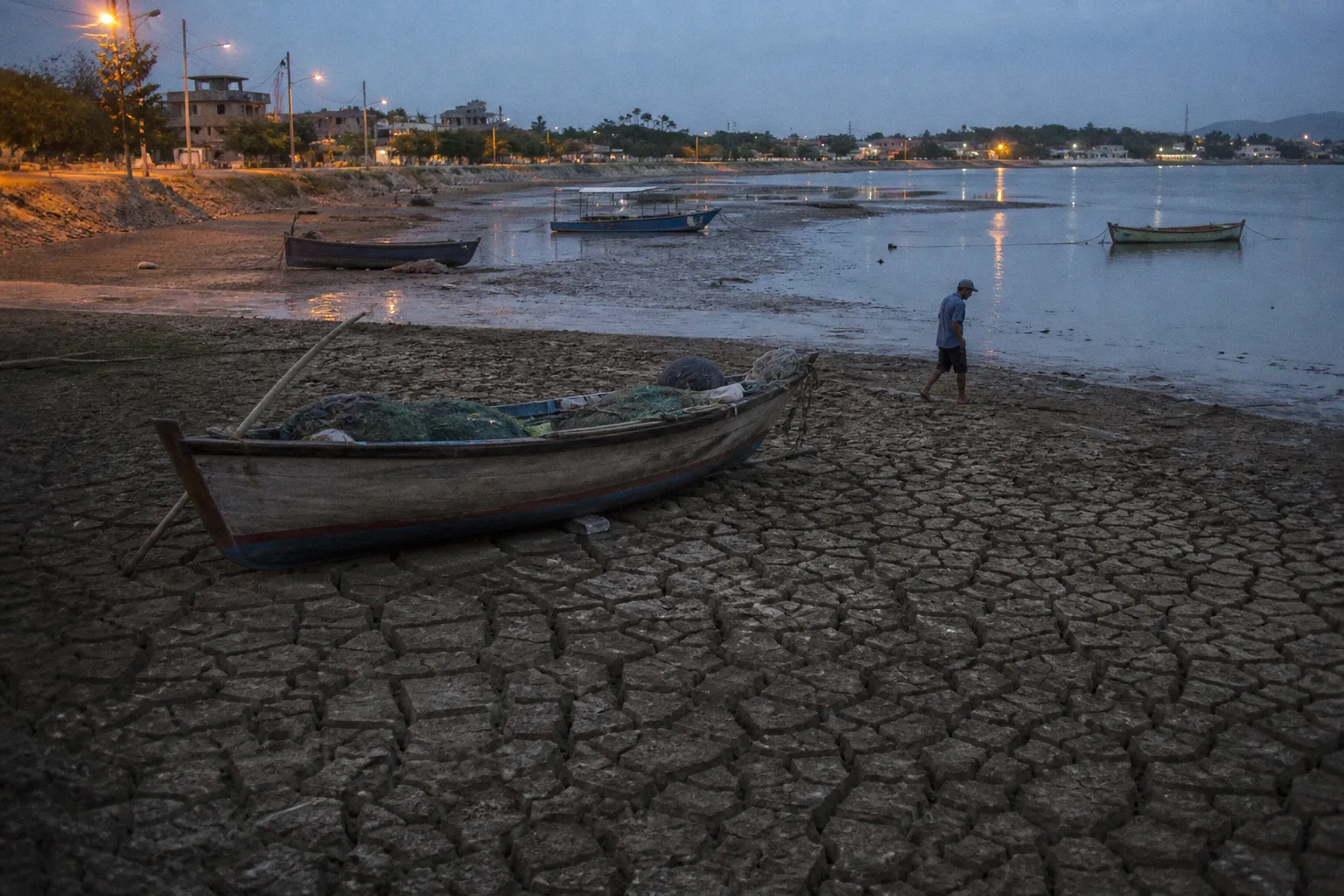
According to the research, fossil-fuel-driven global warming has pushed El Niño events more than 36% stronger than they were before the industrial age. The latest, an informally dubbed "Godzilla" event currently brewing in the eastern tropical Pacific, is set to peak later this year — and, by some projections, could push 50 million people into acute hunger before the end of next year.
That figure isn't a model output or a press-release flourish. It comes from painstaking chemical analysis of ancient coral deposits on the Galápagos Islands, where University of Michigan climate researcher Julia Cole and her team worked backward through a thousand years of sea-surface temperatures. The result is something the industry has historically been able to file under "natural variability": proof that human activity has measurably amplified one of the planet's most disruptive natural cycles. "Our findings suggest El Niño can supercharge global warming but also global warming can supercharge El Niño — that is what we are seeing," Cole said.
The Treaty Nobody Read
What's striking isn't the magnitude. It's the timeline. El Niño variability remained "fairly stable" through most of the millennium-long record the team reconstructed. The break, per Cole, comes around the late 19th century — the moment mass industrialization took hold — and becomes sharply more extreme after the 1982 event. "After the El Niño in 1982, we start seeing much more variability; it's a lot more extreme and looks like nothing in the previous 1,000 years," she said.
That "last 40 years," of course, corresponds neatly with the so-called framework era of international climate diplomacy: the voluntary national pledges, the offset registries, the non-binding targets, the round upon round of carefully worded communiqués. Each successive "super" El Niño — 1998, 2016, 2024 — has coincided with another broken global temperature record and another set of eloquent footnotes. The new paper's conclusion is that this isn't coincidence, and it isn't a fluke. The acceleration is built into the physics. "There is just such a large, distinct difference between what has been happening in the last 40 years compared to preindustrial times," Cole noted.
What It Means at the Margin
For readers who track carbon markets, the implication is unwelcome. If El Niño events are now reliably stronger than the baseline that policymakers and corporate actuaries used to price risk, then every "net zero" pathway that quietly assumes stable climate conditions has an undeclared liability attached — and the 50-million hunger figure attached to the brewing event alone isn't even a worst-case scenario. Adaptation budgets, food-security reserves, insurance re-ratings: all of them are now being repriced against a moving target the industry spent decades insisting wasn't moving.
The unresolved question, as ever, is whether the next round of talking points will absorb Cole's number or simply file it alongside the others — acknowledged, footnoted, and conveniently located outside the binding portion of any framework. The team has done the unglamorous work of measuring. The political class, characteristically, retains the option of looking the other way.