India wants energy independence through renewables. The math points somewhere else entirely.
India's case is sharp, but it's not unique. The same dependency architecture is quietly locking in across Central Asia — and the capex numbers tell you why.
The BRI Pivot: From Rails to Turbines
China's Belt and Road Initiative has now channelled US$1.3 trillion in cumulative investment, with a 257 per cent spike in Central Asian outlays year-on-year. The five states of the region — Kazakhstan, Kyrgyzstan, Tajikistan, Turkmenistan, Uzbekistan — have become a proving ground for Beijing's renewable export model. Between 2003 and 2024, Chinese cumulative investment in the region reached US$44.4 billion across 175 projects, compared to US$50.6 billion and 135 projects from US firms. The gap in project count already favours Beijing; the gap in capital is closing fast.
The investment thesis is straightforward. Kazakhstan generated 49 per cent of its energy from coal in 2023; Uzbekistan drew 79 per cent from natural gas. Renewables sat at roughly 2 per cent in both countries. Tashkent now targets 50 per cent renewable electricity by 2030. Astana's goal is 15 per cent. Neither has the domestic manufacturing base to deliver those numbers alone.
Project-by-Project: The Capex Reality
Southern Kazakhstan's 100MW Zhanatas Wind Power Plant has been operational since 2021. Build cost: US$140 million, co-financed by the Asian Infrastructure Investment Bank, Industrial and Commercial Bank of China, EBRD, and the Green Climate Fund. China Power International Holding controls an 80 per cent stake through subsidiaries. That's not a partnership — it's ownership.
Uzbekistan's pipeline is wider. Tashkent recently signed agreements with Chinese firms for a 100MW energy storage system in the capital and a 500MW wind plant in Bukhara. China Southern Power Grid had already invested US$240 million in two existing Bukhara wind projects. Sany Renewable Energy initiated a US$1.2 billion wind farm in Karakalpakstan. The scale is significant; the ownership concentration is more significant still.
The Dependency Paradox
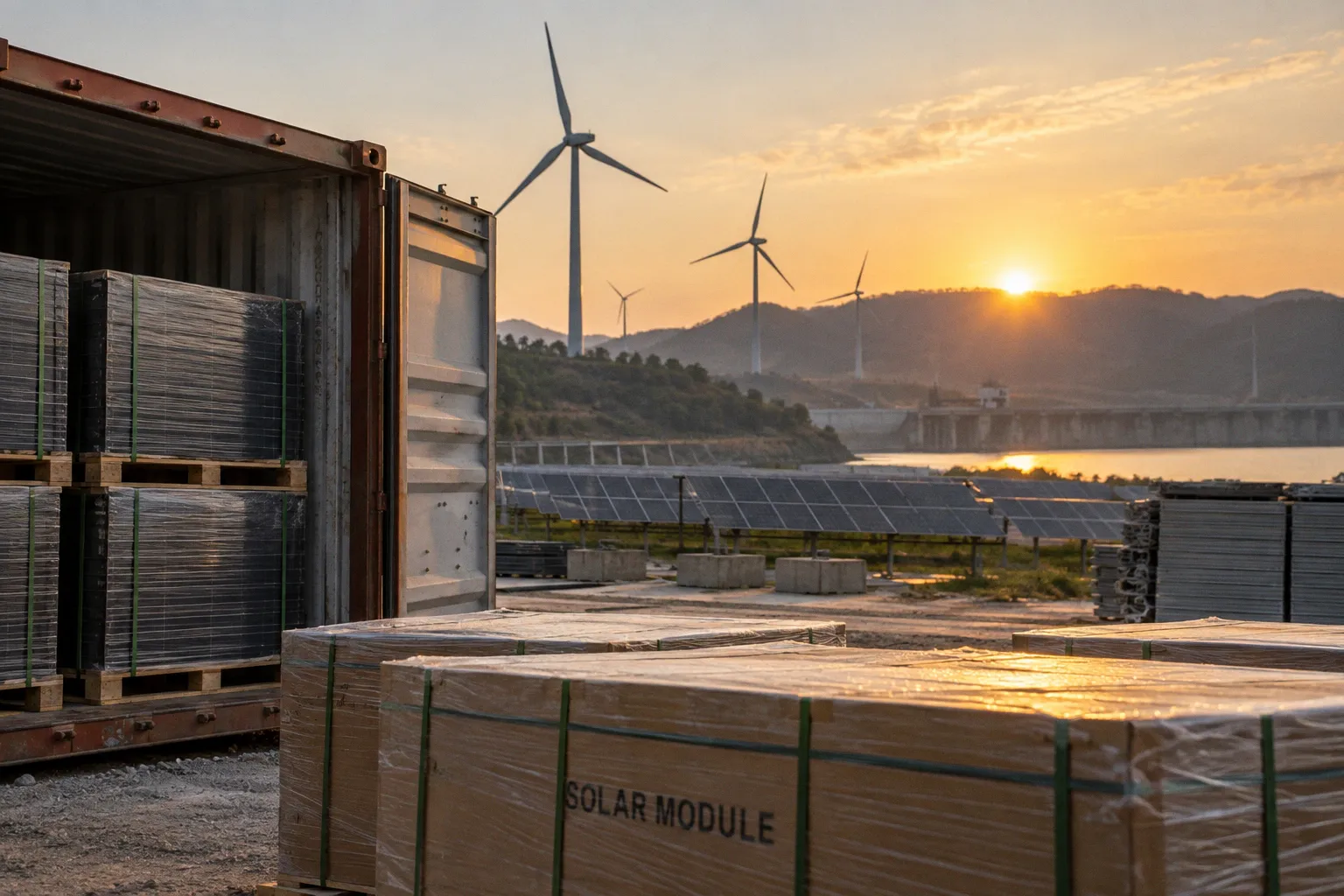
Here's the bottleneck every energy planner should be stress-testing. China dominates global solar panel manufacturing, wind turbine production, and battery cell output. When a country like India or Uzbekistan sets aggressive renewable targets, the procurement math funnels toward Chinese suppliers almost by default — not because of ideology, but because of baseload economics and capex efficiency.
The security argument for renewables — reduced fossil fuel import vulnerability — is real. But it trades one dependency for another. A nation importing liquefied natural gas from multiple suppliers can diversify. A nation whose grid-scale battery storage and turbine fleet are sourced predominantly from one country has a single-point-of-failure problem that doesn't show up in capacity factor projections.
Vietnam is now mapping renewable energy hubs to build green supply chains, according to reporting from the Vietnam Investment Review. Whether that effort can achieve genuine supplier diversification — or simply repackaging of Chinese components through third-country assembly — is the question that will determine if these hubs represent structural independence or just rebranded dependency.
No emerging economy has yet solved this equation at scale. The commercial viability of a truly diversified green supply chain remains, for now, an aspiration rather than an engineering fact.