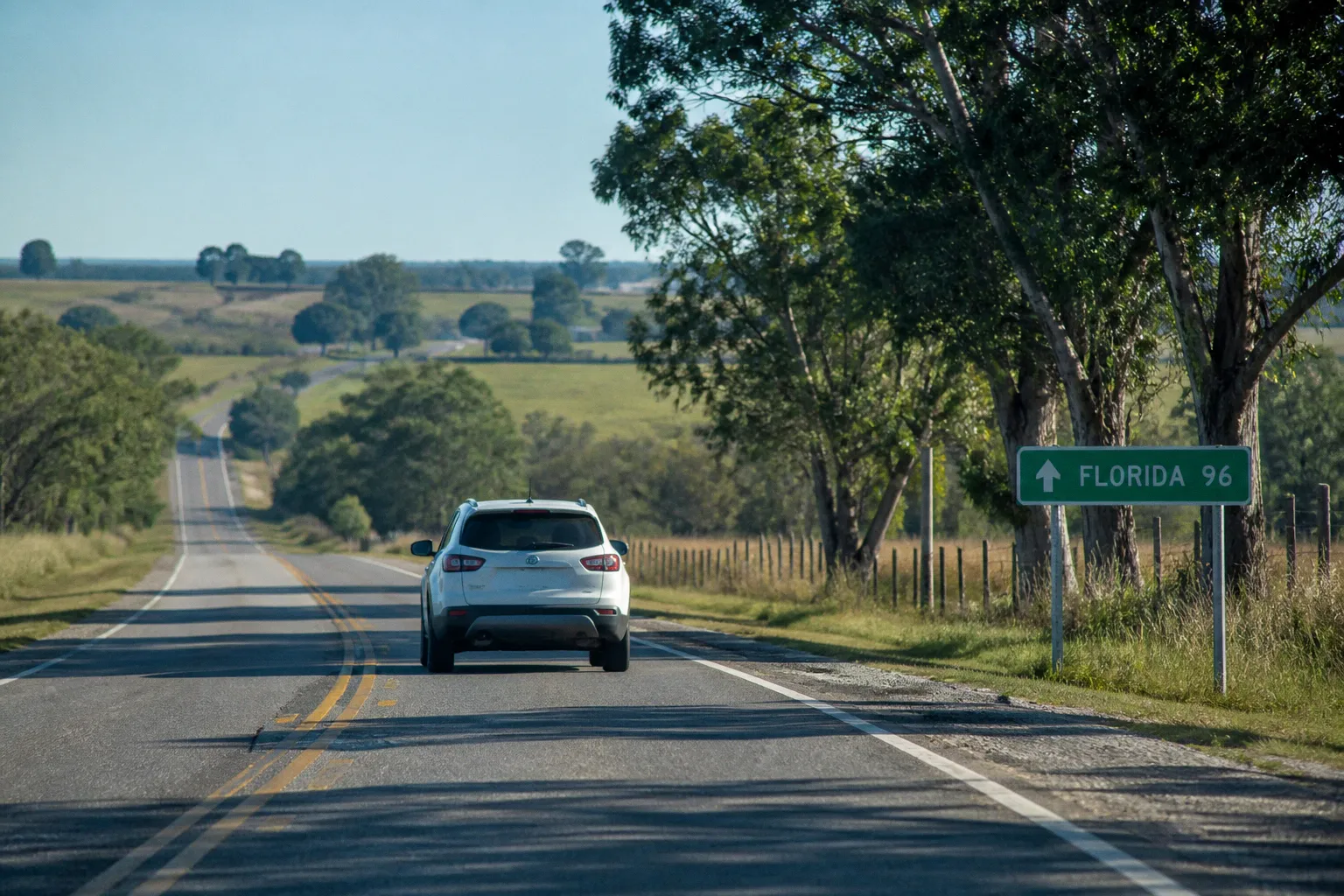
To explore this central-southern region, travelers typically secure a vehicle at these main hubs before driving north via Ruta 5.
Good to know
Driving: on the right.
Local currency: UYU.
Emergency number: 911.
| Main Highway Connection | Ruta 5 (Brigadier General Fructuoso Rivera) |
| Distance from Montevideo | 96 km to 100 km |
| Typical Daily Cost (Compact) | USD 35–70 |
| Blood Alcohol Limit | 0.0% BAC (Zero tolerance) |
| Toll System | Cashless Telepeaje (automated) |
| Driving Permit Validity | Up to 90 days (Latin script license) |
For those planning a journey to Florida, Uruguay, a quiet city of about 36,471 residents, having your own vehicle is the most practical way to navigate the surrounding countryside. However, securing a car hire in Florida, Uruguay, comes with specific regional logistics. The town itself does not host large-scale international rental offices. Instead, the standard approach is to arrange your rental at Carrasco International Airport or central Montevideo, and then drive approximately 100 kilometers north along Ruta 5. This guide details everything you need to know about navigating Uruguayan roads, managing the automated toll system, and understanding local driving regulations. By preparing your vehicle pickup in advance and understanding the strict national traffic laws, you can ensure a smooth, independent trip through the heart of the Florida Department.
L'essentiel
Driving to Florida, Uruguay, requires strict adherence to national road laws. First, Uruguay enforces a zero-tolerance policy for drinking and driving (0.0% Blood Alcohol Concentration), established in 2015. Second, you must keep your headlights turned on at all times, day and night, on all public roads and highways. Speed limits are strictly monitored: the standard limit is 45 km/h in built-up urban areas, 90 km/h on rural secondary roads, and up to 110 km/h on major national highways like Ruta 5.
Additionally, Uruguay operates an automated cashless toll system called Telepeaje. Cash payments at highway toll plazas were phased out in 2023. When you rent a car, ensure the vehicle's license plate is registered in the Telepeaje system, or set up automated billing using an international credit card. Tourists can legally drive for up to 90 days using a valid national driver's license written in Latin script alongside a passport, though carrying an International Driving Permit (IDP) is highly recommended.
Price overview and booking timing
The typical daily cost range for renting a compact car in Uruguay is USD 35–70. Because major multinational rental operators do not maintain full-scale branch offices directly inside Florida town, you will need to book your vehicle through hubs in Montevideo.
To secure the best rates and ensure vehicle availability, it is highly recommended to book well in advance. This is particularly true if you require specific vehicle features. For instance, the availability of automatic transmission vehicles at small regional rental providers in the interior of the country is highly uncertain without pre-booking from Montevideo. Booking early online allows you to compare rates across major providers and guarantees that your car, equipped with the necessary Telepeaje transponder, will be ready for your drive north.
Where to get the car
If you are looking to rent a car for Florida, Uruguay, your primary pickup points will be in Montevideo, located about 96 km to 100 km south. Major multinational rental car operators—including Europcar, Localiza, Sixt, Enterprise, Alamo, and Avis—maintain their fleets at key transport hubs such as Carrasco International Airport (MVD) and downtown Montevideo.
Travelers should not expect to find permanent rental counters for these international brands inside Florida city itself. While local independent operators may exist in the department, their real-time fleet availability and exact daily rental prices remain variable and difficult to verify online. The most reliable strategy is to pick up your vehicle immediately upon arrival at Carrasco Airport and drive directly to Florida via Ruta 5.
Travel tips from the city
Once you have secured your vehicle, Florida serves as an excellent starting point for exploring central Uruguay. The city is connected to the capital via Ruta 5 (officially named 'Brigadier General Fructuoso Rivera' in 1975). Driving this route is straightforward, but you must remain alert to changing speed limits when transitioning from the highway (110 km/h) to rural secondary roads (90 km/h) and urban zones (45 km/h).
Keep in mind that gas stations can be sparse on secondary rural roads, so it is wise to keep your tank filled. Always double-check that your rental agency has activated the Telepeaje system before you leave the Montevideo metropolitan area, as you will encounter toll plazas on your way north to Florida.
Where to go by car
| Destination | Distance | Time | Tolls (est.) | Why go |
|---|---|---|---|---|
| Montevideo | ~98 km | ~1 h 15 min | — | Return to the capital city via the well-maintained Ruta 5 highway. |
| Durazno | ~90 km | ~1 h 10 min | — | Drive north along Ruta 5 to visit this neighboring department capital. |
| San José de Mayo | ~80 km | ~1 h 15 min | — | Travel west along regional routes to explore this historic agricultural hub. |
| Sarandí Grande | ~45 km | ~40 min | — | Take a short drive north within the Florida Department to visit its second-largest town. |
Tolls: rates vary by country and route segment — check current pricing before you go.